Showing posts with label Grottoes. Show all posts

Sunday, October 01, 2006

west lake of Hangzhou


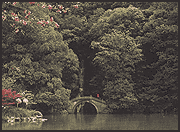
Misty Trees by Nine Streams

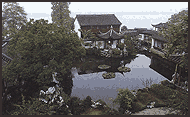
Guozhuang Park

Autumn Moon on the Calm Lake

Bai Dyke
I visited it at 2001 for the first time.
the West Lake has all along been extolled as a sparkling pearl. Legend has it that the lake used to be an auspicious pearl hewn into its sparkling shape by the Jade Dragon and the Golden Phoenix but it was later stolen by the Mother Queen of the West. When Jade Dragon and Golden Phoenix scrambled with the Mother Queen, this pearl accidentally fell onto a land that was known as Hangzhou.

overview

Saturday, September 30, 2006

The Longmen Grottoes

The world-famous Longmen Grottoes are located 12km south of Luoyang. Here two mountains, namely, East Hill (Mt. Xiangshan) and West Hill (Mt. Longmen), confront each other with the Yi River traversing northward between them, just like a pair of Chinese gate towers. So during the Zhou and Qin dynasties, it was called "Yi Que" (Gate of Yi River). Later, when the Sui established its capital city in Luoyang, the palace gate was just facing Yi Que, hence the name "Longmen" which means "Dragon Gate".

Spanning a length of over 1,000 meters on the hillsides along the Yi River, the Longmen Grottoes, together with the Mogao Caves in Dunhuang (Gansu Province) and the Yungang Grottoes (Shanxi Province), are reputed as the three greatest stone sculpture treasure houses in China. In the year 2000, Longmen Grottoes was listed by UNESCO as a World Cultural Heritage Site.

The Longmen Grottoes were first sculptured and chiseled around 493AD when the capital of the Northern Wei Dynasty (386-534) was moved from Datong to Luoyang. The entire construction of Longmen Grottoes lasted more than four hundred years through the Northern Dynasties, Sui Dynasty, Tang Dynasty and up to Song Dynasty. Today, there are still 2345 caves and niches, 100,000 Buddhist images ranging in size from 2 cm to 17.14 meters, more than 2800 inscribed tablets, and 43 Buddhist pagodas remaining in both East Hill and West Hill. Altogether 30 % date from Northern Wei Dynasty, 60 % from Tang Dynasty and the rest 10 % from other periods.

Masterpieces of Longmen Grottoes

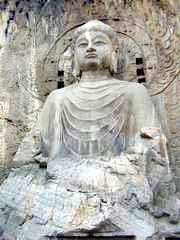
Fengxian Temple Stretching along the precipitous cliff of the southern side of West Hill, Fengxian Temple, also named Grand Vairocana Buddha Niche, is the largest cave in Longmen. Measuring 35 meters in width and 39 meters in length, this cave was carved over 1300 years ago (from 672 to 675 AD) during the Tang Dynasty. When it was first constructed, the entire grotto was covered with a roof and enclosed from the natural elements. Today the roof is missing and the sculptures stand out in the open air.The most extraordinary statue in Fengxian Temple is the Grand Vairocana Buddha, which is 17.14 meters tall with his head 4 meters long and his ear 1.9 meters wide. Sitting in the middle of the niche, this colossal Buddha shows a perfect combination of moral integrity, delicate emotions, broad mind and elegant semblance. Her lips are slightly upturned and her head a little bit lowered, a slight smile makes her look like a sagacious and benign middle-aged woman whom you would respect but not fear.

Guyang Cave Guyang Cave, sculpted between 495 and 575 AD, is regarded as the earliest of the Longmen Grottoes. Based on a natural limestone cave, this cave is the most important cave in the series and represents the highest skill of carving, rock painting, and architecture of the Northern Wei.

Lianhua Cave This cave was so named because there is a large and beautiful lotus flower on its ceiling.
This cave was dug out about 527 AD in the late period of the Northern Wei Dynasty. A statue of Sakyamuni, as the chief Buddha, is enshrined in this cave. Adopting a standing position, this statue is 5.1 meters high and has the face and one forearm showing damage.In this cave there are also numerous niches decorated with fine carvings of colorful strings, clouds, lotus flowers, geometrical patterns etc. Upon the cave ceiling there is a large lotus flower surrounded by figures of Apsaras in relief, which are slim, graceful and vivid. This cave is named in honor of this lovely flower.

Maijishan Grottoes

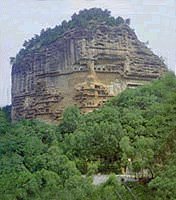
Maijishan ("Wheatstack Mountain"), located on the northern side of the Qinling Mountain Range and at a height of 1742m above sea level, gets it's name from its giant, haystack-like shape. The mountain's fame arises not just from its appearance, but from the many Buddhist caves that are gouged into its southwestern face. This is the fourth largest area of concentrated Buddhist grottoes in China, after Dunhuang, Datong and Luoyang. The area around and on the mountain is one of the most beautiful sights in Gansu for both stunning natural, and impressive man-made, scenery. The mountain, studded with caves and strapped by many winding walkways and spiral stairs, rises majestically from the surrounding heavily wooded slopes, so any visitor here with a bit of time on their hands could easily spend a few days hiking and admiring.

It is the Buddhist Grottoes (Maijishan shiku), some dated from as early as the Northern Wei Dynasty (386-534 AD), that most visitors come here to see. On arrival at the sight the most prominent sculpture is the 16m Buddha that is carved high up on the mountain. The grottoes, all packed together on the sheer, rocky cliff faces below and above this, look from afar like chambers of a gargantuan beehive. On ascending the mountain, the grottoes are divided into two sections, the western and eastern, since the central section was almost completely destroyed by an eighth century earthquake. The western section is probably the better, with statues and other Buddhist articles dating mainly from the Northern Wei Dynasty to the Tang (618-907 AD). Just ascending the mountain, on winding, rickety walkways and spiral stairs, with the wooded mountain panorama below, is a breath of fresh air for even the most unconvinced China traveler.

The area itself should be proud of its statistics! After centuries of renovation, expansion, partial destruction and then restoration, the grottoes that you can see today still number an impressive 194. Within these can be found over 7,800 pieces of clay sculptures and stone carvings, and murals with an aggregate area of over one thousand square meters. The stone sculptures that can be seen within the caves are of rock that had to be imported to the mountain, since the local rock was of too soft a consistency. The clay sculptures, reflecting the rich styles of high-ranking daily life, mainly portray two distinct eras: the Northern Dynasties (386-581 AD) characterized by slim figures and the Sui and Tang Dynasties (581-907 AD) featuring plumper ones. The only problem with the grottoes are that they are all locked up and, unless you have brought a guide to open them up, you will have to make do with the limited lighting that the barred entrance affords. For those on a budget this is not such a bad option, since some of them are lit not too badly and the views away from the mountain are worthwhile in themselves. Guides, however, can be bought to open them.

The Grottoes are not the end of a comprehensive trip here. 15m above the giant clay Buddha, on the eastern slope, is the Seven Buddha Pavilion (Qifo ge), a typical Han Dynasty (206 BC-220 AD) construction of interesting architectural value. Recent years have also witnessed the opening of a few of the dilapidated temples around the mountain making the area good for hiking. The best place for such activity is in the Botanical Garden. This is situated in front of the mountain, reached by taking stairs to the right, down the road before the grottoes' ticket office.

Tags