The Mogao Caves
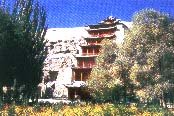 The Mogao Caves, also known as the Mogao Grottoes or the Caves of A Thousand Buddhas, are set into a cliff wall of Echoing Sand Mountain about 25km southeast of Dunhuang, the oasis city in the Gobi desert. This honeycomb of caves was constructed over a millennium, from the 4th to the 14th centuries, and represents the height of Buddhist art and the world's richest treasure house of Buddhist sutras, murals and sculptures.
During its heyday, the cave complex had thousands of caves, and today, a total of 492 grottoes, 45,000 square-metres of murals, 2,400 painted statues and over 250 residential caves remains. Almost every grotto contains a group of colorful paintings of Buddha and Bodhisattvas and other religious paintings, or social activities of different dynasties. The caves carved on the cliff wall provide voluminous research material for the study of all aspects of Chinese medieval society, in areas such as religion, art, politics, economics, military affairs, culture, literature, language, music, dance, architecture and medical science. The rich culture and art unearthed in the caves has even given birth to a new field of study, called "Dunhuangology"!
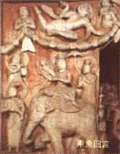
The mural paintings in existence today can be divided into seven categories, including the jataka stories depicting beneficence of Sakyamuni in his previous incarnations, sutra stories 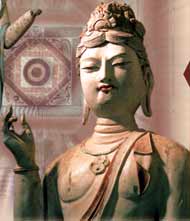 depicting suffering and transmigration, traditional Chinese mythology and so on. Although the religious scriptures are primarily Buddhist, written in Chinese, Uygur, Tibetan, Turkic and other languages, Taoist, Manichean and Confucian scrolls are also part of the collection.
(Unfortunately, due to the corrupt and impotent governments after the later Qing dynasties, many of the treasures of the Mogao Caves were plundered by heinous thieves like Aurel Stein, Paul Pelliot, Langdon Warner and Albert von Le Coq, mainly by theft but also through unfair transactions. These treasures can now be found in places like Britain and Germany.)
According to historical records, in the year 336, a monk called Le Zun came near the Echoing Sand Mountain and suddenly had a vision of golden rays of light shining upon him like thousands Buddhas. He started to carve the first grotto to memorize the accident and show his respect to the Buddha. Other pilgrims and travelers followed for the next thousand years.
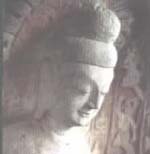
During the Northern Wei Dynasty founded by the Turkic-speaking Toba tribe, pilgrims restarted to hewing grottoes after the preceding years of turmoil, to depict their ideal heavenly world which contrasted with their painful material world. Forty of the Northern Wei caves remain today. Shades of Indian Buddhism still can be seen from the clothing, hair and facial features of Buddhas. The finely chiseled sculptures in the Wei caves show large heads, wide faces, large noses, thin lips, high cheekbones and curly hair, with slim and ethereal figures. The females are high breasted. The Buddhas, bodhisattvas and disciples are quite and serene, in strong contrast with the aggressive and fierce devils. The Wei paintings often depict the patrons who paid for cutting caves, as servants of the Buddhas or as supplicants, usually small in size.
During the short Sui Dynasty, the Mogao Caves continued to boom and mark the end of the foreign influence, slowly transitioning to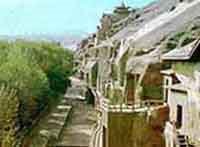 the more indigenous styles of central China. There are now 78 Sui caves left. The statues produced during the Sui Dynasty are mostly in good condition and more formal than the Wei statues.The Sui style shows statues with fuller faces, longer earlobes, loosely draped clothing and disproportionate upper bodies. Jataka stories are still the main theme while more varied subjects appear. The feitian, or asparas, become more pretty and elegant. Lotus flowers and other symmetrical patterns are frequently used as decorations on the ceilings.
The grottoes of Tang Dynasty represent the most splendid period of the caves, reflecting the highest level of artistic achievement. Today, 220 of the Tang caves remain. Most of the caves are square and have three levels to lodge bigger sculptures which were artistically brilliant, gentle and realistic.
The Buddhas became more like men, wearing ornaments and jewels and dressed like Tang nobles. The images of patrons became bigger and tended to occupy important places in the murals. The themes of the murals focused more on Buddhist scripture stories instead of jataka stories. This Dynasty introduced scenes of cruising aristocrats.
During the Five Dynasties, there was no space left on the cliff, so some caves were enlarged or repainted. As a result, old paintings are now being discovered lying under new ones. Discovering the hidden caves has been the main legacy left by this Dynasty.
Many caves were restored during the Yuan Dynasty. The murals depict various Indian mandalas and bodhisattvas. Some caves were decorated in Tibetan style. After the Mongol reign, there was no artistic development. In the Ming Dynasty, Dunhuang was once abandoned, and the caves gradually faded into the sand of the Gobi desert until a Taoist priest discovered the treasure house in beginning of the 19th century.