Showing posts with label China. Show all posts

Tuesday, October 10, 2006

Guilin(桂林山水) - Amazing Landscape

Taking a trip into the hully karst landscape of Guilin at sunset is one of the most breath-taking site in China. Guilin by the banks of the Li River in southern China is justifiably considered to be one of the most beautiful in China. Today, Guilin attracts innumerable tourists because of its unique landscape. Until the end of the 1970s, it was a quiet, sleepy area. Since then, Guilin and the settlements along the Li River have undergone an incredible development through tourism. This town with over 400,000 inhabitants acquired its name from the Cassia trees, whose blooms carry their sweet scent through the whole town in autumn. Guilin literally means "Cassia Tree Forest". Guilin is said to be founded in 214 BC. At that time, the Lingqu Canal was built under the regency of the first Chinese emperor, Qin Sin Huangdi. It still connects the central Asian plain with southern China, and South-East Asia, via the Yangzi, the Lijiang and the Pearl river. Guilin and its surroundings are still mostly agricultural, but this is limited by the numerous mountains which pose a problem in the whole of Guangxi region. The landscape is characterised by terraced rice paddies, water buffalos, and bamboo groves, and peasants with turn up trousers and cone-shaped straw hats. Guilin is famous for it spicy Guilinjiang, a type of pepper sauce. From the Mountain of Coloured Layers, a 223 metre high mountain on the north, visitors can get a wonderful view of Guilin and Lijiang. The most beautiful tourist spot is the Crystal Palace of Dragon King, in the Reed Flute Cave at north west of the city centre and a subterranean water landscape, which resembles the landscape around Guilin and the Li River.
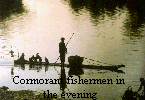
A boat trip on the peaceful Li River is the absolute high point of any visit to Guilin. A cruise from Guilin to Yangshuo, visitors will experience the winding and twisting Li River, goes past the many bizarre mountains whose shapes have inspired and fired the Chinese imagination, the Elephant Trunk Mountain, Old Man Mountain, Pagoda Mountain and Hole Mountain. Cormorant fishermen in narrow bamboo boats, bathing children, water buffaloes, small settlement and women doing their washing on the banks of the river can be seen along the way. Yangshuo, at the end of the boat journey is today a developed village that thrives mainly on tourism and seems to have nothing but tourist shops.

North-east of Guilin is Sanjiang, a settlement of the Song people. Changyong Bridge is an architecturally unique sight. South-west of Guilin, in the centre of the Autonomous region of Guangxi is Linzhou with 600,000 inhabitants, is an expanding industrial town, pricturesque and typically southern Chinese. The main attraction is the Dule Rock with its numerous karst caves. Another area with a beautiful landscape is the settlement of Guiping. The capital of the Autonomous Region of Guangxi is Nanning. It is located deep in the south and is only 160 km from the Vietnamese border. South-west of Nanning, near the Vietnamese border by the river Zuojiang, is a landscape as fantastic as that in Guilin. In Ningmeng county, visitors can see a 1,700 year old mysterious rock painting along a steep rock face by taking a boat on Zuojiang river.

Google Maps,Google Maps coordinate,Only show at Item-Page.


地理位置

1、地理位置:桂林是世界著名的风景旅游城市和历史文化名城,地处南岭山系西南部,广西壮族自治区东北部,109°45''-104°40'',北纬24°18''-25°41''。
  2、行政区划:辖秀峰,象山,七星,叠彩,雁山5城区和灵川,兴安,全州,临桂,阳朔,平乐,荔浦,龙胜,永福,恭城,资源,灌阳12个县,行政区域总面积27809平方公里。其中市区面积565平方公里。

  城市历史

  桂林历史悠久。根据市区宝积岩和甑皮岩洞穴发现的遗物,经考证,甑皮岩人已进入母系氏族社会阶段,距今约一万年。
  夏商周时期,这里是“百越”人的居住地。秦始皇置桂林,象,南海三郡,这是“桂林”名称的最早起源,但郡治不在今天的桂林市。汉元鼎六年(公元前111年),在这里设始安县,隶属荆州零陵郡。东汉时改属始安侯国。三国时先属蜀,后归吴。甘露元年(265年),置始安郡始安县,郡县治所都在今之桂林。隋唐时属岭南桂州总管府。唐武德四年(621年),李靖修城于独秀峰南。贞观八年(634年)改名临桂县,属桂州始安郡。光化三年(900年)始,属静江节度。五代十国时先后属楚和南汉的桂州。宋时,前属广南西路桂州,后属静江府。元时属广西行中书省静江路。明清时均属广西省桂林府。民国时属广西省。1914年改名桂林县,1940年始设桂林市。1944年11月至1945年7月28日,为日寇占领。光复后仍为广西省辖市。历史上长期为广西省会。   1949年11月22日桂林解放,为广西省辖市,1958年改称广西壮族自治区桂林市,辖桂林城区和郊区。
  1981年7月、1983年10月阳朔、临桂划归桂林市管辖。
  1996年12月26日桂林市委,市人民政府按国务院,自治区批复的方案,实行区划调整,将郊区更名为雁山区。
  1998年9月8日经国务院批准,桂林市和桂林地区合并,组建新的桂林市。More

Monday, October 09, 2006

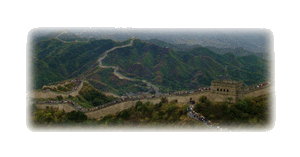
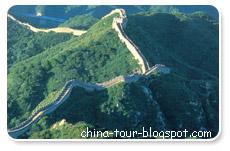
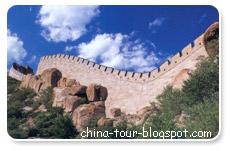
The History of The Great Wall(长城)

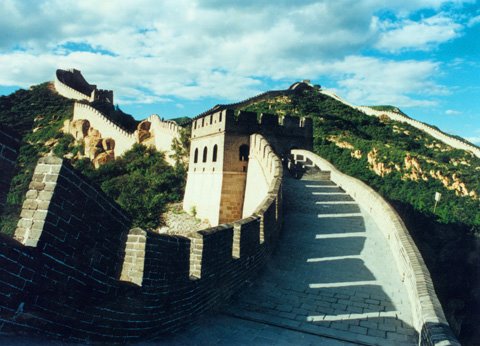
The Great Wall is well-known because of its magnificent majestic appearance.Now,in the call of "Loving our China, repairing our Great Wall", many places of The Great Wall have be repaired, which make it more boundless. The Great Wall has become the head key point of interest in China. more and more foreign people was attracted by it. The people who visited it are all acclaim as the peak of perfection.
 The Great Wall convolves on the ridges of mountains and desert.It's maked up of city gates,circumvallations, enemy towers,signal beacon towers and so on, it was the martial recovery engineering system of the different place and nations in China Long time ago.It was built through several thousands years by Chinese people, it's the embodiment of the Great power and strong purpose of Chinese people. It has become the irradiant treasure of our Chinese archaic civilization. Many move one to praises and tears stories have taken place between the people bide inside and outside of The Great Wall in the long time traffics, it has been attracting many bookmen indited or paint for it, which added so many cantos and paints to our artistic thesaurus.
 B.c. Eleven Century, Xi-Zhou, Our country had the recordation that is "The city wall set down in the north". From B.c. Seven Century to B.c. Three Century that is called the Spring and Autumn Period and the Warring States Period, The princes of many little states began to fight and swallow up each other. They all built the long city wall for self-defence, for instance, Chu state built its wall in the Nanyang district firstly, Qi state built its wall in the Shandong province, Zhongshan state, Wei state, Han state, Yan state, Zhao state, Qin state and so on all began to build their city wall. The total of the city wall's length was more than five thousand kilometre, but they were distracted from each other.
 B.c. 221 Year, QinShiHuang consolidated all six states, He pulled down the wall between the states one side, the other side he built the new city wall in the north to defense the Hun. He command MengTian general and thousands upon thousands people to build the new city wall, it stretch more than five thousand kilometre in an unbroken chain, which is the oldest Great Wall.
 During the West Han state period, The Hun in the north bacame more and more stronger, So the Han state had to build new city wall, and strengthen the old Qin Great Wall. From the eastern parts of Liaoning province to the YuMen gate, The Great Wall is longer then ten thousand kilometre. Its scale had beyond the Qin Great Wall's by far. During the East Han state period, people built new wall inside of the West Han Great Wall to defense the Serbi and the Qiang nationality, The length of it is more then five kilomitres also. The Great Wall which was built in the two Han period, is the biggest project in our history.
 After this, the nations in the north began to come into the north of China, city gate and backland. They built the new North Dynasty kaiserdom, standed face to the North Dynasty kaiserdom. The West Wei state, East Wei state, West Qi state,West Zhou state in the North Dynasty kaiserdom, all built the mulriple Great Wall in the northern parts of Yellow River. The Shui Dynasty unified the whole nation, then built the new city wall from the middle-head reaches of the Yellow River to the western parts of Ganshu province, its length is three kilomitres, and it forms a new system with the eastern Great Wall.

 During the Tang Dynasty, the power of country is so strong that the all nantion in the north have to submit to the authority of Tang, So the archon haven't built any new Great Wall, only built three city to accept surrenders.Here, the eastern Gaoli built more the one thousand kilomitres Great wall from the northeast of China to the Datong River estuary to defense Tang.
 In the Zhu,Liao,Jin Dynasty Period, the north parts of Chian was occupied by the Khitan, the west parts of the Yellow River was occupied by West Xia, The North Song Dynasty only repaired the Yan Gate. Since this, Liao and Jin state became more and mire stronger, and occupied the whole parts in the north of the Yellow River, so the South Song has no ability to build any new Great Wall.But the Liao-Jin kaiserdom built the new Great Wall in the northeastern parts of Neimenggu province to fight against the other nantion in the northern parts. People often call it as "Genghis khan City Wall".
 After the Ming Dynasty was founded, the archons began to build new Great Wall in the northern parts of China to defense the Yuan state come back and Dadan, Waci, Nvzhen etc.And they also built many Great Wall in southeast of China near to the sea to oppugn the foreign enemy. The count of the Ming Great Wall is the best large in our history. The main part of it begins from the the Yalu River to the JiaYu Gate, its length is more than seven thousand kilomitres. Thereinto, The part which from ShanHai Gate to the JiaYu Gate is kept most well.
 At the beginning of Qing Dynasty, in the Liaoning,Jilin Province people built the ShengJing city wall, it extends 2600 kilomitres. And the people also repaired the ShanHai, JuYong, YanMen, JiaYu Gate etc. But from the metaphase of Qing Dynasty, the Great have not been repaired more.
 Now, Under the years run out and the man-made destroy, Many parts of The Great Wall have become very slipshod, even includes the Ming Great Wall. But The Great Wall whose length is more than a hundred thousand kilomitres is the huge Chinese dragon, is the best greatness and grandest work in the history of the whole human being. It also materializes the architectural skill. Now the people who bide inside and outside of The Great Wall, through the long time traffics, have unified one big family. The Great Wall is the symbolize of our China and is our pride. It will also contribute to promotion the friendship between people who come from the different countries.

Google Maps,Google Maps coordinate,Only show at Item-Page.

万里蜿蜒于中华大地的长城,以其无比宏伟的雄姿久闻于世。今天在“爱我中华、修我长城”的号召下,许多地方已修缮一新,更加气势磅礴,成为我国名胜之首。它吸引着国内外成千上万的游人,以一览长城为平生快事。凡到过长城的人,莫不叹为观止。

  像巨龙般腾越在崇山峻岭、沙漠戈壁的长城,是由城关、城墙、敌台、烽火台等构 成的,是我国古代各地和各民族统治集团间的军事防御工程体系。它是两三千年来,由各族人民反复多次修筑而成的,体现着中华民族的伟大力量和坚强意志,成为 我国古代文明中的一项光辉灿烂的瑰宝。长城内外各族人民在无数次斗争和长期交往中,发生过许多可歌可泣的动人故事,吸引着历代文人墨客为它们赋诗作画,在 我国文学艺术宝库中,增添了许多优美动人的篇章与画卷。

  远在公元前十一世纪,我国西周就有“城彼朔方”的记载。公元前七到三世纪的春秋战国时期,各诸侯国互相吞并,形成群雄并立不断混战的局面,他们在自己 的边境,先后筑起长城以自卫。如楚率先在南阳地区筑方城数百里;齐则在山东从平阴到东海边琅琊台筑长城,又沿黄河故道筑堤为城;中山、魏、韩、燕、赵、秦 等国,各修筑长城数百里至数千里。当时长城总长已上万里,不过是分散各自独立而已。

公元前221年,秦始皇统一六国后,一方面拆毁诸国间的长城,另一方面为防北边匈奴,又调动军民上百万人,命大将蒙恬督筑长城,西起洮河沿黄河向东,再按 原秦、赵、燕长城走向一直到辽东,绵亘万余里,成为我国最早的万里长城。

  西汉时,北部的匈奴族更强盛,屡向南犯,汉朝除采取通好、和亲及出击等手段外,并着手大规模兴筑长城以固边陲。除修缮秦长城外,西面更增筑河西、玉门 关、居延泽等长城。北出雁门,五原阴山,东循燕秦长城,从辽东到最西的玉门关,长达两万余里。并列亭西至楼兰,北至胪朐(乌兰巴托东北地区),规模远逾秦 代。东汉初北防鲜卑、西防羌戎,又在西汉长城以内,大兴障塞堠坞,总长也达万里以上。两汉时期一北一南所筑长城,是历代规模最大的。

  此后,北方各族逐渐进入华北、关中,直至中原,建立起北朝政权,形成南北朝对峙的局面。北朝的北魏、东魏、北齐、北周先后在黄河套以北东至辽西地区, 修筑了多重的长城,纵横交错,总长也上万里。隋统一全国后,在黄河中上游由云中经五原、榆林、宁夏至陇西,筑长城四五千里,与北朝在东部的长城正好构成又 一体系。

  唐代国势强盛,长城以北以西的各部族都归附通好,因此未筑长城,仅在阴山内建“受降城”三座,东西互距四百里,并连以城障;在甘肃西部复筑瓜州故城。 这时,东部的高丽为了防唐,在我国东北由扶余、开原、新宾至朝鲜大同江口筑长城二千余里。

  朱、辽、金时期,华北的燕云十六州尽归契丹、河西已属西夏、北宋只修治了雁门险阻。以后辽金相继强盛,深入淮汉、以至江北,造成南宋偏安局面,再无力去修筑长城。北方辽金政权却因与蒙古和其他各族间的斗争与矛盾,在今东北内蒙等地兴筑濠堑长城,总长也上万里,称明昌长城,俗称成吉思汗边墙。

  明朝建立后,为防范元朝复辟及达旦、瓦刺、女真、吐蕃等族骚扰,在北方不断修筑长城,并且为抗击外国入侵,在东南沿海要地也零星筑了一些长城。明长城 之多,是历代之最。主要长城从鸭绿江边的九连城到甘肃的嘉峪关,全长一万五千余里。在北京和山西偏关间,分成南北两道长城。在许多地段上长城除主城墙大边 外,还有二边、三边、外边、内边、护边等多道的城墙,如雁门关外有大石墙三道、小石墙二十三道。其中从山海关到嘉峪关间的一万二千七百里的主长城保存较完 善,特别是山海关到北京周围,经戚继光重新督筑过的长城最为壮观。

  清朝初,在辽宁、吉林间筑了有名的盛京边墙(柳条边),新旧边墙总长2600余里。对古长城也局部修缮了山海、居庸、雁门、嘉峪等关隘和长城的某些段落。中期以后就未再修缮了。

  经历了长久的岁月和人为的破坏之后,许多古长城已到了十分零落的程度。就是明长城也遭到许多损毁。但是,总长十几万里的中华巨龙,仍然是人类古代最巨 大壮观的工程。并且它在不同时代、不同地点、因险制塞、呈现着千姿百态、无一类同的奇丽景观,体现了建筑上的艺术才思。长城内外我国各族人民,经过长期交 往,终于突破人为的分割阻碍,已凝结成统一团结和睦友爱的中华民族大家庭。长城作为我们中华伟大文明古国的象征,既是我们民族感到自豪、也为世界各地人民 所向往,它将为增进各国人民的友谊作出重大的贡献

Saturday, October 07, 2006

Tian'anmen(天安门)-the Gate of China, Beijing

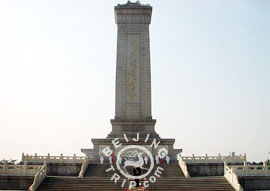
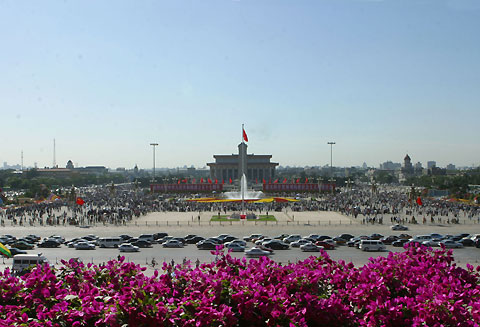
With a total area of 440,000 square meters, Tiananmen Square is the largest square in the center of Beijing. For over a hundred years, many ceremony and demonstrations have been held here. The grandeur of Tiananmen Gate (Heavenly Peace Gate) is a national symbol, with the Great Hall of the People on the western side and the Museum of the Chinese Revolution and the Museum of Chinese History to its east and west. The Monument to the People's Heroes - the 36 meters obelisk, made of Qingdao granite, dominates the center of the square. The Chairman Mao Memorial Hall and the Qianmen gate, sit in the south.

Tian'anmen Gate

A stone lion in front of the Tian'anmen TowerTian'anmen Gate (Gate of Heavenly Peace) was built in the 15th Century and restored in the 17th Century. From imperial days, the yellow glaze-tiled double-eaves tower functioned as a rostrum for proclamations to the assembled masses. October 1, 1949, Chairman Mao Zedong proclaimed the founding of the new China. The tower has five doors and in front of it are seven bridges spanning a stream. Only the emperor could use the central door and bridge. On the top of the central door is a gigantic portrait of Chairman Mao with slogans on each side stating 'Long Live the People's Republic of China' and 'Long Live the Unity of the Peoples of the World'. Walking through the gate, you can enter the imperial city - Forbidden City with free charge while a panoramic view from the tower costs 15RMB for Foreigners.
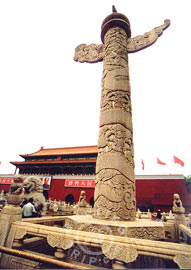
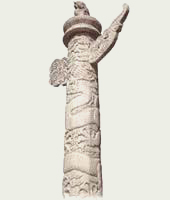
Obelisk marble columns engraved with entwisting dragons and clouds - an ornamental architecture called Huabiao in front of the Tian'anmen
Huabiao

Right beside a pair of marble lions in front of the Tian'anmen Gate stand obelisk of marble engraved with entwisting dragons and clouds - an ornamental architecture called Huabiao. Its history can be traced back to the Yao and Shun, legendary kings in remote antiquity. To solicit public criticism, it is said that wooden crosses were erected at marketplaces for people to write down complaints. Later during the Han (206 B.C. -- 220 A.D.) wooden posts were replaced by stone pillars, which gradually became the sumptuous columns to palace gates. Huabiao can be usually found in imperial gardens and mausoleums.

On the top is a plate-shape flat called Chenglupan (dew-collecting) on which squats an animal called kong (a legendary animal for watch-keeping) facing to the south. They were called "Wangjungui" or "looking forward to the emperor's return," who watched over the emperor's excursions and called him back. The couple inside the gate facing north, called Wangjunchu or "looking forward to the emperor's progress," were considered to supervise the emperor's behavior in the court when he neglect court affairs.

Great Hall of the People

Great Hall of the People, in Tian'anmen SquareThis is the venue of the legislature, the National People's Congress. Summit meetings are often held in the 10,000-seat auditorium with the familiar red star embedded in a galaxy of lights in the ceiling. Also you can visit the 5000 seat banquet room where US president Richard Nixon dined in 1972. The admission costs £¤ 15.

Monument to the People's Heroes (Renmin Yingxiong Jinianbei)

Built in 1958 on the southern side of Tian'anmen Square, this 36-meter obelisk bears brass-relief carvings of key revolutionary events such as the Chinese destroying opium in the 19th century.

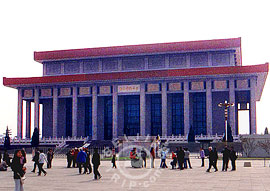
Mao Zedong Memorial Hall (Mao Zhuxi Jiniantang)

Behind the Monument to the People's Heroes is the hall where the embalmed body of Chairman Mao is kept and many Chinese show deep respect when confronted with the physical presence of Mao. more

Opening: 9:00 - 16:30


Google Maps,Google Maps coordinate,Only show at Item-Page.


位于北京城的中轴线上的天安门,始建于明永乐十五年(14l7年)。原名承天门,以示皇帝“承天启运,受命于天”。清顺治八年(1651年)重建后,改称天安门.既包含了皇帝是替天行使权力。理应万世至尊的意旨;又寓有“外安内和,长治久安”的含义。明、清时,天安门是皇城的正门,城门五阙,重楼九楹,高为33.87米;1970年翻建后高达34. 7米。它造型典雅,是我国传统建筑艺术的代表作。

天安门的主体建筑分为上下两层。上层是重檐歇山式,黄琉璃瓦顶的巍峨城楼,东西面阔九楹,南北进深五间,取“九五”之数,象征皇帝的尊严。正面有36扇菱花格式的门窗。城搂基座周围有汉白玉栏杆、栏板,雕刻着莲花宝瓶图案。城楼内所用木材大部分是楠木,60根红漆巨柱排列整齐,柱顶上有藻井与梁枋,绘着金龙吉祥彩画和团龙图案。地面铺的全是金砖,面积约2000平方米。屋顶的正脊与垂脊上装饰着螭吻、仙人、走兽。下层是高13米的朱红色城台,四周环绕琉璃瓦封顶的矮墙,下部是1.59米高的雕刻精美的汉白玉须弥座台基。城台的总面积达4800平方米,东西两侧各有一条长达百级供上下城楼用的梯道,俗称马道。还有5个拱形门洞,中间的门洞最大,高8.82米,宽5.25米,唯有皇帝可以进出。城楼前有外金水河,河上飞架7座汉白玉雕栏石桥,中间一座最宽阔的称“御路桥”。专为皇帝而设;御路桥两旁有宗室亲王过往的“王公桥”;王公桥左右的“品级桥”是供三品以上的官员行走的;四品以下的官员和兵弁、夫役只能走“公生桥”。公生桥架在太庙(劳动人民文化宫)和社稷坛(中山公园)门前。5座内金水桥除有类似严格的等级规定外,还表示“万方来朝”之意。金水河两岸有两对威风凛凛的石狮及两座连同须弥座高为9.57米的华表。石狮系明代永乐年间原物,距今已有500多年。石狮后面两边设有红色观礼台,台前东西各筑花坛,游人们常在这里驻足观景。华表上满刻着盘龙与云朵,巨柱顶端加上了云板、承露盘并蹲坐着石兽,此兽有注视皇帝出入之意,因而人们把前华表上两只背北面南的石兽叫“望君归”;把后华表上两只背南面北的石兽称“望君出”。

天安门在明、清两朝是皇帝颁发诏令之地。遇有新皇帝登基、大婚等重大庆典活动和皇帝父母进宫,都要启用天安门。皇帝平时一般不走天安门。只有每年去祭天、祭地、祭五谷时,才由此门出入。另外,皇帝御驾亲征或大将出征,都得在天安门前祭路、祭旗,以求马到成功,凯旋归来,同时显示威风。天安门还是“金殿传胪”的场所。每逢殿试后的两天,皇帝召见、传呼新中进士们的姓名,这叫“传胪”。考中前三名的状元、榜眼、探花插上金花,身披红绸,骑马游街,以谢皇恩。天安门唯独皇帝可以出入,而且只能出入喜事,绝对禁止出入丧事。

天安门是中华人民共和国举行开国大典的主会场,也是国徽图案的重要组成部分。它是我们伟大祖国的象征,已成为人们喜爱的观瞻胜地。more

Friday, October 06, 2006

HuangShan(黄山) Anhui

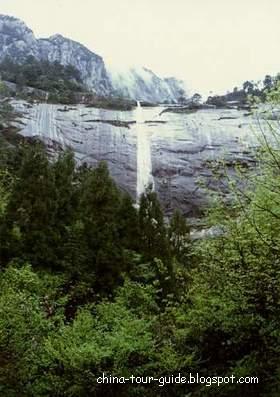
Huangshan Mountain in east China's Anhui province is one of Chinas ten best-known scenic spots, It is characterized by the four wonders, namely, odd-shaped pines, grotesque rock formation, seas of clouds and crystal-clear hot springs. Mount Huangshan is celebrated for having all the features of mountain scenery. Known as the No. 1 Mountain Under heaven, it features numerous imposing peaks(77 exceed an altitude of 1,000m), forests of stone pillars and evergreen sturdy pines; other features include grotesquely-shaped rocks (many of which are individually named, such as "pig-headed monk eating water melon"), waterfalls, pools and hot springs. Because of its mists and clouds, natural scenery in the area changes beyond prediction. Xu Xiake, a noted Chinese geologist and traveler in Ming Dynasty, praised Huangshan Mountain as the best of all mountains.

Mount Huangshan was listed as one of the World Natural and Cultural Heritages in 1990.

Mount Huangshan extends 40 kilometers from south to north and 30 kilometers from east to west, covering an area of 1200 square kilometers, the highlights of which occupy 154 square kilometers.
Huangshan Mountain is a marvel: within an area of 154 square kilometers there is a crowd of peaks, 72 of which have names indicating the shapes they resemble. Lotus, Brightness Top and Celestial Capital are the three major ones, all rising above 1,800 meters above sea level. The mountains are a body of granite, often with vertical joints. Erosion and fracture contributed to shape the rocks into huge columns, giving rise to lofty peaks and deep ravines. When it is cloudy the pinnacles loom in mists as if they were illusionary, while the sun is shining they unfold in all their majesty and splendor. Huangshan Mountain change its color and appearance with the alternation of seasons. In spring blooming flowers decorate the slopes in a riot of color and fill the valleys with fragrance; in summer you see verdure peaks rising one upon another and hear springs gurgling merrily. Autumn dresses the mountains in red and purple as maples and some other trees are blazing-red; winter turns them into a world of frost and ice with silver boughs and rocks everywhere. Here in Huangshan, pines and rocks are intimately involved with each other, almost every rock has a pine tree growing out of the crevice, and every tree has tortuous and gnarled roots and branches.The still sea of snow-white cloud can suddenly begin to roll and toss, rise or fall, gather or disperse while the peaks emerge and disappear in the clouds like isles in the ocean. So from ancient times it has been frequented by tourists seeking their mystery and admiring their frequented by tourists seeking their mystery and admiring their scenery. They come to the conclusion that the fantastic pines, the grotesque rocks, the sea of clouds and the hot springs are the four major attractions of the Yellow Mountains. As a matter of fact there are marvels almost everywhere, especially in the following scenic areas: Wenquan (Hot Spring), Yupinglou (Jade Screen Tower), Xihai ( West Sea), Beihai (North Sea), Yungusi (Cloud Valley Temple) and Songgu'an (Pine Valley Nunnery).

There is plentiful rainfall in Huangshan Mountain. Therefore there are thick forests.Owing to the peculiar terrain, the Huangshan Mountain's climate is marked by a vertical change, and the vertical distribution of vegetation is also distinctive: plants on the summit, on the middle levels and at the foot belong to the frigid, temperate and subtropical zones respectively. There are more than 1500 species of plants, of which trees comprise one third. So the Huangshan Mountain occupy an important place in China's botanical research. Here you will find century-old pines, firs, ginkgoes, actinidia, Chinese torreyas and camphor woods, remnants of the glacial era. A number of trees are celebrated on account of their age, grotesque shape, or precipitously perched position. Mount Huangshan abound in flowering plants; many of them are rare ones, such as Huangshan Rhododendron, magnolia as well as azalea, camellia, plum, lily, orchid, and so on. It has a rich store of medicinal herbs; more than 300 kinds are found here; the notable ones being glossy ganoderma ginseng, Chinese gold thread rhizome and Chinese cinnamon. Maofeng tea of Huangshan is well known at home and abroad.

Huangshan Mountains also provide the natural habitat for a wide variety of fauna. Among the animals there are monkeys, goats, deer, pangolin and squirrels. There are rare birds such as the red-billed leiothrix, the silver pheasant, the octave-tone bird and the oriole, all good singers. The red-billed leiothrix (called "love birds" in Chinese) are so lovely that they have become favorites of foreign tourists and are exported by pairs. Besides, chukkar(stone frog) from the streams is good to make delicious dishes with.

Mt. Huangshan's climate is mild and humid, neither too hot in summer nor too cold in winter, the temperature is agreeable all the year round .
It is cool in summer, averaging 70 °F at the North Sea Area ( 1 ,630 meters above sea) and 80 °F at Hot Spring Area (630 meters above sea) in July (the hottest month). As clouds often shut out the sun, hot weather never stays long, and this makes Yellow Mountains an ideal summer resort.
Mt.Huangshan lies in subtropical zones, so it's not quiet cold in winter, at least, not so cold as some people expected. The temperature ranges from 25 °F to 40 °F, but it's enough to result in a fantastic snow scenery and a silver world with pines and precipitous peaks covered with snow and decorated with icicles

Today Mt. Huangshan has become a world-famous tourist attraction. With its convenient facilities: three cable lines, four three-star hotels on the top, all the paths paved with flat stones, it lures millions of visitors both from home and abroad. Seeing is believing. Welcome to Mount Huangshan. More


add:Google Maps,Google Maps coordinate

黄山雄距于风景秀丽的皖南山区,它以“三奇四绝”的奇异风采名冠于世。1982年黄山被国务院列为首批国家级重点风景名胜区,1986年经评选列入中国十大风景名胜区,1990年被联合国教科文组织列入“世界遗产”名录。此后,黄山又相继被评选为国家级“卫生山”、“安全山”,1998年被建设部、国家旅游局等部门确定为全国首批十个文明景区之首。

  黄山,古称黟山,唐天宝六年(公元747年)依轩辕黄帝曾在黄山炼丹羽化升天的传说,唐明皇敕改黟山为黄山。它地跨市内歙县、休宁、黟县和黄山区、徽州区,面积1200平方公里,现划入黄山风景区的154平方公里,是号称“五百里黄山”的精华部分。

  黄山是以自然景观为特色的山岳旅游风景区,奇松、怪石、云海、温泉素称黄山“四绝”,令海内外游人叹为观止。黄山有名可数的72峰,或崔嵬雄浑,或峻峭秀丽,布局错落有致,天然巧成。天都峰、莲花峰、光明顶是黄山的三大主峰,海拔高度皆在一千八百米以上,并以三大主峰为中心向四周铺展,跌落为深壑幽谷,隆起成峰峦峭壁,呈现出典型的峰林地貌。

  登上一千八百多米的高处纵览,山中奇峰汇聚,峭壁千仞,拔地擎天,峥嵘崔嵬。青松在悬崖上争奇,怪石在奇峰上斗艳,烟云在峰壑中弥漫,霞彩在岩壁上流光,自然的美在这里汇聚,在这里升华,赋予它超凡脱俗的品质,塑造出它威武雄壮的气概。在黄山的面前,时空变得狭小,沧桑变得平淡,它是大自然的骄子,独领天下奇山的风骚。故而当之无愧地赢得“登黄山天下无山,观止矣”(徐霞客语)的崇高赞誉。More

Thursday, October 05, 2006

Jiuzhaigou(九寨沟)

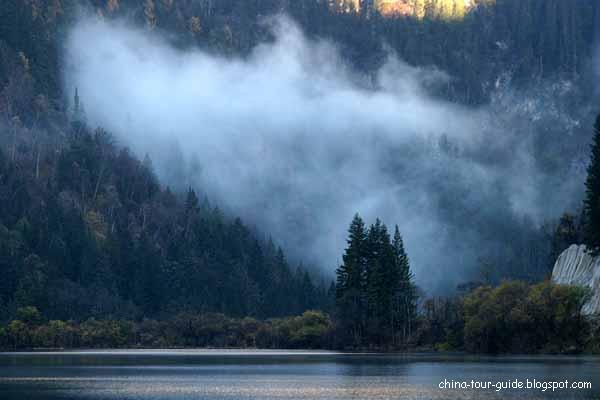
Known as the "Fairyland on Earth" . Jiuzhaigou sits on 103° 46' –I04° 4 ' E and32° 15 ' -33° 19' N, within the boundary of Jiuzhuigou County , Aba Prefecture , Sichuan . It lies between the southwest margin of the Qinghai-Tibet Plateau and at the north foolt of Duo'ema Mountain Range, with an average , altitude between 2, 000 and 3,000 meters, and a distance of about 435 kilometers from Chengdu , the capital city of Sichuan Province .

To its east, Jiuzhaigou neighbors both the Baihe River Nature Reserve and the Wanglang Nature Reserve , and to its south is the Huanglong Place of Scenic Interest . Jiuzhaigou covers a total area of 720 square kilometers, with a periphery zone of 600 sq. m. and a buffer zone of 110sq. m.

Jiuzhaigou, also called "Yangtong" in ancient times, cur- rently has other names like "Heyao Jiuzhai", and the " Jade Sea ". Jiuzhaigou, literally the Nine Village Valley , is hence known for the nine Tibetan villages within its boundary, that is, Panxin, Rize. Yacuo , Panya, Zechawa , Heijiao, Shuzheng, Heye and Zharu. The area of Jiuzhaigou as well as the upper reaches of the Jialing River and Minjiang River are called the land of Shiqiang (Qiang ethnic minority ) in aocient times, where human activities have been recorded dating back as early as to o the Yin-Shang Period (16th- 11th Century B. C.). Ac- cording lo The Records afSongpan (vol. I - Rivers and Mountains), the "Jade Sea is 50-odd kilometers to the northeast county, within the territory of Zhongyang Tongfan Tribe. Its valleys are as long as several kilometers with green water and jade-like ripples." This evidences that the Jade Sea beauty was well known as far back in ancient times.

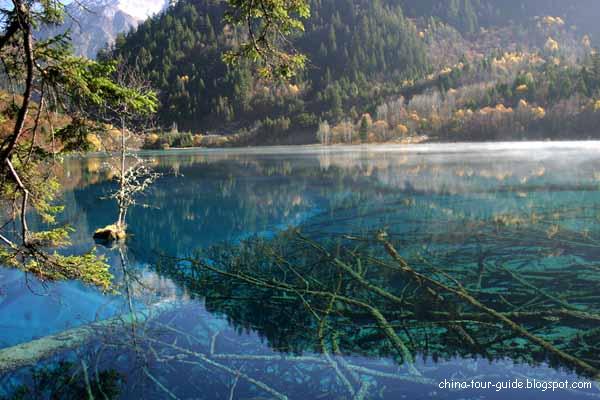
Jiuzhaigou covers the Shuzheng Valley . Rize Valley and Zechawa Valley that take a "Y" shape, in the Minshan Mountain Range. Inhabited by Tibetans, the nine vil- lages and alpine lakes, affectionately called "Ham", are like reflecting mirrors or crystal jade blocks inlaid in snow mountains and forests. At the end of Zechawa Valley is the Chang (Long) Lake and the end of Rize Valley are virgin forests. From .south to north, both val- leys stretch and meet al Nuorilang. The drop between the two valleys and Shuzheng Valley is over 1,000 meters, with 1 14 lakes lying downward in an echelon manner, on which arc 17 waterfalls, 11 rip currents and 5 travertine beaches, formulating alpine lake clusters and travertine spots that are rarely seen in China and even in the world. A fairyland on earth. Jiuzhaigou col- lects the primitive, natural beauties best demonstrated in its lakes, waterfalls, beaches, water currents, snow peaks, virgin forests and Tibetan customs. more

Magic Mirror Cliff
It's a gigantic cliff rising 800 metres from the level ground. Its surface is as smooth and slippery as a mirror. Capped with pines and China firs, the cliff top resembles a human head with cropped short hair and curly beard, which in local mythology, was left over by Zhayiga, the Ancester of mountains to keep the evil spirit under control.

Penjinghai Lake (Miniature Landscape Lake)
On the Lake's shallows, a few dozens of miniature-potted-landscape-like bushes of azalea, poplar, metasequoia etc. scatter about. They assume various forms: some in the shape of a fierce spread eagle, and some, of a galloping steed.

Luweihai (Reed Marshes)
It is 1375 metre long and over-grown with reeds. A clear brook zigzags its way through the marshes, where waterfowls are seen hovering overhead. When the season turns, the green meandering brook presents a striking contrast with the yellow spread of reeds.

Huohahai (sparkling Lake)
The west hill commands a spectacular view of the sparkling reflections of bright sunlight upon the Lake's deep blue surface. Lying Dragon Lake: In the middle of the lake, submerges a dimly visible yellowish "Lying Dragon" in some 20 metre deep water. When a gentle wind from the mountain whips up ripples on the Lake's clear surface, it looks as if the "Dragon" were stretching herself, and once the wind increases intensity, the "Dragon" begins to shake her head and wag her tail, as if poising for a take off.

Shuzheng Group of Lakes
It consists of some 40 large and small inter-connected lakes stretching as long as ten Li. The waters overflow the inter-lake banks of calcic soil over-grown with willows, pines and cypresses and become a succession of waterfalls. The nearby Shuzheng stockaded village still preserves two primitive stone mills and one wooden bridge, They are simple and rough, but very charming.

Nuorilang waterfalls
A massive water current washing over a cliff top over-grown with willows, drops some 30 metre down and form spectacular waterfalls of various size and shape. Some waters fall straight down to the ground. Some dash against protruding rocks midway and explode into millions of colorful tiny beads.

Pearl Shoal
A stream rushes down a 20 degree slope into the Shoal splashing water about like millions of bouncing silver pearls and then goes on down to form fantastic waterfalls of various shape with thunderous roars echoed by the deep valley.

Wuhua Hai (Five Flower Lake)
Due to different water depths and silts on the bottom, the Lake's waters assume a variety of colors, such as light yellow, dark green, deep blue, jadeite, under the sun light, they are as colorful and beautiful as a peacock's feathers.

Panda Lake Waterfall
It consists of 3 waterfalls with sizes of 5x19m., 2x24 m., and 14x19 m., respectively. Three separate streams rush down a precipice and form waterfalls with multiple sections of 65 m, in total height.

Swan Lake
It's 2250 m. long and 125 m. wide (at maximum) encompassing an area of 142.8 mu . The surface is domed with weeds and wild flowers. It's a tranquil and secluded place frenquented by swans and wild ducks.

Hanging Dagger Spring
Overlooking the Swan Lake is a solitary Lofty peak, 500 metre high and resembling a dagger piercing through the sky. From the halfway down the peak, voluminous waters gash out and drop some thousand feet like a white chain hanging in the air.

Five Color Pool
Filled with crystal-clear waters the pool looks colorful, radiant and fascinating.

Long Lake
It's the largest lake in Jiuzhaigou Valley, covering an area of 7.5 km, long and 0.375 km. wide. It is 3103 metres above sea level, with a maximum depth of 103 metres. The melted snow from the South Peak and the waters of surrounding mountain streams and brooks all find their way into the Lade which has no exit. The excess water either vapours or seeps into the earth. The waters never spill over the banks in spite of downpours in summer and autumn. The Lake won't dry up either in spring and winter, even there's a long dry spell. In spring, Jiuzhaigou Valley is radiant and enchanting. The air is filled with fragrance of wild blossoms. In summer, the beautiful trees are luxuriantly green. In autumn, the breeze is intoxicating, while tree leaves turn crimson. In winter, the mountains and valleys are wrapped in snow and ice.


九寨沟风景名胜区位于四川省阿坝藏族羌族自治州南坪县境内,距离成都市400多公里,是一条纵深40余公里的山沟谷地,因周围有9 个藏族村寨而得名,总面积约620平方公里,大约有52%的面积被茂密的原始森林所覆盖。林中夹生的箭竹和各种奇花异草,使举世闻名的大熊猫、金丝猴、白唇鹿等珍稀动物乐于栖息在此。 自然景色兼有湖泊、瀑布、雪山、森林之美。沟中地僻人稀,景物特异,富于原始自然风貌,有“童话世界”之誉。有长海、剑岩、诺日朗、树正、扎如、黑海六大景区,以翠海、叠瀑、彩林、雪峰、藏情这五绝而驰名中外。

  九寨沟处于四川盆地向青藏高原过渡的边缘地带,属松潘、甘孜地槽区,恰好位于我国第二级地貌阶梯的坎前部分,在地貌形态变化最大的裂点线上,地势南高北低,有高山、峡谷、湖泊、瀑布、溪流、山间平原等多种形态。其地貌属高山狭谷类型。山岭的海拔高度大都为 3500-4500米,最高峰嘎尔纳峰海拔4764米,最低点羊峒海拔2000米。整个景区内沟壑纵横,山峦叠嶂,好似大自然撰写的一部壮丽史诗,记录着地壳的沧桑变迁和生命的进化历程。

  在传说中九寨沟是仙女的宝镜幻化而成,优美的故事带给人梦幻般的想象。但从科学的角度看,九寨沟翠海叠瀑的形成,则是由于地壳变化、冰川运动、岩溶地貌和钙华加积等多种因素造就的。

  九寨沟地处四川盆地向青藏高原延伸的过渡带,为多种自然要素交汇地区。山地切割较深,高差悬殊,植物垂直带谱明显,植被类型多样,植物区系成分十分丰富。区内有高等植物2576种,其中国家保护植物24种;低等植物400余种,其中藻类植物212种,且40余种属四川首次发现,为九寨沟独有。许多古老的孑遗植物保存良好,波士曼博士称“九寨沟是个丰富多彩的博物馆,是实力雄厚的基因库。”

  九寨沟海拔高差大,地形地貌复杂,植被类型丰富,保留有大面积的原始生态环境,为不同类型的动物提供了适宜的栖息环境。湖面,野鸭水鸟起落;林中飞禽走兽云集。据有关部门粗略统计,生活在这里的野生动物,已知的就有近300种。其中被列为国家重点保护的珍稀动物27种,如大熊猫、金丝猴、牛羚、白唇鹿、黑颈鹤、天鹅、鸳鸯、红腹角雉、雪豹、林麝、水獭等,九寨沟堪称动物王国。

Monday, October 02, 2006

Business in China (search by Google)

Well,the results come from google.
Business-China.com - China Web Directory and Search Engine - [ 翻译此页 BETA ]Internet's only China web search engine and directory in multiple languages.
www.business-china.com/

Chinese Business World - Your China Business and Information Link - [ 翻译此页 BETA ]Chinese Business World, your one stop information source for business, travel, entertainment,shopping, education and beyond,chineseemarketplace,chinacantonfair.
www.cbw.com/business.html

Business, investment, sourcing and manufacturing in China - [ 翻译此页 BETA ]Business-in-asia.com is for business, manufacturing, sourcing, logistic, strategy, consulting, site selection, company registration, moving factory and contacts in China.
www.business-in-asia.com/china.htm


Doing Business in China - [ 翻译此页 BETA ]Summary of Country Services for China Page from The Internationalist. This page contains information pertaining to accountants, banks, consultants, financial services, government links, insurance agencies, law firms and real estate ...
www.internationalist.com/business/China.php

People's Daily Online -- Business News - [ 翻译此页 BETA ]A website by the People's Daily newspaper; China, business, world, science, education, sports news and commentaries. ... China-US Business Forum will be held at the Great Hall of the People, Beijing, on Feb. 14-15, 2006. ...
english.peopledaily.com.cn/business.html


China Daily Website - Connecting China Connecting the World - [ 翻译此页 BETA ]Chinadaily.com.cn is the largest English portal in China, providing news, business information, BBS, learning materials. The Website has channels as China, BizChina, World, Opinion, Sports/Olympics, Entertainment, Lifestyle, Culture, ...
www.chinadaily.com.cn/

China Business, China wholesalers, chinese wholesalers, china ... - [ 翻译此页 BETA ]China Business, China wholesalers, chinese wholesalers, china factories, computer wholesalers, suzhou industrial park, china mobile, golden week economic, China market, electronics wholesalers, beijing real estate, wholesalers in India, ...
english.china.com/zh_cn/business/

Business China 商机中国商机中国. 百度中文搜索引擎. ©2005 Business China. 2006年中国海关报关实用手册.
www.bc.org.cn/

China Vista -- the world's premier online gateway into China ... - [ 翻译此页 BETA ]As a bridge connecting Chinese and international businesses, this section features a large daily updated database providing a comprehensive listing of business and trade information and opportunities. Explore trade offers, or promote ...
www.chinavista.com/home.html


Sunday, October 01, 2006

China's economy expected to up 10.5% in 2006

This is a good news, but I was still only 3,000RMB(less than 400USD) per month.


BEIJING, Oct. 1 -- China's economy is expected to grow by 10.5 percent and the consumer price index by 1.5 percent in 2006, according to the latest report published by a research group under the People's Bank of China, the central bank.

The report also projects the country's gross domestic product (GDP) to grow by 9.5 percent in the first half of 2007, with the CPI up 1.8 percent.

China's economy will continue to maintain a steady and fast growth, though the growth rate might slow down, the report said.

The country's consumption will keep a fast growth in the future; the growth rate of domestic investment will slow down but is still on the fast track; the growth rate of export will gradually fall and net export will decrease for reasons of slowing global economy and rising trade frictions, analyzed the report.

China's economy grew at 10.2 percent last year and the growth rate was 10.9 percent in the first half of this year. Since the second half of last year, the government has strived to cool the economy before it is overheated.

The growth rate of fixed assets investment, a major indicator of economic growth, dropped 5.9 percentage points from July to 21.5 percent in August, as reported by China's National Bureau of Statistics.(xihua,China Daily)

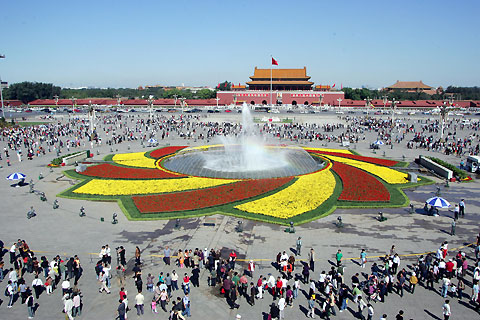
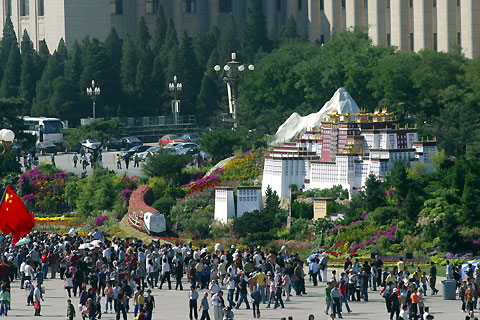
Before 10.1,Tian'anmen Square prior to National Day

A themed parterre is seen on the Tian'anmen Square on Friday.

A themed parterre is seen on the Tian'anmen Square on Friday. [China Daily]

A themed parterre is seen on the Tian'anmen Square on Friday.

A themed parterre is seen on the Tian'anmen Square on Friday. [newsphoto]

A themed parterre is seen on the Tian'anmen Square on Friday.

A themed parterre is seen on the Tian'anmen Square on Friday. [newsphoto]

Grand reception marks 57th National Day

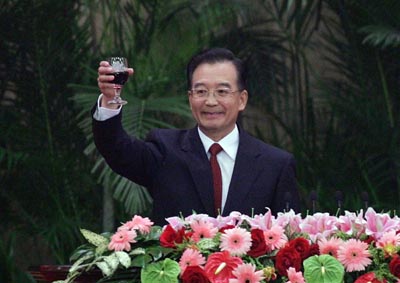
,,Wen Jiabao,,reception,,national day,,
Premier Wen Jiabao proposes a toast at a reception marking the 57th anniversary of the founding of the People's Republic of China at the Great Hall of the People in Beijing September 30, 2006. China is celebrating the anniversary on October 1.
(@China Daily) View
China is an oriental country with a long history.I'm proud I am Chinese.国庆节快乐。

China aims to become world's leading tourist destination

China, already the world'sfifth most popular tourist destination, plans to be the global leader by 2020.

Sun Gang, deputy-director of the China National Tourism Administration, made the remarks here to Asian tourism industry professionals in the Boao Forum for Asia -- Tourism Conference, which just concluded in this scenic tourist spot in southwest China's Guangxi Zhuang Autonomous Region

"China's current ranking in world tourism demonstrates its status as a major tourism destination," Sun said. "The developmentof China's tourism industry constitutes an important part in the country's process of building a well-off society."

According to information from China's State Administration of Statistics, overseas tourist arrivals in 2001 totaled 89.01 million, a rise of 6.7 percent over the previous year. Travelers staying longer than one night reached 33.16 million, the fifth largest number in the world.

The overseas tourists brought 17.79 billion US dollars to the region, a yearly increase of 9.7 percent, making China the fifth largest earner of foreign currency from tourism for the first time.

In the first nine months of this year, China received 28.12 million travelers, up 14.8 percent from the same period last year.

Chinese tourism professionals believed these results are both the start-up points and a solid foundation for China to build itself as a world-class tourism destination.

China's tourist infrastructure construction development and management have seen all-round improvement during the past 20 years. The latest statistics show that by the end of 2001, China had put 780 billion yuan into tourism fixed assets investment and had 288,000 tourism enterprises, 274,000 hotels and inns, and morethan 10,000 travel services.

China has issued 17 sets of tourism industry standards, achieving fruitful results in tourism standardization.

All these efforts put China's tourism on an international level.   

Tourism has become a new niche of growth for the Chinese economy. The total tourism related income brings an average annual growth of 12 percent, or five percentage points higher than the GDP growth of the same period. China's tourism earns 499.5 billion yuan, or 5.2 percent of China's GDP. The foreign currency earning is expected to hit 20 billion US dollars. China is expected to earn 30 billion US dollars from tourism in five years.

The holiday economy, initiated by China, has become a booster of China's tourism industry. Last year in the three "seven-day vacations" for the Chinese New Year, May Day and National Day, China's domestic travelers reached 200 million. The tourist incomeduring these periods was 73.6 billion yuan. The holiday tourism gave an injection into the accommodation, transportation, shopping and catering industries, generating shopping sprees and driving the domestic demand.

"Out-bound traveling has become a must for the Chinese people in their well-to-do life," Sun said.

The industry also played an active role in promoting the sustained economic, social and environmental development, job creation and poverty alleviation.

"China is one of the first countries in the world to eradicate poverty through tourism development," said Wu Bihu, a doctor with the Beijing University Tourism Development and Planning Research Center. "Thanks to the development of tourism and related industries, a great number of people in such poverty-stricken areas as Yunnan and Guangxi finally solved the problem of feeding and clothing themselves."

Experts estimate that the labor-intensive tourism industry has created 35 million direct or indirect job opportunities in the past 10 years in China.

More importantly, China's tourism has become an integral part of world tourism. According to the estimation of the World Tourism Organization (WTO), China will become the world's largest host country and the fourth largest to send tourists abroad by 2020.

In this year alone, according to the WTO, about 10 million Chinese will spend 18 billion US dollars traveling to other Asian destinations. In the year 2020, Chinese outbound travelers are expected to reach 100 million, a figure equal to the outbound travelers of all other Asian destinations combined.

China still lags behind the current world-class tourist destinations, such as Britain, France and the United States, Sun said, adding that the development of its rich tourism resources, the management of tourism enterprises and promotion still remain low.

"There is still a long period of time before 2020, and I believe the current gap will be gradually narrowed," he said. Enditem

Before Departure

Home Security

Notify family members and/or neighbors as to how long you will be away from home. Place valuables in the bank. Suspend all deliveries, including your newspaper subscription. Have the post office hold your mail. Leave a house key with a neighbor and set up automatic timers to activate lights and play the TV or radio at set times. Turn the thermostat down to 55-63 degrees (if you generally keep it set at a higher temperature); turn the thermostat up to 76-78 degrees (if you live in a hot and humid climate). Disconnect electrical appliances and turn off the hot-water heater. Empty and defrost the refrigerator; keep the refrigerator door propped open in order to avoid mildew. Secure all window and door locks.

Arrange for the care of your house, lawn, garden, plants, and pets. Well-kept grounds give the impression that the house continues to be lived in. Arrange for the in-home care or boarding of your pets. Ask a family member, friend, or neighbor to make periodic checks of your home or consider employing a house-sitting service.

Leaving For the Airport

Always reconfirm your airline reservations before leaving home, preferably 72 hours in advance of your departure. When making or reconfirming any arrangements, be sure to obtain the name of the person with whom you have spoken as well as a confirmation number.

Arrive for your flight a little early. Airlines suggest that passengers on international flights arrive a minimum of two hours before take-off. Give yourself extra time to avoid getting frazzled should you be slowed down by heavy traffic or inclement weather on your way to the airport.

Leave an itinerary with hotel telephone and fax numbers as well as the Regent contact number (if you are on a Regent tour) with someone. Let one or two people know where to reach you.

Keep An Open Mind

When you leave your home in North America, you are embarking on a journey that will take you to places that are very different from your usual way of life. Try to be flexible and enjoy the unexpected. Embrace new sights, sounds, people, and the culture around you. Sample the food, try to speak the language, ask questions, and smile; you will return home a more knowledgeable person with happy memories. Many travelers have told us that Chinese people are the friendliest people in the world--find out for yourself!

Money Exchange

Dollars & Yuan

The official name for the currency in China is Renminbi (abbreviated as RMB, the "people's money") with denominations of the yuan, jiao, and fen, which bear a relationship to each other somewhat like the U.S. dollar, dime, and penny.

RMB is not traded on international markets and can be officially purchased or exchanged only in China. Foreign currencies and traveler's checks may be converted to RMB at hotels. The rate of currency exchange is the same everywhere in China. The 1999 rate of currency exchange was 7.89 yuan = US$1. For example, if an item costs 10 yuan RMB, it will be equivalent to US$1.21; this is calculated by dividing 10 by 7.89. See conversion table.

Your first opportunity to exchange your money for Chinese yuan will be at your first hotel.

It is wise to carry some U.S. cash in $1, $5, $10, and $20 denominations as this can be a plus when buying from street vendors.

Most stores at tourist stops accept U.S. dollars.

ATM Access

ATM machines are not readily available in China.

Traveler's Checks

It is recommended that you carry traveler's checks as a safety measure. Also, traveler's checks usually command a better exchange rate than cash. For convenience, carry some traveler's checks in $20 denominations. All traveler's checks drawn on American banks are accepted in China. Be sure to make a list of your check numbers and keep the list in a safe place separate from your wallet, purse, or passport.

Credit Cards

Major credit cards (except Discover Card) are accepted at all hotels, tourist stores, and factory outlets in China. Be sure to record your account numbers (and customer service telephone numbers) in case you lose your credit cards.

Make major purchases by credit card. You will get a good exchange rate, the protection of the card's charge-back provisions, and often an extra guarantee on your purchase.

U.S. and China Customs Information

Upon Entering China

Each visitor to China is required to complete a customs declaration form and health declaration form; these forms are distributed by the cabin crew during the flight to China. The customs form must be filled out in duplicate and include a listing of items of value you are declaring--i.e., all currencies (including cash and traveler's checks), jewelry, watches, cassette players, radios, cameras, and calculators. Caution: When in doubt about an item, declare it!

If you are traveling with a group, your tour director will collect everyone's forms and present all forms to the customs officer.

The endorsed duplicate copy will be returned to you by your group tour director. You are required to keep the duplicate copy of the customs declaration form until you exit China; at that time, you must again present the form with your declaration of all valuable items.

In theory, all personal possessions declared upon entry into China must be taken out of the country at the end of your trip. Therefore, if an item declared upon entry is lost while in China, check with your Chinese host immediately. Depending upon the value of the item, it may be necessary to file a report with the local police in order for you to clear China customs at the end of your trip. Currently, if you are traveling with a Regent group on a group visa, you will not have to do any of the above.

However, this arrangement may change at any point should the Chinese government change its entry policy.

U.S. Customs

When leaving the U.S. with any foreign-made serialized items--e.g., cameras, watches, etc. that appear to be new--such items must be accompanied by the sales slip or be registered with the U.S. Customs Service in order to prevent having to pay duty upon re-entering the U.S. Thus, to avoid any confusion, you should declare any such items at your nearest U.S. Customs Service office or at the U.S. Customs Service office at the international airport from which you depart.

If you carry more than US$10,000 (all currencies, traveler's checks, money orders, or other bearer monetary instruments) into or out of the U.S., you are required by U.S. law to file a report with the U.S. Customs Service.

When re-entering the U.S., the duty-free exemption for each person over 18 years of age is 200 cigarettes, 100 cigars, or 1.36 kilograms (3 pounds) of tobacco. In addition, the duty-free exemption for each person over 21 years of age is one liter (33.8 fluid ounces) of wine, beer, or distilled spirits.

When re-entering the U.S., you must declare, at the price paid, everything acquired abroad, including gifts given to you and articles purchased even if they have been worn or used. You should be able to produce receipts for all goods acquired abroad and calculate their total U.S. dollar value.

Warning: If you fail to declare (or if you understate) the value of your purchases, penalties can be severe and articles subject to seizure. Again, if in doubt, declare it!

While abroad, gift packages may be sent to friends and relatives at addresses different from your own, and these may be received free of duty if the value does not exceed US$50.

Note that many travelers are confused by the term "duty-free" as it relates to shops. Articles bought in "duty-free" shops in foreign countries are subject to U.S. customs duty and restrictions, but may be included in your personal exemption. Also, articles purchased in U.S. "duty-free" shops are subject to U.S. customs duty if they are brought back into the U.S. "Duty-free" really means that the shop has not been required to pay a duty on the items it sells.

Caution: Be prepared for challenges to the originality of artwork and the authenticity of antiques. An original artwork is duty-free, but mass-produced artwork carries a 25% duty. In order to qualify as original, the piece should be the only one of its kind and should be signed. (You can argue past the absence of a signature. If the piece is indeed original, hold your ground and make your case.)

Certified antiques are duty-free, but duty on non-antique porcelain, bronzes, and jewelry can range from 25% to 110%, depending on the item. The U.S. Customs Service requires a signed receipt from the dealer certifying that the item is more than 100 years old.

Note also that you may get a good price for a supposedly brand-name product because it is counterfeit and thus subject to seizure.

Caution: Do not bring meats, fruits, or vegetables into the U.S. Also, many items made from the bone and/or skin of endangered wildlife may not be imported into the country. Among these items are all products made from sea turtles, all ivory, furs from spotted cats, furs from marine mammals, feathers and feather products from wild birds, and most coral.

The pamphlet, Know Before You Go, gives pertinent information about U.S. Customs Service requirements and how they apply to articles acquired abroad. Obtain a copy from your nearest U.S. Customs Service office or from the U.S. Customs Service, P.O. Box 7407, Washington, D.C. 20044.

Regent Education Fund

The founders of Regent have had first-hand experience in poverty-stricken areas of China where children yearn for an opportunity to go to school but their parents cannot afford this luxury for them.

Since 1997, the Regent Education Fund has assisted many children in rural China in receiving elementary education. In the beginning, all funds relied solely on contributions from Regent companies and staff. Gradually, more and more Regent travelers are contributing to this cause.

Annual tuition and books cost approximately US$60 per child. The Regent Education Fund sponsors individual children and also contributes to general purpose school expenses such as teaching aids and library books.

For more details, you may contact Regent offices in either China or the U.S. personally, through this web site http://www.regenttour.com/school, or by telephone, fax, or mail. Our guides in China will also be happy to provide you with more information.

Shopping

Most of your shopping will probably be done in hotel stores, department stores, or factory stores--or from vendors at attraction sites. Remember to keep a log of your purchases; this will make it easier to complete customs forms. Include in your log what you paid in Chinese currency along with the U.S. dollar equivalent.

Antiques

Antiques may be purchased only in licensed shops. Chinese government authorities generally have restricted the sale of items older than 120 years. They regulate what is purchased by marking items with a special red or brown hard wax seal requiring a special customs declaration form to be issued at the time of purchase.

Caution: Old artifacts are often offered for sale at urban "free markets." Should you purchase a genuine antique at one of these markets, it will be confiscated by Chinese customs officials. You will experience considerable embarrassment in addition to the loss of your purchase.

Handicrafts

As far as handicrafts are concerned, you should always bear in mind that these items are usually regional products and may not be available in another part of the country.

Bargains

You can bargain in tourist stores. If you are not sure about the appropriateness of bargaining in a particular situation, ask your local guide.

Beware of duty-free shops, especially in Hong Kong. Most of them do not offer any real bargains. You may find a bargain if you are an experienced shopper or at least have a target price in mind.

Sales Tax

There is no sales tax in China.

Disputes

If you travel with a Regent group, our guides will take you only to reputable, government-approved tourist stores. Still, disputes may arise. For example, a US$1,000 jade piece may be appraised for only US$200 by your local jeweler in the U.S. It could be that the store overcharged you. It could also be that your local jeweler does not recognize the value of the jade piece, given the many varieties of jade available in China.

Our suggestion: When in doubt, do not buy. However, your credit card issuer may provide some help in carefully documented disputes.

Shipping large purchases

Remember that Regent will provide its tour group members with a collapsible tote bag to carry home souvenirs. (You may also find the tote bag to be a convenient means of carrying essential personal items for daily touring.)

However, should you purchase large items, the outlet where you make such purchases will provide reliable packing and shipping to your hometown at an additional charge. We suggest that you request door-to-door shipment. In many cases, due to freight consolidation, air shipment is cheaper than surface shipment; remember to inquire about these rates at the time of purchase.

Also, keep in mind that you will be liable for U.S. customs duties, prevailing state user taxes, bonding, customs broker fees, trucking charges, etc. that may total well over US$200. It will take six to twelve weeks for your shipment to reach you. You will be notified by a U.S.-based shipping/delivery company when your shipment arrives in the U.S. If in doubt about shipping procedures--or concern about a late delivery--contact the store where you placed your order, remembering to include the invoice number.

Saturday, September 30, 2006

TOURISM

Introduction

Modern tourism in China sprang up in the early 1950s. In 1954, the China International Travel Service was established, with 14 branches in Guangzhou, Shanghai, Beijing and other major cities. In 1964, the State Tourism Administration of China was formally established. Since the initiation of the policies of reform and opening to the outside world in 1978, China's tourism has entered a stage of rapid development. In 1999, the number of tourists entering China reached 72.8 million, of which 8.43 million were foreign tourists, 40 times the figure for 1978. Consequently, the foreign exchange income from this industry reached US$14.1 billion, 54 times that of 1978. Currently, China has become an important tourism destination in Asia, and the fifth large fourism country in the world. Domestic tourism is also growing vigorously. In 1999, the number of domestic tourists reached 719 million, spending a total of 283.2 billion yuan - 14.3 percent and 105.9 percent increases over 1995, respectively. With the improvement of the Chinese people's living standards, Chinese citizens have an increasingly strong interest in traveling abroad. In recent years, Chinese citizens have traveled to Southeast Asia and Europe. Foreign travel agencies are now opening offices in China to attract Chinese to travel abroad.

Now, China is fast on its way to becoming a country with developed tourism, and constantly improving tourism facilities and services. It is estimated that, by 2020, China will be the world's No.1 tourism destination and the fourth-largest nation of tourists.

Tourism Resources

China is a vast land, rich in tourism resources. It comes out in front in the world in scenic spots and historical sites, spectacular landscapes, and colorful and varied national customs. At present, there are two major tour routes in China: One is the "S"-shaped traditional tour route, containing famous political and cultural cities such as Beijing, Xi'an, Shanghai, Suzhou and Hangzhou; the other one is the crescent-shaped tour route containing coastal open regions, such as the Liaodong and Shandong peninsulas and the Yangtze and Pearl river deltas. Following the "S"-shaped tour route, tourists may climb the Badaling Great Wall and visit the Imperial Palace and Temple of Heaven in Beijing, and view the terracotta warriors and horses excavated from the Mausoleum of the First Qin Emperor, the Stele Forest and the Great Wild Goose Pagoda in Xi'an, wander along the bustling Bund and Nanjing Road and through the Pudong New Zone in Shanghai, enjoy Suzhou's gardens and the sights of the West Lake in Hangzhou. Following the crescent-shaped tour route, visitors may get some idea of the enormous changes which have taken place in the open coastal cities since the initiation of reform and opening to the outside world, and appreciate the charming seaside areas in north and south China. Moreover, the coastal towns all have holiday villages and various recreation facilities.

In 2000, China is sponsoring the "China Century Tour". The program consists of dozens of tourism celebrations and festivals, such as the Ice and Snow Festival, Lantern Festival, and Pingyao Ancient City Cultural Festival. Nine specially chosen tourism routes along the Yangtze River, Yellow River and Three Gorges are expected to attract more foreign tourists. Meanwhile, China is starting large-scale promotion activities in the domestic tourism market, so as to make the Chiense people get to know their own country's tourism resources better. During the China Century Tour activities, China is promoting "China's World Heritage - World-Level Tourist Attractions in the 21st Century" as China's competitive products in the international tourism market.

Friday, September 29, 2006

China Travel

Travel to China is a life time experience and a better way to understand China. Only when you are there, you may start to appreciate and understand what a difference to live in a nation with a population of 1.2 billion.

China offers variety choices for visitors. If you are interested in Chinese history, Chinese culture and Chinese scenery, your trip will be very fulfilled and very interesting. If you want to enjoy a peaceful sunshine beach holiday, there are plenty of tourist areas along the coastal line, which have unspoiled beaches and luxury hotels for visitors. In Hainan Island, the beautiful Sangya beaches are opened whole year around and there is no winter in this island. If you want excitements and nightlife, stay in big cities. There are many places every night for international gathering. If you are adventurers, go to remote areas to watch wild life or visit minorities to see how they live in the hillsides or desert. If you are sporty, take a cycle trip along the countryside, enjoy the rural life and meet with Chinese people along the route.

You may have heard or read a lot about China from books, newspapers, magazines and TV programs. Some of them are true but most of them are out of date, incorrect or even false. China is different from many of your previous experiences and may shock you in many ways. This is what China is!

This country is changing and progressing every day. Yet it is still a developing country. After the economic reform, most of the developments concentrate in major cities and remote areas are still very backward. China is a very populated nation and people have to cope with the crowded environment. Foreign visitors may not get use to the mentality of the people and sometimes become frustrated with the situation, which they never experienced before. Basically Chinese are reserve, peaceful and nice. They are very polite too but in their own way. When a foreigner is willing to take a more positive attitude to recognize the difference, the trip will become worthwhile or you may ruin your trip completely by unreasonable expectation and misjudgment of the people in general.

China Briefing

China is one of the biggest countries in the world. It has an area of about 9.6 million square kilometers which comprises about 6.5 per cent of the world total land area. Its population of more than one billion accounts for 23 per cent of the world's population. China is the world's oldest continuous civilization. World Travel Organization predicts that by year 2020, China will become the number one travel destination in the world.

China is situated in the eastern part of Asia on the west coast of the Pacific Ocean. It is the third largest country in the world (after Canada and Russia). The distance from east to west measures over 5,200 kilometers and from north to south, over 5,500 kilometers. When the sun shines brightly over the Wusuli River in the east, the Pamire Plateau in the west is in the very early morning. When blizzards wrap the north along the Heilongjiang River in the winter, spring sowing is underway on Hainan Island in the south.

China has a land border of 22,143.34 kilometers long and is bordered by twelve countries: Korea in the east; Russian in the northeast and the northwest; Mongolia in the north; India, Pakistan, Bhutan and Nepal in part of the west and southwest; Burma, Laos and Vietnam in the south.

Beside a vast land area, there are also extensive neighboring seas and numerous islands. The coastline extends more than 14,500 kilometers. Across the East China Sea to the east and South China Sea to the southeast are Japan, the Philippines, Malaysia, and Indonesia. More than 5,000 islands are scattered over China's vast territorial seas; the largest being Taiwan and the second largest, Hainan. One territorial sea and three neighboring seas altogether constitute 4.73 million square kilometers.

China Culture

Calligraphy has traditionally been regarded as China's highest form of visual art - to the point that a person's character was judged by the elegance of their handwriting! Decorative calligraphy is found all over China, in temples and adorning the walls of caves and the sides of mountains and monuments. The basic tools of calligraphy - brush and ink - are also the tools of Chinese painting, with linework and tone the all-important components.

Despite the ravages of time, war and ideology, there's still a lot to see architecturally. Traces of the past include the imperial structures of Beijing, the colonial buildings of Shanghai, the occasional rural village and Buddhist, Confucian and Taoist temples. Funerary art was already a feature of Chinese culture in Neolithic times (9000-6000 BC), ranging from ritual vessels and weapons to pottery figures, jade and sacrificial vessels made of bronze. Earthenware production is almost as ancient, with the world's first proto-porcelain being produced in China in the 6th century AD, reaching its artistic peak under the Song rulers.

China's language is officially Mandarin, as spoken in Beijing. The Chinese call it Putonghua. About 70% of the population speak Mandarin, but that's just the tip of the lingusitic iceberg. The country is awash with dialects, and dialects within dialects - and few of them are mutually intelligible. Of the seven major strains, Cantonese is the one most likely to be spoken in your local Chinese takeaway. It's the lingua franca of Guangdong, southern Guangxi, Hong Kong and (to an extent) Macau.

China's literary heritage is huge, but unfortunately its untranslatability makes much of it inaccessible to Western readers. Traditionally there are two forms, the classical (largely Confucian) and the vernacular (such as the prose epics of the Ming dynasty). Chinese theatre is also known as opera because of the important role played by music, and has spawned such diverse arts as acrobatics, martial arts and stylised dance. Many Western film-lovers are fans of Chinese cinema, with releases enjoying success at film festivals and art-house cinemas. Recently there has been an emergence of talented 'fifth-generation' post-Cultural Revolution directors, including Zhang Yimou (Red Sorghum, Chen Kaige (Farewell, My Concubine), Wu Ziniu and Tian Zhuangzhuang. Add to them Hong Kong's East-meets-West action directors John Woo (Hard Boiled) and Ringo Lam (Full Contact) and you have a full-fledged, extremely successful film industry.

Chinese cuisine is justifiably famous, memorably diverse - and generally not for the squeamish. The Chinese themselves like to say they'll eat anything with four legs except a table. For the most part, however, it's a case of doing ingenious things with a limited number of basic ingredients. The cuisine can be divided into four regional categories: Beijing/Mandarin and Shandong (with steamed bread and noodles as staples), Cantonese and Chaozhou (lightly cooked meats and vegetables), Shanghainese (the home of 'red cooking' and wuxi spare ribs) and Sichuan (spicy, with lots of chilli). Tea is the most common nonalcoholic beverage on sale, although Coca-Cola (both original and bogus) is making inroads, while beer is by far the most popular alcoholic drink. 'Wine' is a loose term which can cover oxidised and herb-soaked concoctions, rice wine and wine containing lizards, bees or pickled snakes. Another favourite is maotai, a spirit made from sorghum which smells like rubbing alcohol and makes a good substitute for petrol or paint thinner.

China Economy Overview

The size of the Chinese economy is likely to climb, in world rankings, from its current position as the sixth largest to the second largest by 2030, said economists with global investment bank Lehman Brothers.

With its gross domestic product (GDP) growing at an annual rate of 6 per cent, China will come in after the United States to secure the second place spot, the economists said.

Such an economy stands to offer exciting business and capital market opportunities to foreigners over the next 10 years or so, said Robert Subbaraman, a Lehman Brothers senior economist who is the co-author of a newly released comprehensive report on China's economic, political, social and foreign policy prospects over the next 10 years.

At a press conference last week in Beijing, Subbaraman and his colleagues offered detailed explanations of their forecasts regarding the impact of the country's accession to the World Trade Organization (WTO), growth opportunities and how to do business in China.

Tags