Showing posts with label Chinese. Show all posts

Thursday, October 05, 2006

Jiuzhaigou(九寨沟)

Known as the "Fairyland on Earth" . Jiuzhaigou sits on 103° 46' –I04° 4 ' E and32° 15 ' -33° 19' N, within the boundary of Jiuzhuigou County , Aba Prefecture , Sichuan . It lies between the southwest margin of the Qinghai-Tibet Plateau and at the north foolt of Duo'ema Mountain Range, with an average , altitude between 2, 000 and 3,000 meters, and a distance of about 435 kilometers from Chengdu , the capital city of Sichuan Province .

To its east, Jiuzhaigou neighbors both the Baihe River Nature Reserve and the Wanglang Nature Reserve , and to its south is the Huanglong Place of Scenic Interest . Jiuzhaigou covers a total area of 720 square kilometers, with a periphery zone of 600 sq. m. and a buffer zone of 110sq. m.

Jiuzhaigou, also called "Yangtong" in ancient times, cur- rently has other names like "Heyao Jiuzhai", and the " Jade Sea ". Jiuzhaigou, literally the Nine Village Valley , is hence known for the nine Tibetan villages within its boundary, that is, Panxin, Rize. Yacuo , Panya, Zechawa , Heijiao, Shuzheng, Heye and Zharu. The area of Jiuzhaigou as well as the upper reaches of the Jialing River and Minjiang River are called the land of Shiqiang (Qiang ethnic minority ) in aocient times, where human activities have been recorded dating back as early as to o the Yin-Shang Period (16th- 11th Century B. C.). Ac- cording lo The Records afSongpan (vol. I - Rivers and Mountains), the "Jade Sea is 50-odd kilometers to the northeast county, within the territory of Zhongyang Tongfan Tribe. Its valleys are as long as several kilometers with green water and jade-like ripples." This evidences that the Jade Sea beauty was well known as far back in ancient times.

Jiuzhaigou covers the Shuzheng Valley . Rize Valley and Zechawa Valley that take a "Y" shape, in the Minshan Mountain Range. Inhabited by Tibetans, the nine vil- lages and alpine lakes, affectionately called "Ham", are like reflecting mirrors or crystal jade blocks inlaid in snow mountains and forests. At the end of Zechawa Valley is the Chang (Long) Lake and the end of Rize Valley are virgin forests. From .south to north, both val- leys stretch and meet al Nuorilang. The drop between the two valleys and Shuzheng Valley is over 1,000 meters, with 1 14 lakes lying downward in an echelon manner, on which arc 17 waterfalls, 11 rip currents and 5 travertine beaches, formulating alpine lake clusters and travertine spots that are rarely seen in China and even in the world. A fairyland on earth. Jiuzhaigou col- lects the primitive, natural beauties best demonstrated in its lakes, waterfalls, beaches, water currents, snow peaks, virgin forests and Tibetan customs. more

Magic Mirror Cliff
It's a gigantic cliff rising 800 metres from the level ground. Its surface is as smooth and slippery as a mirror. Capped with pines and China firs, the cliff top resembles a human head with cropped short hair and curly beard, which in local mythology, was left over by Zhayiga, the Ancester of mountains to keep the evil spirit under control.

Penjinghai Lake (Miniature Landscape Lake)
On the Lake's shallows, a few dozens of miniature-potted-landscape-like bushes of azalea, poplar, metasequoia etc. scatter about. They assume various forms: some in the shape of a fierce spread eagle, and some, of a galloping steed.

Luweihai (Reed Marshes)
It is 1375 metre long and over-grown with reeds. A clear brook zigzags its way through the marshes, where waterfowls are seen hovering overhead. When the season turns, the green meandering brook presents a striking contrast with the yellow spread of reeds.

Huohahai (sparkling Lake)
The west hill commands a spectacular view of the sparkling reflections of bright sunlight upon the Lake's deep blue surface. Lying Dragon Lake: In the middle of the lake, submerges a dimly visible yellowish "Lying Dragon" in some 20 metre deep water. When a gentle wind from the mountain whips up ripples on the Lake's clear surface, it looks as if the "Dragon" were stretching herself, and once the wind increases intensity, the "Dragon" begins to shake her head and wag her tail, as if poising for a take off.

Shuzheng Group of Lakes
It consists of some 40 large and small inter-connected lakes stretching as long as ten Li. The waters overflow the inter-lake banks of calcic soil over-grown with willows, pines and cypresses and become a succession of waterfalls. The nearby Shuzheng stockaded village still preserves two primitive stone mills and one wooden bridge, They are simple and rough, but very charming.

Nuorilang waterfalls
A massive water current washing over a cliff top over-grown with willows, drops some 30 metre down and form spectacular waterfalls of various size and shape. Some waters fall straight down to the ground. Some dash against protruding rocks midway and explode into millions of colorful tiny beads.

Pearl Shoal
A stream rushes down a 20 degree slope into the Shoal splashing water about like millions of bouncing silver pearls and then goes on down to form fantastic waterfalls of various shape with thunderous roars echoed by the deep valley.

Wuhua Hai (Five Flower Lake)
Due to different water depths and silts on the bottom, the Lake's waters assume a variety of colors, such as light yellow, dark green, deep blue, jadeite, under the sun light, they are as colorful and beautiful as a peacock's feathers.

Panda Lake Waterfall
It consists of 3 waterfalls with sizes of 5x19m., 2x24 m., and 14x19 m., respectively. Three separate streams rush down a precipice and form waterfalls with multiple sections of 65 m, in total height.

Swan Lake
It's 2250 m. long and 125 m. wide (at maximum) encompassing an area of 142.8 mu . The surface is domed with weeds and wild flowers. It's a tranquil and secluded place frenquented by swans and wild ducks.

Hanging Dagger Spring
Overlooking the Swan Lake is a solitary Lofty peak, 500 metre high and resembling a dagger piercing through the sky. From the halfway down the peak, voluminous waters gash out and drop some thousand feet like a white chain hanging in the air.

Five Color Pool
Filled with crystal-clear waters the pool looks colorful, radiant and fascinating.

Long Lake
It's the largest lake in Jiuzhaigou Valley, covering an area of 7.5 km, long and 0.375 km. wide. It is 3103 metres above sea level, with a maximum depth of 103 metres. The melted snow from the South Peak and the waters of surrounding mountain streams and brooks all find their way into the Lade which has no exit. The excess water either vapours or seeps into the earth. The waters never spill over the banks in spite of downpours in summer and autumn. The Lake won't dry up either in spring and winter, even there's a long dry spell. In spring, Jiuzhaigou Valley is radiant and enchanting. The air is filled with fragrance of wild blossoms. In summer, the beautiful trees are luxuriantly green. In autumn, the breeze is intoxicating, while tree leaves turn crimson. In winter, the mountains and valleys are wrapped in snow and ice.


九寨沟风景名胜区位于四川省阿坝藏族羌族自治州南坪县境内,距离成都市400多公里,是一条纵深40余公里的山沟谷地,因周围有9 个藏族村寨而得名,总面积约620平方公里,大约有52%的面积被茂密的原始森林所覆盖。林中夹生的箭竹和各种奇花异草,使举世闻名的大熊猫、金丝猴、白唇鹿等珍稀动物乐于栖息在此。 自然景色兼有湖泊、瀑布、雪山、森林之美。沟中地僻人稀,景物特异,富于原始自然风貌,有“童话世界”之誉。有长海、剑岩、诺日朗、树正、扎如、黑海六大景区,以翠海、叠瀑、彩林、雪峰、藏情这五绝而驰名中外。

  九寨沟处于四川盆地向青藏高原过渡的边缘地带,属松潘、甘孜地槽区,恰好位于我国第二级地貌阶梯的坎前部分,在地貌形态变化最大的裂点线上,地势南高北低,有高山、峡谷、湖泊、瀑布、溪流、山间平原等多种形态。其地貌属高山狭谷类型。山岭的海拔高度大都为 3500-4500米,最高峰嘎尔纳峰海拔4764米,最低点羊峒海拔2000米。整个景区内沟壑纵横,山峦叠嶂,好似大自然撰写的一部壮丽史诗,记录着地壳的沧桑变迁和生命的进化历程。

  在传说中九寨沟是仙女的宝镜幻化而成,优美的故事带给人梦幻般的想象。但从科学的角度看,九寨沟翠海叠瀑的形成,则是由于地壳变化、冰川运动、岩溶地貌和钙华加积等多种因素造就的。

  九寨沟地处四川盆地向青藏高原延伸的过渡带,为多种自然要素交汇地区。山地切割较深,高差悬殊,植物垂直带谱明显,植被类型多样,植物区系成分十分丰富。区内有高等植物2576种,其中国家保护植物24种;低等植物400余种,其中藻类植物212种,且40余种属四川首次发现,为九寨沟独有。许多古老的孑遗植物保存良好,波士曼博士称“九寨沟是个丰富多彩的博物馆,是实力雄厚的基因库。”

  九寨沟海拔高差大,地形地貌复杂,植被类型丰富,保留有大面积的原始生态环境,为不同类型的动物提供了适宜的栖息环境。湖面,野鸭水鸟起落;林中飞禽走兽云集。据有关部门粗略统计,生活在这里的野生动物,已知的就有近300种。其中被列为国家重点保护的珍稀动物27种,如大熊猫、金丝猴、牛羚、白唇鹿、黑颈鹤、天鹅、鸳鸯、红腹角雉、雪豹、林麝、水獭等,九寨沟堪称动物王国。

Monday, October 02, 2006

Addressing Chinese

Chinese family name comes first and then a given name. Generational and given names can be separated by a space or a hyphen, but are frequently written as one word. For example, in the case of Teng Peinian, Teng is the family name and Peinian is the given name. Therefore, it is always a good idea to ask a native speaker which name is the family name. The first names of those born during the cultural revolution era usually carries political meaning showing support toward Chairman Mao and his wife, Jiang Qing.

For business purposes, it is traditionally acceptable to call a Chinese person by the surname, together with a title, such as "Director Wang" or "Chairman Li." Avoid using someone's given name unless you have known him or her for a long period of time. If a person does not have a professional title, address a person using his or her family name only, such as Mr. Chen or Ms. Hsu. Formality is a sign of respect, and it is advisable to clarify how you will address someone very early in a relationship, generally during your first meeting.

Do not try to become too friendly too soon, and do not insist that your Chinese counterparts address you by your given name. The American pattern of quick informality should be resisted.

A married Chinese woman usually retains her maiden name; she will use her husband's last name on occasions for formal addressing only.

Address people using official titles such as "General" "Committee Member",or "Bureau Chief" whenever possible. It is customary to address the deputies by skipping the word 'deputy,' such as, 'Chief' for 'Deputy Chief,' 'Chairman' for 'Vice Chairman' 'General Manager' for 'Assistant General Manager'.

Unless you're a Communist, never refer to someone as “Comrade”, which means guy.

Gift-Giving

General Guidelines

With few exceptions, good business relationships are built upon strong personal relationships. Selecting an appropriate and proper gift requires knowledge and sensitivity. The art of gift giving is a tradition that has been around for a long time. There exists an excellent suggestion is avoiding giving something people already have.

It is appropriate to bring a gift, particularly something representative of your town or region, to a business meeting or social event. A gift should always be wrapped, but avoid plain black or white paper because these are the colors of mourning.

Present the gift with both hands as a sign of courtesy and always mention that this is only a small token of appreciation. Do not expect your gift to be opened in your presence. This indicates that it is the thought that counts more than the material value. Lucky numbers are 6 and 8 (especially in a series, such as 66 or 888).

Prepare a list of items that represent your local culture, region, country, company. Keep a detailed list of gifts that you have presented, and the names of recipients. Duplicating gifts shows lack of thoughtfulness. Keep a detailed list of gifts you have received. This is very helpful when preparing thank you letters, and it is an excellent way to evaluate relationships.

The Chinese will refuse a gift at first before finally accepting according to Chinese culture. You will have to continue to insist. Once the gift is accepted, express gratitude. You will be expected to go through the same routine if you are offered a gift.

In the presence of other people, never present a valuable gift to one person. This gesture will cause only embarrassment, and possibly even problems for the recipient, given the strict rules against bribery in Chinese business culture. Do not take any photograph of any gift giving unless it is a symbolic gift presented to the organization as a whole.

Giving a gift to the entire company, rather than an individual, can be acceptable in Chinese business culture. Make sure that all business negotiations be concluded before gifts are exchanged.

Specify that the gift is from the company you represent. If you can, explain the meaning of the gift to the receiver. Present the gift to the leader of the Chinese negotiating team. Do not get anything that is obviously expensive, so that the company will not feel obliged to reciprocate.

Valuable gifts should be given to an individual only in private and strictly as a gesture of friendship. Make sure that the gifts given to people of the same level of importance are equitable or of similar grade. Somehow, they may find out later, and the difference may lead to strains in your relationship.

Do not wrap a gift before arriving in China, as it may be unwrapped in Customs. If possible, have your gifts wrapped in red paper, which is considered a lucky colour. Plain red paper is one of the few “safe” choices since a variety of meanings, many of which are negative, are attributed to colours in Chinese culture.

Pink and gold and silver are also acceptable colours for gift wrap. Wrapping in yellow paper with black writing is a gift given only to the dead. Also, do check the variations from region to region about colours. Provide cultural training for employees who are responsible for making gift selections, and/or, work with cultural experts that can make suggestions, or review your corporate gift giving programs.

Appreciated Gifts

  • a good cognac, or other fine liqueur
  • a fine pen [not a pen with red ink--writing in red ink symbolizes severing ties
  • solar calculators
  • kitchen gadgets
  • stamps, if the recipient is interested in them [stamp collecting is very popular here]
  • a cigarette lighter, assuming the recipient is a smoker

Often, gifts are not opened in the presence of the giver.

Acceptable gifts for a company include items from your country or city, such as handicrafts, or an illustrated book. Be sure to bring a supply of these items with you, so that you can reciprocate if it happens that you are presented with a gift.

A banquet is usually a welcome gift; since it's likely you will be invited to one, you will have to follow Chinese business protocol and reciprocate. In some parts of China, although senior local officials host the welcoming party, you might be expected to pay for the cost of the banquet. Check this out and be prepared.

Gifts of food are acceptable, but not at dinner parties or other occasions where appetizers and meals will be served. Candy and fruit baskets, however, are acceptable as thank-you gifts sent after these events.

Eight is considered one of the luckiest numbers in Chinese culture. If you receive eight of any item, consider it a gesture of good will. Six is considered a blessing for smoothness and problem free advances. Four is a taboo because it means 'death'. Other numbers such as '73' meaning 'the funeral' and '84' meaning 'having accidents' are to be avoided.

Gifts to Avoid

Never give sharp objects such as knives or scissors as they would signify the cutting of a relationship. As a gesture of friendship, if you do want to give these items as a gift, ask your friend to give you a very small amount of money, such as 10 cents or One RMB in return for this gift. By doing so, you would have 'sold' it to him rather than given it to him.

The following items are to be avoided as they are associated with funerals:

  • Straw sandals
  • chrysanthemums
  • clocks
  • handkerchiefs
  • umbrella or white flowers
  • four of any item [the Cantonese word for “four” sounds similar, in the same language, to “death”]
  • gifts or wrapping paper in white, black, or blue

Public Behaviour

Handshakes are popular in China, however, wait for your Chinese counterpart to initiate the gesture. The Chinese will sometimes nod as an initial greeting. Bowing is seldom used except in ceremonies. Visit to school, theater, or other workplace is likely to be greeted with applause as a sign of welcome. In turn, you should respond by applauding back.

You should avoid making expansive gestures and using unusual facial expressions. The Chinese do not use their hands when speaking, and will only become annoyed with a speaker who does, so make an effort not to use your hands to illustrate your speech (talking with your hands). However, some hand gestures are necessary. For example, to summon attention, you can turn your palm down, waving your fingers toward yourself and use your whole hand rather than your index finger to point.

Do not touch your Chinese colleague, do not even pat him on the shoulder. The Chinese, especially those who are older and in positions of authority, dislike being touched by strangers.

Acknowledge the most senior person in a group first. Try as well to refrain from looking straight into the eyes of your Chinese colleague: this is particularly offensive during a meeting and will offend your Chinese colleagues' feelings. An offense or insult is a proven formula for failure of the meeting.

Smiling is not as noticeable in China, since there is a heavy emphasis on repressing emotion. Members of the same sex may hold hands in public in order to show friendliness. Public displays of affection between the sexes are frowned upon.

Do not put your hands in your mouth, as it is considered vulgar. Consequently, when in public, avoid biting your nails, removing food from your teeth, and similar practices.

Pushing and cutting ahead is common in lineups among Chinese, but they do not appreciate being cut in front of themselves. Spitting in public is no longer acceptable. It is subject to a heavy fine now. Blowing your nose with a handkerchief is also acceptable, but it is advisable to turn away from people while doing so.

Sunday, October 01, 2006

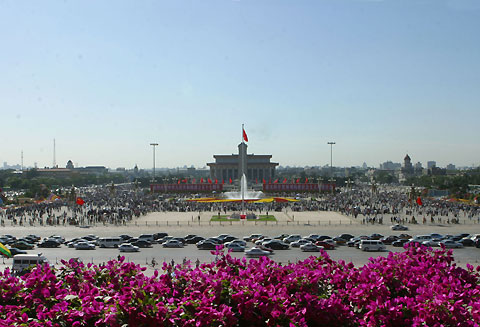
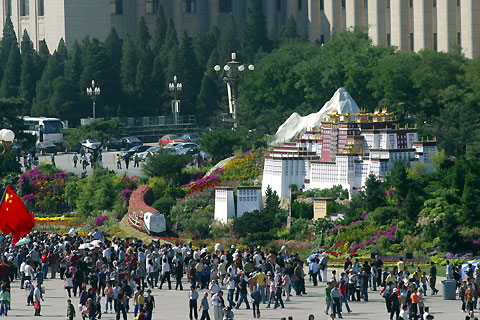
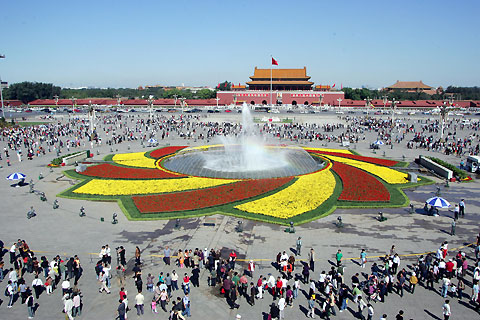
Before 10.1,Tian'anmen Square prior to National Day

A themed parterre is seen on the Tian'anmen Square on Friday.

A themed parterre is seen on the Tian'anmen Square on Friday. [China Daily]

A themed parterre is seen on the Tian'anmen Square on Friday.

A themed parterre is seen on the Tian'anmen Square on Friday. [newsphoto]

A themed parterre is seen on the Tian'anmen Square on Friday.

A themed parterre is seen on the Tian'anmen Square on Friday. [newsphoto]

Grand reception marks 57th National Day

,,Wen Jiabao,,reception,,national day,,
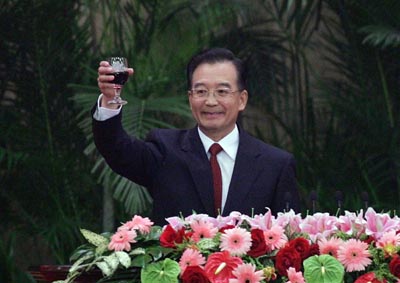
Premier Wen Jiabao proposes a toast at a reception marking the 57th anniversary of the founding of the People's Republic of China at the Great Hall of the People in Beijing September 30, 2006. China is celebrating the anniversary on October 1.
(@China Daily) View
China is an oriental country with a long history.I'm proud I am Chinese.国庆节快乐。

Chinese Words

Chinese Phrases:

  • Mei-guo (May-gwaw) - America
  • Zhong-guo (Joong-gwaw) - China
  • Ni Hao. (Knee How) - Good day / Hello / How are you
  • Xie-xie ni. (Syeah-syeah nee) - Thank you.
  • Dui-bu-qi. (Dway-boo-chee) - Excuse me.
  • Wo bu dong. (Waw boo-doong) - I don’t understand.
  • Qing shou Ying-wen. (Ching shwaw Ying-wun) - Please speak English.
  • Qing bang-zhu wo. (Ching baang-joo waw) - Please help me.
  • Wo mi-lu le. (Waw mee-loo luh) - I am lost.
  • Zai jian. (Dzai gee-en) - Goodbye.
  • Ni, chi fan le, mai you (Knee chir fawn la, may yo) - Have you eaten
  • Ming tien jian. (Ming tien jian) - See you tomorrow.
  • Tai gui le. (Tai gwee luh) - (It is) too expensive.
A few hard to pronounce Chinese pinyin letters:
  • ZH - as in the beginning of "jeweler"
  • CH - as in ZH above, but with a strong puff of breath
  • SH - as in "shoe"
  • R - as in "run"
  • C - like the "ts" in "it's high," but with a strong puff of breath
  • J - as in "Jeff"
  • Q - like the "ch" in "cheese"
  • X - like the "sh" in "sheep"
I, me
Wo [3] (Waw)

You (singular)
Ni [3] (Knee)

He / she
Ta [1] (Tah)

China
Zhong-guo [1-2] (Joong-gwaw)

Good day / hello / how are you?
Ni hao? [3-3] (Knee how?)

Thank you
Xie-xie ni [4-4-3] (Syeah-syeah nee)

Excuse me
Dui-bu-qi [4-2-3] (Dway-boo-chee)

I don't understand
Wo bu dong [3-2-3] (Waw boo-doong)

Please speak English
Qing shou Ying-wen [3-1-1-2] (Ching shwaw Ying-wun)

Please help me
Qing bang-zhu wo [3-1-4-3] (Ching baang-joo waw)

I am lost
Wo mi-lu le [3-2-4-0] (Waw mee-loo luh)

Goodbye
Zai jian [4-4] (Dzai gee-en)

Have you eaten?
Ni, chi fan le, mai you? [3-1-4-5, 3-3] (Knee chir fawn la, may yo?)

Acupuncture
Zhen jiu [1-1] (Gin joe)

1, 2, 3, 4, 5, 6, 7, 8, 9, 10
(counting from one to ten)
Yi, Er, San, Sz, Wu, Leo, Qi, Ba, Jou, Shi

Qigong
Qi gong [4-1] (Chee gung)

See you later
Ming tien jian [2-1-4] (Ming tien jian)

Taijiquan (T'ai Chi Ch'uan)
Tai ji quan [4-2-2] (Tie gee chwan)

I don't understand
Wo bu dong [3-4-3] (Waw boo dung)

Tags