Showing posts with label Attractions. Show all posts

Tuesday, October 10, 2006

Guilin(桂林山水) - Amazing Landscape

Taking a trip into the hully karst landscape of Guilin at sunset is one of the most breath-taking site in China. Guilin by the banks of the Li River in southern China is justifiably considered to be one of the most beautiful in China. Today, Guilin attracts innumerable tourists because of its unique landscape. Until the end of the 1970s, it was a quiet, sleepy area. Since then, Guilin and the settlements along the Li River have undergone an incredible development through tourism. This town with over 400,000 inhabitants acquired its name from the Cassia trees, whose blooms carry their sweet scent through the whole town in autumn. Guilin literally means "Cassia Tree Forest". Guilin is said to be founded in 214 BC. At that time, the Lingqu Canal was built under the regency of the first Chinese emperor, Qin Sin Huangdi. It still connects the central Asian plain with southern China, and South-East Asia, via the Yangzi, the Lijiang and the Pearl river. Guilin and its surroundings are still mostly agricultural, but this is limited by the numerous mountains which pose a problem in the whole of Guangxi region. The landscape is characterised by terraced rice paddies, water buffalos, and bamboo groves, and peasants with turn up trousers and cone-shaped straw hats. Guilin is famous for it spicy Guilinjiang, a type of pepper sauce. From the Mountain of Coloured Layers, a 223 metre high mountain on the north, visitors can get a wonderful view of Guilin and Lijiang. The most beautiful tourist spot is the Crystal Palace of Dragon King, in the Reed Flute Cave at north west of the city centre and a subterranean water landscape, which resembles the landscape around Guilin and the Li River.
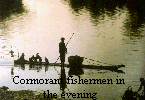
A boat trip on the peaceful Li River is the absolute high point of any visit to Guilin. A cruise from Guilin to Yangshuo, visitors will experience the winding and twisting Li River, goes past the many bizarre mountains whose shapes have inspired and fired the Chinese imagination, the Elephant Trunk Mountain, Old Man Mountain, Pagoda Mountain and Hole Mountain. Cormorant fishermen in narrow bamboo boats, bathing children, water buffaloes, small settlement and women doing their washing on the banks of the river can be seen along the way. Yangshuo, at the end of the boat journey is today a developed village that thrives mainly on tourism and seems to have nothing but tourist shops.

North-east of Guilin is Sanjiang, a settlement of the Song people. Changyong Bridge is an architecturally unique sight. South-west of Guilin, in the centre of the Autonomous region of Guangxi is Linzhou with 600,000 inhabitants, is an expanding industrial town, pricturesque and typically southern Chinese. The main attraction is the Dule Rock with its numerous karst caves. Another area with a beautiful landscape is the settlement of Guiping. The capital of the Autonomous Region of Guangxi is Nanning. It is located deep in the south and is only 160 km from the Vietnamese border. South-west of Nanning, near the Vietnamese border by the river Zuojiang, is a landscape as fantastic as that in Guilin. In Ningmeng county, visitors can see a 1,700 year old mysterious rock painting along a steep rock face by taking a boat on Zuojiang river.

Google Maps,Google Maps coordinate,Only show at Item-Page.


地理位置

1、地理位置:桂林是世界著名的风景旅游城市和历史文化名城,地处南岭山系西南部,广西壮族自治区东北部,109°45''-104°40'',北纬24°18''-25°41''。
  2、行政区划:辖秀峰,象山,七星,叠彩,雁山5城区和灵川,兴安,全州,临桂,阳朔,平乐,荔浦,龙胜,永福,恭城,资源,灌阳12个县,行政区域总面积27809平方公里。其中市区面积565平方公里。

  城市历史

  桂林历史悠久。根据市区宝积岩和甑皮岩洞穴发现的遗物,经考证,甑皮岩人已进入母系氏族社会阶段,距今约一万年。
  夏商周时期,这里是“百越”人的居住地。秦始皇置桂林,象,南海三郡,这是“桂林”名称的最早起源,但郡治不在今天的桂林市。汉元鼎六年(公元前111年),在这里设始安县,隶属荆州零陵郡。东汉时改属始安侯国。三国时先属蜀,后归吴。甘露元年(265年),置始安郡始安县,郡县治所都在今之桂林。隋唐时属岭南桂州总管府。唐武德四年(621年),李靖修城于独秀峰南。贞观八年(634年)改名临桂县,属桂州始安郡。光化三年(900年)始,属静江节度。五代十国时先后属楚和南汉的桂州。宋时,前属广南西路桂州,后属静江府。元时属广西行中书省静江路。明清时均属广西省桂林府。民国时属广西省。1914年改名桂林县,1940年始设桂林市。1944年11月至1945年7月28日,为日寇占领。光复后仍为广西省辖市。历史上长期为广西省会。   1949年11月22日桂林解放,为广西省辖市,1958年改称广西壮族自治区桂林市,辖桂林城区和郊区。
  1981年7月、1983年10月阳朔、临桂划归桂林市管辖。
  1996年12月26日桂林市委,市人民政府按国务院,自治区批复的方案,实行区划调整,将郊区更名为雁山区。
  1998年9月8日经国务院批准,桂林市和桂林地区合并,组建新的桂林市。More

Saturday, September 30, 2006

the Forbidden City

The Imperial Palace, also known as the Forbidden City or "Gugong", was the imperial residence and center of the kingdom during the reign of 24 emperors. 14 in the Ming and 10 in the Qing dynasty resided and ruled from this palace for 491 years until Puyi, the last emperor of the Qing dynasty and of China. It is now the largest and best preserved ancient architecture in China.

Located in the center of Beijing, the Imperial Palace covers an area of 72 hectares. Rectangular in shape, it runs 960 meter long from north to south. And 750 meter wide extended from east to west. There is a 10-meter high wall, encircled by a 52-meter wide moat.

The palace boasts more than nine thousand rooms, with layout following strict feudal code. The palace is divided into two main sections:- the Front Palace and the Inner palace. In the center of the Front Palace stand the Hall of Supreme Harmony, the Hall of Complete Harmony and the Hall of Preserving Harmony. The Inner Palace includes the Palace of Heavenly Purity, the Hall of Prosperity, the Hall of Earthly Peace and the Imperial Garden.

There are four gates at each corners of the walls:-The Meridian Gate to the south, the Gate of Divine Military Genius to the north, the East Flowery Gate to the east and the West Flowery Gate to the west. The Gate of Divine Military Genius was the gate connecting the imperial palace with the market area to the north of the palace. It is the largest gate of the Forbidden City, 35.6 meters high and surmounted by five pavilions. The central pavilion is rectangular in shape, while the other four, two on each side are square and hence the nickname is "The Five Phoenix Tower"

The Meridian Gate was so named because the Chinese emperors believed that they lived in the center of the universe, and the Meridian Line went through the Forbidden City.

A pair of bronze lions guards the Gate of Supreme Harmony, symbolizing the imperial power. In China, lions were supposed to be good doorkeepers and put at the gate to ward off evil spirits. Lions are frequently seen in front of buildings as guardians, one playing with a ball (male) and the other a cub (female). It was considered auspicious. The ball is said to represent imperial treasury or peace. The cub sucks milk from underneath the claw, because the female doesn抰 have breast.

The hall of Supreme Harmony is 35 meter high, 60 meter wide and 33 meter on both sides. It is now the largest, best preserved wooden hall in China. Twenty-four pillars support the roof. The Central six are gilded and painted red. The Emperor抯 throne, which is surrounded by art treasures of symbolic significance, is in the middle of the hall.

Above the throne is gold painted caisson, or coffer ceiling, with dragon designs, from which hangs a spherical pearl called "The Xu Anyuan mirror".

Three flights of marble steps leads up to the terrace In the middle of the central flight is a huge carving in the design of "Dragons playing with pearls", over which the emperors' sedan chairs were carried. At the east corner of the terrace is a sundial, and at the west corner stands a small temple in which the grain measure was kept. The sundial and grain measure is both symbols of rectitude and fairness.

Behind the Hall of Preserving Harmony, between the stairways, is a huge one-piece marble carving of "Dragons playing with pearls". This marble was brought here all the way from Fang Shan District, about 70 km away from Beijing City proper. It is about 17 meters long, 3 meters wide and 1.7 meters thick, weighing about 250 tons. Without any modern means of transportation, you can imagine how difficult it was for the Chinese laborer to transport such a huge piece of stone here!

Facing the Gate of Imperial Supremacy in the Hall of Jewelry is the famous Nine Dragon Screen, the best of its kind and the biggest in China. The main body of the screen was engraved with nine huge dragons. Each dragon is playing with a jewelry ball, each with different unique appearance. The dragons were painted with different colors with three dimension visual appearance and were handcrafted with highest skill of workmanship. It is truly the most beautiful piece of art.

The Imperial Palace is the largest museum in China; it preserves more than 900,000 priceless antiques covering all dynasties of Chinese history. It has been recognized as the biggest and most important treasury house of Chinese culture and arts in the world.

Lushan

Lushan is situated in the southern part of Jiujiang city in Jiangxi Province. Solitary and imposing, it towers over the southern bank of the Yangtze River, leaving behind its shadows upon the Boyang Lake. Nature has excelled herself in such a spectacular lone mountain. As a result of tremendous rubbing and grinding of glaciers, its grotesque peaks and cragged cliffs look all the more precipitous. The enveloping clouds and mists make it very hard to define the true shapes of the billowing peaks and ridges. The rapid streams cascade down and form numerous deep pools and hanging waterfalls. The lush mountain alongside with a crystal clear glimmering lake is picturesque. Mysterious and enchanting sceneries nestle in the secluded valleys and deep ravines. To describe the infinite variety of fantastic shapes of Lushan Mountain, Sudongpo (a famous Chinese ancient poet) wrote in his poetic masterpiece:" I can't tell the true shape of Lushan, because I myself am in the mountain!"


Dragon Head Cliff
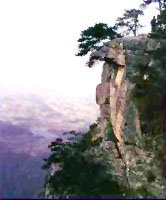
Besides a craggy cliff, it springs up some thousand feet out of the ground, rearing in the sky like a dragon head. From top down, it's inlaid with protruding grotesque stones and overgrown with upside down pines. Standing at the top, one can enjoy a bird's eye view of the Tiechuan Peak and hear the surfing of wind in the pine forest mingled with roaring of the waterfalls in the Stone Gate Ravine.

Three Tier Spring
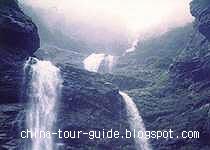
Originating in Dayue Mountain, the spring angles around the backside of Wulaofen (Peak of Five Old Men) and pours into Jiudiego (Nine Tier Gully), crashing twice upon huge rocks, and then converges into a torrent, and drops once again, splashing and throwing about millions of water beads. Driven by the gully wind, the tiny drops dance in the misty air, sparkling in the sunlight, and falling like countless dazzling pearls.

Huangshan

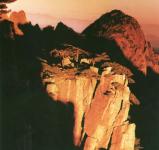
Situated in the southern part of Anhui Province in China, Huangshan (Yellow Mountain) is a famous scenic spot. On the mountain, the peaks rise one upon another and the pines and cypresses are luxuriantly green. Among the 72 big and small mountain peaks and ridges, the lakes, brooks, deep pools and waterfalls can be found everywhere. All over 1800 metres above sea level, and shrouded in clouds and mist, its main three peaks: Lotus Flower Peak, Ever Bright Peak and Heavenly Capital Peak present a scenery of boundless variety. Huangshan owes its unique scenic value to four factors, i.e. queer pines, grotesque rocks, cloud seas, and a hot spring. The exquisite scenery varies with the various seasons. Most spectacular are blossoms in Spring, pools in Summer, forests in Autumn and snow in Winter. In 1990, the UNESCO listed Mt. Huangshan as "A World Cultural And Natural Heritage."

Heavenly Capital Peak
Located in the south-eastern part of Huangshan, and 1810 metres above sea level, it is the most perilous peak of the three. The path to the top is via a vertical ladder inlaid in a precipitous cliff, and fenced in with stone posts and iron chains. The last section of the path to the top is about 30 metre long and 1 metre wide hunch-backed rocky ridge rising up from a deep ravine. Due to its riskiness, in spite of protections provided by the stone posts and iron chains it is figuratively called "Silver Carp's Back." On the summit, there is a stone cave large enough to seat a hundred people. Near the cave entrance, lies a rock resembling "A Drunkard Immortal Reclining On His Side" who was as if assigned to guard the gate of the cave. The summit commands a distant view of misty ranges of mountains and rivers diminishing into tiny lines. Here, one is at last at "the Peak of Perfection" as the inscription on a rock close at hand reads.

Lotus Flower Peak
Situated in the centre of Huangshan, and 1886 metres above sea level, it is the highest one of Huangshan's three main peaks. Lofty and precipitous, its principal peak towers over a number of smaller ones around it. The summit area is only a few square metres. Standing on it, one is as if to assume the dauntless spirit of propping up the sky from falling down. Far ahead in all directions are myriad of mountains vying with one another for beauty, and streams and rivers competing to be the fastest.

First Belief Peak
It is located in the eastern part of Huangshan, and 1668 metres above sea level. The peak is famous for exquisite rocks and graceful pines. With its three sides being precipitous and fathomless cliffs, First Belief Peak, flanked by Rising Peak and Stalagmite Peak as Fairy Bridge spans the summit. A poetic inscription on a rock there reads "you are a lone climber from a freezing river."

Wudalianchi

Wudalianchi (Five Big Linking Lakes) is situated in the northern part of Dedu County, Heilongjiang Province, to the western foot of Xiao Xinanling Ridge and on the upper reach of Bai River, branch of the Nemoer River. It has five lakes with one wave reflecting the other, one lake linking the other, meandering forward. People call it Wudalianchi, a famous scenic spot of the nation.

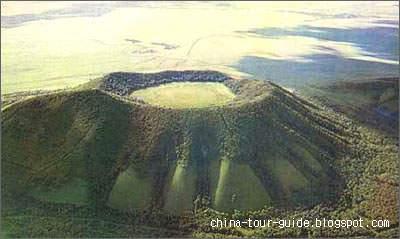
Group Volcanoes: Surrounding the Wudalianchi there spot scores of volcanoes, rising sheer from level ground, layer upon layer and range upon range, a grand and magnificent scene. In the long geologic age, a series of long, consecutive and intricate geological functions formed 11 "shield shape volcanoes", 14 "compound volcanoes" and large scale lava.

Group Mineral Springs of Medicine: The more interesting thing in the Wudalianchi is that one can drink to his heart's content the mineral water, which is called generally "mineral water of heavy carbonate". It contains more than ten elements beneficial to health, which have certain curative effect for stomach trouble, iron deficiency anemia, chronic cholecystitis, neurasthenia, skin disease, and high blood pressure, focuses etc.

Wudalianchi mineral spring consists of North Spring, South Spring, New South Spring, South Bathing Spring and Fanhua (Seething Waves) Spring, which are scattered on the area of Yaoquanshan (Mountain of Medical Spring). North Spring, South Spring and New South Spring are drinkable while South Bathing Spring and Fanhua Spring are bathing ones.

Heilongshan (Black Dragon Mountain) is one of the youngest volcanoes in Wudalianchi. On the south slope of it, there are two limestone caves; Water Screen Cave and Fairy Palace (cave). During monsoon season, the Water Screen Cave can form and Fairy Palace (cave). During monsoon season, the Water Screen Cave can form a screen of drizzling water, inside which there is coolness and quietness. The depth of the Fairy Palace is of tens of meters, crooked and winding, the bottom of which is covered with hard ice all year round, nip in the air, mysterious and unfathomable. On the north slope of Heilongshan, there is a broad valley which was the place the scorching hot lava flowed through in those years. The dense forest of pine and white birch trees grows in the valley casting thick shadows all around, with birds chirping. Besides, there are reddish brown volcano conglomerate and ashes, but green moss and lichen grow luxuriantly. The long cane twines round twines round trees large air smells moist and fresh with valley spreading forth vitality.

Huanglong

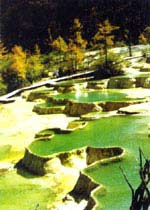
Situated on the middle of Minshan Mountain ranges northeast of Songpan County, Sichuan Province, Huanglong Scenic Area is a state first-class scenic zone, reputed as "Jasper Lake on Earth".

Colorful Lakes Reflecting azalea flowers: They are groups of colorful lakes surrounded by azalea shrubs. Innumerable red and green exotic azalea blossoms sparkle lustrously upon the surface of the lakes.

Zhengyanchi (Lakes Vying with One Another for Beauty): It's the largest group of Huanglong colorful lakes. They vary with one another in size, shape and color. Under the brilliant sunlight from different angles, the Lakes glow alternately with a variety of color: light blue, dark green, light yellow, bluish green, dark blue etc. Viewed from afar, they resemble a spread tail of a peacock.

Back Temple of Huanglong: In Huanglong, there are three temples: the front, middle and back, at an interval of 2500 meters. The Back Temple, basically in good shape was constructed at the end of the Huanglong Gully, with Yucui Peak at back, encompassing 2100 square meters. The buildings, simple and in good taste are of wooden structure with a courtyard and green-tiled roofs. On the lintel of the entrance gate are hung two parallel boards. The upper board is inscribed with the Chinese characters of "Huanglong Ancient Temple", on the middle, "Flying Pavilion Glowing Vermilion" on the right, and "Clear Mountain and Blue Water" on the left. The lower board is inscribed with "Distant Bosom Hearts are Linked" in vigorous and simple calligraphy. One of the two antithetical couplets in the Temple goes: "The Howling of Wind, Pitter-pattering of Rain, and Chiming of Bells, Every Sound is Real; The color of Mountain, The Color of Lake and the Color of Sunrays, All Colors are Illusory." The Grand Hall houses a statue of the True Man of Huanglong in the center. The Temple is encircled by broad lawns.

Huanglong Cave: The Cave entrance is surrounded by azalea shrubs. 10 meters from the entrance, the Cave broadens into a spacious hall, 20 meters high and 50 meters wide. The Cave contains numerous minor caves of various size and shape, which are hard to explore. There are three life-size stalactites resembling seated statues of Buddha.

Wulingyuan

Wulingyuan Scenic Area spreads out among Wulingyuan Mountains in Zhangjiajie city, southwest of Hunan province. It is about 400 kilometers (248.56miles) away from Changsha, the provincial capital. The whole area includes four parts: Zhangjiajie National Forest Park, Yangjiajie Scenic Spot, Suoxiyu and Tianzishan Natural Resources Reserves with an area of 500 square kilometers (193 square miles). Owing to the neighboring plateau southwesterly of it and Dongting Lake to the east, the second biggest fresh water lake of China, Wulingyuan Scenic Area comes into being under interaction of land elevation and depression and the cutting force of flowing water. It presents a unique landscape of high mountains, grotesque peaks, beautiful waters, deep gorges, marvelous caves and exuberant forest.

Long since, Wulingyuan was kept in oblivion because of being hidden in hinterland of the province. It was until 1979 that Mr. Wu Guanzhong, a famous Chinese painter, discovered this magic land. In 1992, UNESCO inscribed it Wulingyuan on World Heritage List.

Zhangjiajie National Forest Park

Zhangjiajie National Forest Park comes up as the first of its kind in China in 1982. It lies in the southwest part of Wulingyuan Scenic Area. There grow over 1000 kinds of plants with coverage of approximately 97.7% of the total area. Among them, the rarities are gingko, sequoia and Yunnan catalpa. It also provides a best homeland for hundreds species of vertebrates, like clouded leopard, tarpon, macaque, giant salamander, pangolin, etc. Its scenery is known for grotesque peaks. Three thousand sandstone peaks, posing in various ways, make up a forest of peaks and shape the land into a natural labyrinth. Eight hundred streams crisscross through the valley with springs and waterfalls interspersed all around.

Suoxiyu Natural Resource Reserve

The land of Suoxiyu marks transitional zone of sandstone and limestone area, so the mountains here are not as cragged as those in Zhangjiajie Park. They do not stand out solitary, but outstretch one after another, like an unfolding scroll of Chinese painting. Besides the peculiar peak and beautiful water, Suoxiyu has its distinct features in bridges and caves. Constructed upon steepy cliff, bridges are noted for their risky location. Most of them were merely piled up by blocks of rocks that dovetailed perfectly by human works. Meanwhile the limestone caves create fascinating underground palace. There are altogether 59 caves full of queerly and differently shaped stalactites and stalagmites.

Tianzishan Natural Resource Reserve

Tianzishan is located in the north of Wulingyuan area, bordering on the south with Zhangjiajie and joining Suoxiyu to the east. It offers a panoramic view due to its higher location than other areas. Its major peak rises 1250 meters (4101feet) above the ground.

Minorities

West of Hunan province, it boasts a rich and special minority culture. In Zhangjiajie city, there live more than 20 minority groups, like Tujia, Bai, Hui, Miao, etc. During the long-time evolvement of civilization, they bring out a set of customs and traditions of their own style, including living habits, funeral and marriage systems, religions, and arts. For example, the Hand-Shaking Dance of Tujia minority, the Drum Dance of Bai, dragon dance of Miao are most representative. Villages of Miao or Tu minority people can be seen with groups of amphibious storied-houses. This kind of house is usually built up of wood or bamboo and typical of the subtropical area in China, like Zhangjiajie, where the climate is subject to monsoon with annual average rainfall of 1.382 millimeters.

The great wall

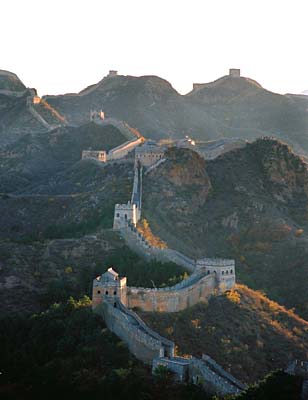
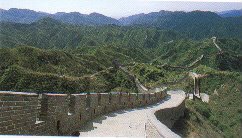
The Great Wall, (Wanli Changcheng) literally means the Ten Thousand Mile Wall, is a great fortification in ancient China. The section at Badaling is the most famous of all due to its proximity to Beijing City and condition of restoration. The imposing Badaling Great Wall climbs up and down, twists and turns along the high mountain ridges. It fully shows the lofty quality of ancient Chinese labor people.

Badaling Great Wall, with more than 1000 meters above sea level, occupies a commanding and strategic position. It is a defensive outpost of the Great Wall. It is called "Bada" as it stretches in all directions.

Badaling Great wall was built in the 18th year of the Ming Hong Zhi reign (1505). The wall, built with high stone slabs on the outside, is 7.8 meters high on the average, some even reaches 8.4meters. The base of the wall was built with more than 2000 large rectangular slab of granite stones. It is about 6.5 meters wide on the average at its base and 5.7 meters wide on the average on the ramparts. The wall is wide enough for five horses to gallop abreast and ten people to advance shoulder to shoulder. The outside of the wall is called rampart wall. The rampart wall was built with bricks 1.7 meters high. Built for the purpose of defense, there are holes on the tip of the wall called watch-hole, and peepholes under the wall called embrasures. Inside of the wall, there are low walls with one meter high called parapets, which can be used as railings. There is a scroll door not far from the inside wall, with is a stone ladder for climbing up and down.

The wall is narrow on the top and broad on the bottom forming an adder-shape structure. This made the wall stands firmly on the rise and fall ridges. The wall was built with 10-14 rectangular slab of stones surrounding its outside, filled with soils and stones in the middle, and paved with square bricks on the top between the bricks were stuck with lime stones. This makes the wall tidy, beautiful, and firm. There are gutters with gargoyles to drain rain-water off the parapet wall.

The landscape of Badaling Great Wall changes every season, with numerous scenery to catch your attention. A sunlit and enchanting scene of spring, with the valley covered with greens. When the rain from mountain comes, the vista will look vast and hazy. The sky in autumn is high with unsoiled stratosphere, while the maple forest is dyed in golden colour. White snow covers the whole scene in winter.

The Mogao Caves

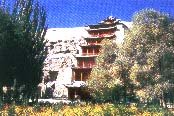
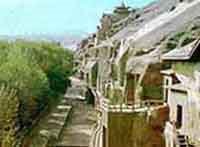
The Mogao Caves, also known as the Mogao Grottoes or the Caves of A Thousand Buddhas, are set into a cliff wall of Echoing Sand Mountain about 25km southeast of Dunhuang, the oasis city in the Gobi desert. This honeycomb of caves was constructed over a millennium, from the 4th to the 14th centuries, and represents the height of Buddhist art and the world's richest treasure house of Buddhist sutras, murals and sculptures.

During its heyday, the cave complex had thousands of caves, and today, a total of 492 grottoes, 45,000 square-metres of murals, 2,400 painted statues and over 250 residential caves remains. Almost every grotto contains a group of colorful paintings of Buddha and Bodhisattvas and other religious paintings, or social activities of different dynasties. The caves carved on the cliff wall provide voluminous research material for the study of all aspects of Chinese medieval society, in areas such as religion, art, politics, economics, military affairs, culture, literature, language, music, dance, architecture and medical science. The rich culture and art unearthed in the caves has even given birth to a new field of study, called "Dunhuangology"!


The mural paintings in existence today can be divided into seven categories, including the jataka stories depicting beneficence of Sakyamuni in his previous incarnations, sutra stories depicting suffering and transmigration, traditional Chinese mythology and so on. Although the religious scriptures are primarily Buddhist, written in Chinese, Uygur, Tibetan, Turkic and other languages, Taoist, Manichean and Confucian scrolls are also part of the collection.

(Unfortunately, due to the corrupt and impotent governments after the later Qing dynasties, many of the treasures of the Mogao Caves were plundered by heinous thieves like Aurel Stein, Paul Pelliot, Langdon Warner and Albert von Le Coq, mainly by theft but also through unfair transactions. These treasures can now be found in places like Britain and Germany.)

According to historical records, in the year 336, a monk called Le Zun came near the Echoing Sand Mountain and suddenly had a vision of golden rays of light shining upon him like thousands Buddhas. He started to carve the first grotto to memorize the accident and show his respect to the Buddha. Other pilgrims and travelers followed for the next thousand years.

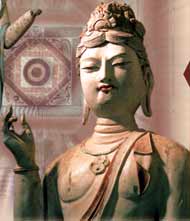
During the Northern Wei Dynasty founded by the Turkic-speaking Toba tribe, pilgrims restarted to hewing grottoes after the preceding years of turmoil, to depict their ideal heavenly world which contrasted with their painful material world. Forty of the Northern Wei caves remain today. Shades of Indian Buddhism still can be seen from the clothing, hair and facial features of Buddhas. The finely chiseled sculptures in the Wei caves show large heads, wide faces, large noses, thin lips, high cheekbones and curly hair, with slim and ethereal figures. The females are high breasted. The Buddhas, bodhisattvas and disciples are quite and serene, in strong contrast with the aggressive and fierce devils. The Wei paintings often depict the patrons who paid for cutting caves, as servants of the Buddhas or as supplicants, usually small in size.


During the short Sui Dynasty, the Mogao Caves continued to boom and mark the end of the foreign influence, slowly transitioning to the more indigenous styles of central China. There are now 78 Sui caves left. The statues produced during the Sui Dynasty are mostly in good condition and more formal than the Wei statues.The Sui style shows statues with fuller faces, longer earlobes, loosely draped clothing and disproportionate upper bodies. Jataka stories are still the main theme while more varied subjects appear. The feitian, or asparas, become more pretty and elegant. Lotus flowers and other symmetrical patterns are frequently used as decorations on the ceilings.

The grottoes of Tang Dynasty represent the most splendid period of the caves, reflecting the highest level of artistic achievement. Today, 220 of the Tang caves remain. Most of the caves are square and have three levels to lodge bigger sculptures which were artistically brilliant, gentle and realistic.

The Buddhas became more like men, wearing ornaments and jewels and dressed like Tang nobles. The images of patrons became bigger and tended to occupy important places in the murals. The themes of the murals focused more on Buddhist scripture stories instead of jataka stories. This Dynasty introduced scenes of cruising aristocrats.

During the Five Dynasties, there was no space left on the cliff, so some caves were enlarged or repainted. As a result, old paintings are now being discovered lying under new ones. Discovering the hidden caves has been the main legacy left by this Dynasty.

Many caves were restored during the Yuan Dynasty. The murals depict various Indian mandalas and bodhisattvas. Some caves were decorated in Tibetan style. After the Mongol reign, there was no artistic development. In the Ming Dynasty, Dunhuang was once abandoned, and the caves gradually faded into the sand of the Gobi desert until a Taoist priest discovered the treasure house in beginning of the 19th century.

The Hukou Waterfalls

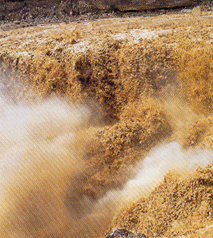
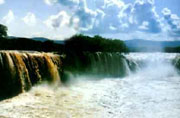
The Hukou Water falls of the Yellow River is the only Yellow Waterfall on earth. The river narrows and cascades dramatically into a stone pond more than 30 metres below, creating the famous Hukou Waterfalls The gentle water turbulent and gains speed as it rushed forward till it finally cascades over the waterfall, forming an illusion of water being poured from a kettle, hence its name "Hukou or Kettle spout" Like thousands of tumbling dragons or enraged animals that have just been set free, the yellow waterplunged down, the pounding against the stones echoes like thunder. The most dramatic changes occur during deep winter and early spring when the river surface becomes frozen. Sometimes, the subsidiary falls freeze into icicles, creating images of crouching beast on top of the cliffs.

The Longmen Grottoes

The world-famous Longmen Grottoes are located 12km south of Luoyang. Here two mountains, namely, East Hill (Mt. Xiangshan) and West Hill (Mt. Longmen), confront each other with the Yi River traversing northward between them, just like a pair of Chinese gate towers. So during the Zhou and Qin dynasties, it was called "Yi Que" (Gate of Yi River). Later, when the Sui established its capital city in Luoyang, the palace gate was just facing Yi Que, hence the name "Longmen" which means "Dragon Gate".

Spanning a length of over 1,000 meters on the hillsides along the Yi River, the Longmen Grottoes, together with the Mogao Caves in Dunhuang (Gansu Province) and the Yungang Grottoes (Shanxi Province), are reputed as the three greatest stone sculpture treasure houses in China. In the year 2000, Longmen Grottoes was listed by UNESCO as a World Cultural Heritage Site.

The Longmen Grottoes were first sculptured and chiseled around 493AD when the capital of the Northern Wei Dynasty (386-534) was moved from Datong to Luoyang. The entire construction of Longmen Grottoes lasted more than four hundred years through the Northern Dynasties, Sui Dynasty, Tang Dynasty and up to Song Dynasty. Today, there are still 2345 caves and niches, 100,000 Buddhist images ranging in size from 2 cm to 17.14 meters, more than 2800 inscribed tablets, and 43 Buddhist pagodas remaining in both East Hill and West Hill. Altogether 30 % date from Northern Wei Dynasty, 60 % from Tang Dynasty and the rest 10 % from other periods.

Masterpieces of Longmen Grottoes

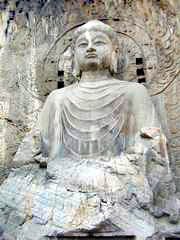
Fengxian Temple Stretching along the precipitous cliff of the southern side of West Hill, Fengxian Temple, also named Grand Vairocana Buddha Niche, is the largest cave in Longmen. Measuring 35 meters in width and 39 meters in length, this cave was carved over 1300 years ago (from 672 to 675 AD) during the Tang Dynasty. When it was first constructed, the entire grotto was covered with a roof and enclosed from the natural elements. Today the roof is missing and the sculptures stand out in the open air.The most extraordinary statue in Fengxian Temple is the Grand Vairocana Buddha, which is 17.14 meters tall with his head 4 meters long and his ear 1.9 meters wide. Sitting in the middle of the niche, this colossal Buddha shows a perfect combination of moral integrity, delicate emotions, broad mind and elegant semblance. Her lips are slightly upturned and her head a little bit lowered, a slight smile makes her look like a sagacious and benign middle-aged woman whom you would respect but not fear.

Guyang Cave Guyang Cave, sculpted between 495 and 575 AD, is regarded as the earliest of the Longmen Grottoes. Based on a natural limestone cave, this cave is the most important cave in the series and represents the highest skill of carving, rock painting, and architecture of the Northern Wei.

Lianhua Cave This cave was so named because there is a large and beautiful lotus flower on its ceiling.
This cave was dug out about 527 AD in the late period of the Northern Wei Dynasty. A statue of Sakyamuni, as the chief Buddha, is enshrined in this cave. Adopting a standing position, this statue is 5.1 meters high and has the face and one forearm showing damage.In this cave there are also numerous niches decorated with fine carvings of colorful strings, clouds, lotus flowers, geometrical patterns etc. Upon the cave ceiling there is a large lotus flower surrounded by figures of Apsaras in relief, which are slim, graceful and vivid. This cave is named in honor of this lovely flower.

The Yungang Caves

The Yungang Caves are located approximately sixteen kilometres west of Datong in Shanxi Province and consists of a series of 53 caves. The caves are home to over 51, 000 stone sculptures that were completed during the Northern Wei Dynasty (460 -494 AD). The grottoes extend one kilometre from east to west and can be classified into three major categories.

The first group consisting of Caves 1, 2, 3 and 4 are at the eastern end separate from others. Cave 1 and Cave 2 have suffered from the rigors of time and being exposed to the elements. Cave 3, is an addition added after the Northern Wei Dynasty and is the largest grotto among Yungang caves.


The second group of caves, 5 threw to 13 is where your tour normally begins.
The grandeur of Yungang art is very noticeable, particularly in this group of caves.

Cave 5 contains a seated Buddha with a height of 17 meters.
In Cave 6, standing in the centre of chamber is a 15-meter-high two-story pagoda pillar. Carvings in the pagoda walls and the sides of the cave illustrate the life of the Buddha from his birth to his attainment of nirvana.

The Bodhisattva is engraved in Cave 7.

In Yungang Cave 8 is an extremely rare statue of Shiva seen with eight arms and four heads and riding on a bull. Cave 9 and Cave 10 are notable for it's front pillars and figures bearing musical instruments.Musicians playing instruments also appear in Cave 12.Cave 11 has a square pagoda-pillar in its centre reaching to the roof. On its four sides are carved images of Buddha.
Cave 13 has the Buddha statue with a giant figurine supported its right arm.

The rest caves belong to the third group. Cave 14 has eroded severely. Cave 15 is named as the Cave of Ten Thousand Buddhas.

Caves numbering 16 to Cave 20 are the oldest in this complexes and each one symbolizes an emperor from the Northern Wei Dynasty and is were the subject of "Emperor is the Buddha" is embodied. The caves from No. 21 onward are built in the later times and cannot compare to their better-preserved counterparts.

The Huangguoshu Waterfall

The Huangguoshu waterfall, one of the largest in China, is situated over the Baishui River, one of the headstreams of the Dabang River in the Zhenning Bouyei-Miao Autonomous County southwest of Guizhou. As part of the Yunnan-Guizhou Plateau, the terrain is carved by the mountains into many canyons, rapids and waterfalls. The bed of the Baishui River is like a staircase descending step by step, forming nine falls at each step, of which the Huangguoshu waterfall is the largest. The Huangguoshu Waterfall is 20 meters wide, sometimes as wide as 30-40 meters in the summer rainy season. Its pothole, pounded into existence by the falling waters in long years is called the Rhinoceros Pool. As the roaring river pours down from a height of 57 meters, it sends up myriads of sprays 100 meters high, which glitter like rainbows in the sunlight. The rapids here provide wide prospects for developing the rich power potential.

Diaoshuilou Waterfall

The Diaoshuilou waterfall is situated near the outlets of Jingbo Lake southwest of Ningan County in the upper reaches of the Mudanjiang River in southeastern Heilongjiang River. Jingbo Lake was formed by the upriver waters of the Mudanjiang River as they were blocked from flowing down by the basaltic lava from volcanic eruptions. As the lake water floods over its two outlets in the north. it leaps down in two columns, each falling 20-25 meters in width of 40-45 meters. The roar of the waters as they pound at the plunge pools below can be heard kilometers away. The hydropower station built at the waterfall site is one of the largest of its kind in china.

Maijishan Grottoes

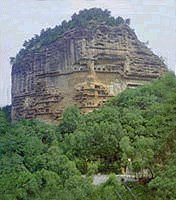
Maijishan ("Wheatstack Mountain"), located on the northern side of the Qinling Mountain Range and at a height of 1742m above sea level, gets it's name from its giant, haystack-like shape. The mountain's fame arises not just from its appearance, but from the many Buddhist caves that are gouged into its southwestern face. This is the fourth largest area of concentrated Buddhist grottoes in China, after Dunhuang, Datong and Luoyang. The area around and on the mountain is one of the most beautiful sights in Gansu for both stunning natural, and impressive man-made, scenery. The mountain, studded with caves and strapped by many winding walkways and spiral stairs, rises majestically from the surrounding heavily wooded slopes, so any visitor here with a bit of time on their hands could easily spend a few days hiking and admiring.

It is the Buddhist Grottoes (Maijishan shiku), some dated from as early as the Northern Wei Dynasty (386-534 AD), that most visitors come here to see. On arrival at the sight the most prominent sculpture is the 16m Buddha that is carved high up on the mountain. The grottoes, all packed together on the sheer, rocky cliff faces below and above this, look from afar like chambers of a gargantuan beehive. On ascending the mountain, the grottoes are divided into two sections, the western and eastern, since the central section was almost completely destroyed by an eighth century earthquake. The western section is probably the better, with statues and other Buddhist articles dating mainly from the Northern Wei Dynasty to the Tang (618-907 AD). Just ascending the mountain, on winding, rickety walkways and spiral stairs, with the wooded mountain panorama below, is a breath of fresh air for even the most unconvinced China traveler.

The area itself should be proud of its statistics! After centuries of renovation, expansion, partial destruction and then restoration, the grottoes that you can see today still number an impressive 194. Within these can be found over 7,800 pieces of clay sculptures and stone carvings, and murals with an aggregate area of over one thousand square meters. The stone sculptures that can be seen within the caves are of rock that had to be imported to the mountain, since the local rock was of too soft a consistency. The clay sculptures, reflecting the rich styles of high-ranking daily life, mainly portray two distinct eras: the Northern Dynasties (386-581 AD) characterized by slim figures and the Sui and Tang Dynasties (581-907 AD) featuring plumper ones. The only problem with the grottoes are that they are all locked up and, unless you have brought a guide to open them up, you will have to make do with the limited lighting that the barred entrance affords. For those on a budget this is not such a bad option, since some of them are lit not too badly and the views away from the mountain are worthwhile in themselves. Guides, however, can be bought to open them.

The Grottoes are not the end of a comprehensive trip here. 15m above the giant clay Buddha, on the eastern slope, is the Seven Buddha Pavilion (Qifo ge), a typical Han Dynasty (206 BC-220 AD) construction of interesting architectural value. Recent years have also witnessed the opening of a few of the dilapidated temples around the mountain making the area good for hiking. The best place for such activity is in the Botanical Garden. This is situated in front of the mountain, reached by taking stairs to the right, down the road before the grottoes' ticket office.

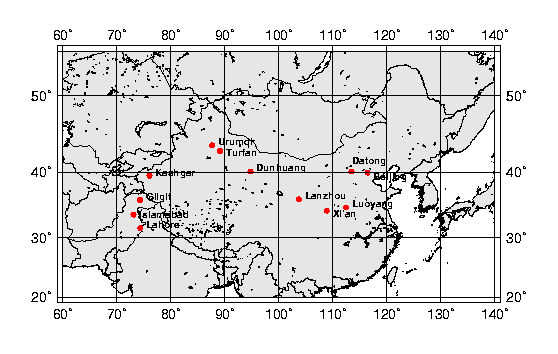
The silk road

The region separating China from Europe and Western Asia is not the most hospitable in the world. Much of it is taken up by the Taklimakan desert, one of the most hostile environments on our planet. There is very little vegetation, and almost no rainfall; sandstorms are very common, and have claimed the lives of countless people. The locals have a very great respect for this `Land of Death'; few travellers in the past have had anything good to say about it. It covers a vast area, through which few roads pass; caravans throughout history have skirted its edges, from one isolated oasis to the next. The climate is harsh; in the summer the daytime temperatures are in the 40's, with temperatures greater than 50 degrees Celsius measured not infrequently in the sub-sealevel basin of Turfan. In winter the temperatures dip below minus 20 degrees. Temperatures soar in the sun, but drop very rapidly at dusk. Sand storms here are very common, and particularly dangerous due to the strength of the winds and the nature of the surface. Unlike the Gobi desert, where there there are a relatively large number of oases, and water can be found not too far below the surface, the Taklimakan has much sparser resources.
The land surrounding the Taklimakan is equally hostile. To the northeast lies the Gobi desert, almost as harsh in climate as the Taklimakan itself; on the remaining three sides lie some of the highest mountains in the world. To the South are the Himalaya, Karakorum and Kunlun ranges, which provide an effective barrier separating Central Asia from the Indian sub-continent. Only a few icy passes cross these ranges, and they are some of the most difficult in the world; they are mostly over 5000 metres in altitude, and are dangerously narrow, with precipitous drops into deep ravines. To the north and west lie the Tianshan and Pamir ranges; though greener and less high, the passes crossing these have still provided more than enough problems for the travellers of the past. Approaching the area from the east, the least difficult entry is along the `Gansu Corridor', a relatively fertile strip running along the base of the Qilian mountains, separating the great Mongolian plateau and the Gobi from the Tibetan High Plateau. Coming from the west or south, the only way in is over the passes.

Tags