Showing posts with label Tibet. Show all posts

Sunday, October 01, 2006

Tibet

Tibet lies on the Qinghai-Tibet Plateau of the southwest border of China. The average height of the whole region is more than 4,000 meters above sea level, for which Tibet is known as "Roof of the World". The highest peak of Tibet, also the highest in Himalayas and in the whole world, is Everest Peak, which is as high as 8,846.27 meters above sea level.

Although a part of China, Tibet has a unique culture of all there own. It is mainly inhabited by Tibetans, a minority nationality of old and mysterious people. Tourist attractions include the Potala Palace in Lhasa, Jokhang Temple, and a number of Buddhist sacred places.

Tibet (Xi Zang in Chinese) is to the south of Xin Jiang Uygur Autonomous Region and Qing Hai Province, to the west of Sichuan, to the northwest of Yunnan and to the north of India and Nepal. Its population of 2.3 million people come from a variety of ethnic groups including Tibetan, Han, Monba and Lhota. Its capital city is Lhasa.

Northwest Tibet, mainly Qing Hai plateau, is home to a variety of unusual and unique animals. Across the northern expanse of Tibet, you can see vast grasslands where horses, cattle and sheep roam freely. The world's lowest valley, the Grand Yarlun-tzanpo River Valley lies in east Tibet.

Nearly all Tibetans follow Tibetan Buddhism, known as Lamaism, with the exception of approximately 2,000 followers of Islam and 600 of Catholicism. Tibetan Buddhism was greatly influenced by Indian Buddhism in its early time, but after years of evolution, Tibetan Buddhism has developed its own distinctive qualities and practices. A well-known example is the belief that there is a Living Buddha, who is the reincarnation of the first, a belief alien to Chinese Buddhism.

It is freezing cold in most time of the year. Most tourists come to visit Tibet only in the warmest seasons, June, July, August and early September.

Recommended Scenic Spots

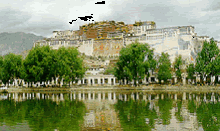
Potala Palace

In 641, after marrying Princess Wencheng, Songtsen Gampo decided to build a grand palace to accommodate her and let his descendants remember the event. However, the original palace was destroyed due to a lightening strike and succeeding warfare during Landama's reign. In seventeenth century under the reign of the Fifth Dalai Lama, Potala was rebuilt. The Thirteenth Dalai Lama expanded it to today's scale. The monastery-like palace, reclining against and capping Red Hill, was the religious and political center of old Tibet and the winter palace of Dalai Lamas. The palace is more than 117 meters (384 feet) in height and 360 (1180 feet) in width, occupying a building space of 90 thousand square meters. Potala is composed of White Palace and Red palace. The former is for secular use while the later is for religious.
Jokhang Temple

Jokhang Temple has been a place of pilgrimage for centuries. It is the spiritual center of Lhasa and stands in the heart of the old city. It was built in 647AD by King Songtsen Gampo, upon establishing his kingdom's capital in Lhasa. Through several renovations it expanded into quite a large group of buildings and now covers an area of over 25,000 sq meters.

Jokhang has 4 stories and its roofs are covered with gilded bronze tiles. It was built in the style of Tang dynasty structures and adopted the characteristics of Nepalese and Indian architecture.

There are numerous elaborately decorated shrines and rooms at Jokhang. There are also statues of King Songtsan Gambo together with his Chinese bride Princess Wen Cheng and Nepalese bride Princess Chizun in the side halls. In the center of the main hall, a gold statue of the young Buddha Sakyamuni, brought to Tibet by Princess Wen Cheng from Chang'an (present Xian) is enshrined.

Saturday, September 30, 2006

Tibetan Festivals

Tibetan New Year (February or March)

It is the greatest festival in Tibet. In ancient times when the peach tree was in blossom, it was considered as the starting of a new year. Since the systematization of the Tibetan calendar in 1027 AD., the first day of the first month became fixed as the new year. On the New Year's day, families unite " auspicious dipper" is offered and the auspicious words " tashi delek" are greeted.

Butter Oil Lantern Festival (February or March)

It's held on the 15th of the first lunar month. Huge yak-butter sculptures are placed around Lhasa's Barkhor circuit.

Saga Dawa Festival (May or June)

It is the holiest in Tibet, there memorable occasions coincide on this day, Buddha's birth and Buddha's enlightenment. Almost every person within Lhasa join in circumambulations round the city and spend their late afternoon on picnic at " Dzongyab Lukhang" park at the foot of Potala.

Gyantse Horse Race & Archery (May or June)

Horse race and archert are generally popular in Tibet, andGyantse enjoys prestige of being the earliest in history by starting in 1408. Contests in early times included horse race, archery, and shooting on gallop followed by a few days' entertainment or picnicing. Presently, ball games, track and field events, folk songs and dances, barter trade are in addition to the above.Tibetan Festivals

Tibetan Culture and Entertainment

Horse Racing
According to historic documents, the forefathers of Huanglong were cavalrymen of the East Tibetan Army during the Tibetan reign in China, who loved the adventurous and powerful horse racing.
The third day of the Tibetan lunar January, all the villages become lively where people wear new clothes waiting at the open and flat horseracing ground surrounded by green grasses. The horse racers are outstanding young people who like to crowd at any horseracing place whereve r it happens.

Wrestling
Tibetan wrestling is similar to that of Mongolia, but with some of its own features. The wrestlers are ruled to use hands only, instead of feet or tricks.

Xuanzi Dance
Also called "Xie", it is danced in accompaniment of an ox-horn instrument, and originates from
Batang in Ganzi Prefecture of beautiful scenery and moderate weather. When dancing, the girls wear a long-sleeved silk gown called "Xiazhi" which is pronounced in a partial tone like "Xie". Movements of Xuanzi Dance are gentle and implicit, seemingly expressing a longing for love and Nature. The song is made of 4 sentences each of 6 words, in precise and flowery styles.

Tap Dance
Developed on the basis of Ali Tibetan Dance, it assimilates the British Tap Dance, in an exquisite style. The top dancer can dance with a bowel full of water on her head. People improve this dance and make it natural, poised and overflowed with enthusiasm.

Guozhuang Dance
Originating from the ceremony to celebrate the victorious hunting or crop harvesting, it is an entertainment activity of Tibetan and Qiang nationalities to express gratification of a happy life. It also serves as a God-pleasing or sacrificial activity.
The Guozhuang dance of Huanglong has two kinds: Qiang Guozhuang and Tibetan Guozhaung, both are danced almost in the same way, except the steps. The steps of Qiang Guozhuang are complicated, somewhat similar to disco.

Flowery Lanterns of Hui Nationality
On big occasions, Hui people go on streets with lanterns, flowers, colored ribbons, and they dance lively with these objects, attracting many spectators.Tibetan Culture and Entertainment

Tibet Geography

Tibet, a rich and beautiful land, is located at the main part of Qinghai-Tibet plateau, south-West frontier of China. Tibet borders with Sichuan, Yuannan, Qinghai And Xinjiang; to the south contiguous to India, Nepal, Sikkim, Bhutan and Burma, and bounded by Kashmir on the west.

When the word Tibet is mentioned something icy chils the readers' nerves. In fact it snows only once or twice in a year and owing to the perpetuity of bright sunshine, it is not at all cold during the daytime even in the coldest of the winter. Tibet is so sunny that it produces a year-round sunshine of over 3,000 hours in a year. Its old name-"land of snow" - the name by which Tibet is almost popilary known as, is always thickly covered with snow with hardly any signs Of inhabitation. In fact, it is correct only when it is referred to the world greatest ranges located in Ima, the Tisi, and like. These ranges, run by leaps and bounds across the country showing their beautiful snow covered peaks against the bluest of skies.

Geographically, Tibet can be divided into three majoy parts, the east, north and south. The eastern part is forest region, occupying approximately one-fourth of the land. Virgin forests run The entire breadth and length of this part of Tibet. The northern part is open grassland, where nomads and yak and sheep dwell here. This part occupies approximately half of Tibet. The southern and central part is agricultural region, occupying about one-fourth of Tibet's land area. with all major Tibetan cities and towns such as Lhasa, Shigatse, Gyantse ad Tsetang located in this area, it is considered the cultural center of tibet. The total area of the Tibet Autonomous Region is 1,200,000 square kilometers and its population is 1,890,000. The region is administratively divided into one municipality and six prefectures. The municipality is Lhasa, while the six prefectures are Shigatse, Ngari, Lhaoka, Chamdo, Nakchu and Nyingtri(kongpo). The People's Government of the Tibet Autonomous Region exercises the hightest adminis-trative authority in Tibet.link

The Artistry of Tibetan Folk Songs

Tibetan folk songs, in common with folk songs of other nationalities, share a popular use of mood, imagery, metaphor and simple language. But Tibetan folk songs are unique in their form of expression and description. Here we will examine five characteristic rhetorical devices commonly employed in the songs.

Figurative expressions are widely used in Tibetan folk songs, adding a vivid touch by describing the nature of one thing in terms of another. For example.

Blame not the tree for being felled,

Blame not the bird for being left nestles;

For the tree has been cut to the root

By the powerful noble we fear.

Here, “tree” and “bird” act as metaphors for two youngsters in love, hence the “powerful noble’s” cutting down of the tree is the cause of their separation.

Tibetan folk songs use things with familiar characteristics to express abstract concepts such as feelings or the inner nature of people. Popular analogies are taken from the nature of environment, e. g. flowers , grass, trees, birds, animals, the sun, moon and stars, mountains, rivers and lakes, wind, rain and lightning, and sometimes gods, demons and spirits from the supernatural word. The Tsangpo River, Kampala Pass, Lake Yamdok Tso, and the goddess Tara and Princess Wencheng also often occur in folk songs, and are closely related to the lives of the Tibetans. Vivid analogies make the songs more appealing, easier to remember and thus easier to spread.

More rhetoric devices are applied in Tibetan folk songs by means of “open analogy,” “hidden analogy” and “borrowed analogy.”

In open analogies the actual object and analogical object are clearly distinguished by the use of formal comparison. For example:

The life of a maiden

Is like an early spring blossom;

Before it is offered up at the altar,

It is spoiled by snowflakes.

In a hidden analogy the actual object and analogy both appear but there is no formal comparison. This kind of metaphor has a greater effect on the imagination. For example:

By bringing the game to bay

The hunter shoots innocent beasts;

By bringing the tenants to bay

The noble robs innocent people.

The borrowed analogy consists solely of the analogy used as a substitute for the actual object. For example, in the song Hope the Clouds Will Gather For Rain the terms “rain”, “mist,” “heavy snow” and “willow catkin” all stand for beloved ones and enemies. This device requires effort on the part of the listener to deduce the actual object, and is thus more powerful.

In Tibetan folk songs,, such rhetoric device as substitution is used in a way that animate or inanimate objects are substituted for a human subject. This makes for vivid, revealing language. Note its vivid use in these two verses:

If I were a fish in the river,

I’d twist in the same stylish way;

But I’m only a bird in a cage

Unable to soar free with the flock.

The vultures at the sight of a corpse

Forget their rocky mountain eyras,

But as ninth approaches

They return to the rocky mountains.

Here these striking substitutions express the feeling of the author and deeply affect audiences. In Tibetan folk songs, substitution is customarily used when expressing inner feelings.

Known as “exaggeration ornament” in Tibetan rhetoric, hyperbole is a commonly used device in Tibetan folk songs. Its application should have a solid foundation in fact, when it creates a vivid effect. An example is :

O you are fairer than goddess,

But your gruel is thinner than water;

You have no need of a mirror,

For your face is reflected in your gruel.

Where the woman’s beauty and the meagerness of her gruel are described using hyperbole. The exaggeration is couched in simple and straightforward language which serves to highlight the device.

Known as “explanatory ornament” in Tibetan rhetoric, using puns as a way to express meaning on two levels, literally and figuratively. Take these verses for example:

The flavorsome nettles of spring

Are sought after but elusive;

The stinging nettles of autumn

Are everywhere but shunned.

Think not that the raspberry

Bears no berry;

Is not today’s white blossom

Tomorrow’s berry?

In the first song the “nettle” also has the meaning of “love.” It is a warning to young people not to be too disdainful otherwise the day will come when nobody will want them and their attempts to gain attention will meet with rebuff. In the second verse, the discussion of the raspberry concludes with a philosophical truth: we should be aware of innate capacity for change as well as external appearance. This kind of aphorism offers much food for thought to the audiences.

Language is of vital importance in any discussion of Tibetan folk songs. The characteristics of the language used in these songs can be summarized in two words: simple and clear. Most folk songs are vividly worded, yet simple and straightforward. Avoiding fanciful phrasing and a plethora of facts, the song becomes a lively work of art. Note how these few, simple words sketch a vivid, if rather nauseating, picture:

A nice fat corpse

Draws vultures in flocks,

When only bones remain

The vultures fly away.

Molded by Tibetan history, the natural environment and conditions of life, the characteristic language of Tibetan folk songs comes from the hearts of the people, and in the process of oral and written transmission have been honed to perfection. This song was sung by a serf on a curve arrange:

As the evening twilight fills the sky,

And the owls come out from rocky mountains,

How I long for the smoky fire of home,

With mother waiting by the cozy hearth.

The words describe not only the pitiful scene of the serf on his errand of forced labor but also his misery. Audiences would sympathy not only with the serf’s situation but also with his forlorn mother left alone by the fireside. This talent for sketching a scene redolent with meaning in plain and simple words is by no means a rarity among the folk songs of Tibet.

Tags