Showing posts with label Travel. Show all posts

Saturday, October 21, 2006

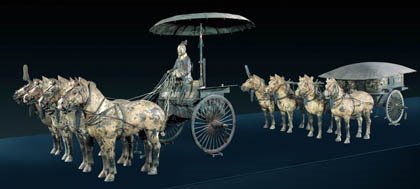
The Terracotta Army Of Emperor Qin's Mausoleum(秦始皇兵马俑)

 xi'an, once the capital of eleven chinese dynasties, is famous throughout the world for life-sized terra-cotta warriors and horses. they have won fame as one of the greatest archaeological finds of this century. back in 1974, while digging a well to fight drought, some farmers from lintong county, about thirty kilometers east of xi'an, unearthed some brown pottery fragments, which led to the great discovery of the executed terra-cotta legions as an exterior section of the mausoleum, of qin shi huang or first emperor of the qin dynasty (255-210b. c.)

  details of qin shi huang's tomb can be traced in the historical records (compiled by sima qian) and legends about it have been widespread. however, for technical reasons, the major part of the tomb remains unexcavated today with its mound still standing 76 meters high against the slopes of mt. lishan and facing the huishui river.

  after 20 years of careful excavation three underground vaults officially opened to the public in 1979, 1989, and 1994 respectively, displaying thousands of terra-cotta warriors, horses and chariots, all arranged in battle formations.

秦始皇兵马俑博物馆网站制作


  vault 1, built with earth and timber, measures 210 meters long, 60 meters wide and 4.6 to 6.5 meters high. in this area of 12, 600 square meters, six thousand life-sized warriors and horses of terra-cotta were found in rectangular battle formation. the troops were of a fairly uniform height of 1.8 meters. they wear helmets and armor and carry real bows and arrows, swords, lances, javelins and crossbows in their hands. each chariot, made of wood, is drawn by a team of four horses, 1. 5 meters in height. three rows of infantrymen make up the vanguard of the formation, and these are followed by the main body of the army, 38 rows of troops. there are also flank columns and rearguards. the array breathes the power of qin shi huang's army.

  vault 2 is approximately one half vault i in size, housing nearly a thousand pottery warriors. compared with vault 1, these warriors are of a larger variety and arranged in more complex battle array. unlike vault 1, the war chariots and infantrymen are arranged separately in four square formations which are linked to one another in a polygon. again, however, the warriors carry real weapons. the projecting part of the polygon consists of archers, either standing or kneeling, with crossbows or handbows and quivers and so appears to be the vanguard of the phalanx.

  the archers are followed by a unit of cavalrymen to the left and one of chariots to the right, forming the two wings of the phalanx. infantrymen and war chariots bring up the rear. each chariot drawn by four horses has1l driver and two assistants, one on either side. the charioteers are armored and carry spears, swords and crossbows, indicating that they could engage in long-range battles, short-range fighting and hand-to-hand combat. all the cavalrymen carry crossbows, a sign that shooting on horseback was a common practice in the army at that time.

  from among the chariots a robust and unusually tall figure at 1. 95 meters has been unearthed. his armor is interlinked and overlapped with finer metal pieces than that of the common soldiers, and he is believed to be a high-ranking commander of the 1egion.

  vault 3 is a modest building more resembling a gallery. it has 69 pottery warriors with defensive weapons and a wooden chariot pulled by four magnificent horses. the structure of the gallery and the line-up of the soldiers suggest that this was likely the headquarters of the troops of vault 1 and 2.

  however, the commander is missing. many archaeologists believe that since the underground army represents the emperor's garrison under his direct command, no marshal was necessary.

  altogether ten thousand pieces of actual weaponry have been unearthed from the three vaults, including arrow-heads, swords, spears and halberds. two long-handled swords dug out recently are still sharp and gleaming despite their burial for more than two thousand years. some bronze arrow-heads from vault 2 are 41 cm in length and 100 grams in weight. they are the biggest bronze weapons excavated in china. important to the study of qin technology was the discovery of bronze arrow-heads and swords treated with a preservative that has prevented erosion for 22 centuries. chemical analysis revealed the sword to have been cast of an alloy of copper, tin and various other elements, including nickel, magnesium, and cobalt. the arrow-heads which contain 7.71 percent lead are considered by archaeologists to be the world's most poisonous.

  experts expect future discoveries to unearth even more amazing art treasures. but they warn that it may require the efforts of one or two generations to recover the entire tomb complex of emperor qin shi huang.

  the three vaults are well preserved in three modern constructions, each with an arched dome and a corridor along the side of the vault so that visitors may overlook the restored figures of warriors, horses and chariots in their original formations. vault 2 is equipped with devices for regulating temperature, lighting and air humidity.

俑是我国传统雕塑艺术中特有的一个类型。秦始皇兵马俑是20 世纪70年代中期发现的。1974年3月,陕西省临潼县宴寨公社西场大队的社员们在骊山秦始皇陵东面约1.5公里的地方打井抗旱,忽然从井中挖出了大小与真人一样、形象逼真的陶俑。他们将此事报告了陕西省文物管理部门,陕西省文物管理局闻讯后立即派人赶赴现场,组织力量进行调查。经考古勘控发掘,竟然发现了一个面积超过1200平方米、埋藏有6000余个兵马俑的大坑,考古学家称为“1号俑坑”。坑中的6000余个兵马俑与真人、真马大小相仿。陶人高约 1.8米,陶马高约1.5米、长2米,形象栩栩如生,容貌各异,排列成以步兵为主,战车相间的长方形军隈。东端有三列横队,每队70人;西部各有一列向外的侧翼。坑中的俑全部是面向东方排列,间有四马一车的38路纵队。步兵簇拥着驷马战车,排列成军阵。看上去威武雄壮,浩浩如烟海荡荡。马俑的制作也相当精致,兵马、战车等制造结构复杂,工艺技术高超,令观者惊叹不已。此外,坑中出土的兵器,埋藏地下2000多年还不锈蚀,将上面的泥土擦拭后,仍然崭新锃亮。从兵马俑坑出土的文物来看,可以窥见秦朝军队素质之高、武器之良,具有很强的作战能力。随后,又在1号坑附近发现了2号坑和3号坑。2号坑从1994 年3月开始挖掘,经密集钻探和部分试掘,也已摸清地下内部基本情况。2号坑面积约6000平方米,分四个单元:由跪射式和立射式弩兵组成的方阵,驷马战车方阵,车、步兵、骑兵俑组成的混合方阵等。四个小阵有机结合,呈现出一幅古代军阵的生动图谱。根据试掘推算,2号坑内藏陶俑、陶马2300多件,战车80 多辆。据初步勘察,3个坑联系在一起,面积达20000多平方米,约有兵马俑8000个以上。在地下驻有一个师以上的军队,这在世界上是绝无仅有的。这一发现向全世界展示了我们中华民族的聪明才智,被世界学术界誉为“世界第八达奇迹”。法国一位前总理目睹了秦始皇兵马俑后惊叹道:“秦俑坑是世界上的奇迹,不看金字塔不算真正到过埃及,不看秦俑也不算真正到过中国。“国家为了更好的保护这些中国历史上的文化瑰宝,在这里建起了秦始皇兵马俑博物馆。

Thursday, October 19, 2006

potala palace 布达拉宫


in 641, after marrying princess wencheng, songtsen gampo decided to build a grand palace to accommodate her and let his descendants remember the event. however, the original palace was destroyed due to a lightening strike and succeeding warfare during landama's reign. in seventeenth century under the reign of the fifth dalai lama, potala was rebuilt. the thirteenth dalai lama expanded it to today's scale. the monastery-like palace, reclining against and capping red hill, was the religious and political center of old tibet and the winter palace of dalai lamas. the palace is more than 117 meters (384 feet) in height and 360 (1180 feet) in width, occupying a building space of 90 thousand square meters. potala is composed of white palace and red palace. the former is for secular use while the later is for religious.

  the white palace consists of offices, dormitories, a buddhist official seminary and a printing house. from the east entrance of the palace, painted with images of four heavenly kings, a broad corridor upwards leads to deyang shar courtyard, which used to be where dalai lamas watched operas. around the large and open courtyard, there used to be a seminary and dormitories. west of the courtyard is the white palace. there are three ladder stairs reaching inside of it, however, the central one was reserved for only dalai lamas and central government magistrates dispatched to tibet. in the first hallway, there are huge murals describing the construction of potala palace and jokhang temple and the procession of princess wencheng reaching tibet. on the south wall, visitors will see an edict signed with the great fifth's handprint. the white palace mainly serves as the political headquarter and dalai lamas' living quarters. the west chamber of sunshine and the east chamber of sunshine lie as the roof of the white palace. they belonged to the thirteenth dalai lama and the fourteenth dalai lama respectively. beneath the east chamber of sunshine is the largest hall in the white palace, where dalai lamas ascended throne and ruled tibet.

  the red palace was constructed after the death of the fifth dalai lama. the center of the complicated red palace is the great west hall, which records the great fifth dalai lama's life by its fine murals. the scene of his visit to emperor shunzhi in beijing in 1652 is extraordinarily vivid. it also has finely carved columns and brackets. the hall has four additional chapels. the west chapel houses three gold stupas of the fifth, tenth and twelfth dalai lamas'. their mummified and perfumed bodies are well kept in those stupas. among the three, the fifth dalai lama's stupa is the biggest, which is made of sandalwood, wrapped in gold foil and decorated with thousands of diamonds, pearls, agates and others gems. the stupa, with a height of 14.86 meters (49 feet), spends more than 3,700 kilograms of gold. the north chapel contains statues of sakyamuni, dalai lamas and medicine buddha, and stupas of the eighth, ninth and eleventh dalai lamas. against the wall is tanjur (beijing edition), a most important tibetan buddhist sutra sent to the seventh dalai lama by emperor yongzheng. in the east chapel a two meters (6.5 feet) high statue of tsong khapa, the founder of gelugpa which is dalai lama's lineage, is enshrined and worshipped. in addition, about 70 famous adepts in tibetan buddhism surround him. the south chapel is where a silver statue of padmasambhava and 8 bronze statues of his reincarnations are enshrined. on the floor above, there is a gallery which has a collection of 698 murals, portraying buddhas, bodhisattvas, dalai lamas and great adepts and narrating jataka stories and significant tibetan historic events. west of the great west hall locates the thirteenth dalai lama's stupa hall. since he was regarded as great as the great fifth, people started to build his stupa after his death in the fall of 1933. taking three years, the stupa is comparable with the great fifth's stupa. it is 14 meters (46 feet) in height, coated with a ton (2200 pounds) of gold foils. in front of it is a mandala made of more than 200,000 pearls and other gems. murals in the hall tell important events in his life, including his visit with emperor guangxu. the highest hall of potala was built in 1690. it used to be the holy shrine of chinese emperors. dalai lamas would come here with his officials and high lamas to show their respects to the central government annually before.

  dharma cave and the saint's chapel are the only structures left which were built in seventh century. they both lie central of the red palace. dharma cave is said to be the place where king songtsen gampo proceeded his religious cultivation. inside the cave, statues of songtsen gampo, princess wencheng, princess tritsun and his chief ministers are enshrined. in the saint's chapel above dharma cave, chenrezi, tsong khapa, padmasambhava, the fifth, seventh, eighth and ninth dalai lamas are enshrined and worshipped. visitors may find a stone with a footprint that was believed left by the infant twelfth dalai lama.

  notes:

  1. potala palace 布达拉宫

  2. princess wencheng 文成公主

  3. songtsen gampo 松赞干布

  4. white palace 白宫

  5. red palace 红宫
Google Maps,Google Maps coordinate,Only show at Item-Page.


布达拉宫是一座融宫堡和寺院于一体的古建筑群,始建于公元七世纪四十年代松蕃王朝松赞干布时期,距今已有一千三百多年历史。它座落在西藏自治区首府拉萨市中心、古城西北约2公里的玛布山(红山)上,最高处海拔3767.19米,是世界上海拔最高的古代宫殿。

1961年国务院将布达拉宫列为全国重点文物保护单位。19XX年,布达拉宫被确认为世界文化遗产。

布达拉宫是西藏自治区内最完整最宏伟的一座古建筑。“布达拉”是普陀罗(普陀)的译音,意即菩萨住的宫殿,相传公元七世纪时,吐蕃赞普松赞干布与唐联姻,为迎娶文成公主而建成此宫,今尚存法王修法洞和观音佛堂两处早期建筑。现有建筑群为17世纪中叶五世达赖受清朝册封后开始兴建,并经过历代达赖不断扩建而成。1959年前,布达拉宫是五世达赖之后历代达赖喇嘛生活起居和从事政治活动的场所,是旧西藏政教合一的统治权力中心,从七世纪起,先后共有九个赞普 (藏王)和十位达赖在这里居住过。

布达拉宫由红山南麓奠基,缘山而上,依势迭砌,从平地直达山顶,几乎占了整座玛布山(红山)。布达拉宫高117米,东西长360米,外观13层,实为9层,面积约12万平方米,殿宇巍峨,金顶辉煌,共有佛堂、经堂、灵塔殿、习经室 15000多间(按西藏建筑计算办法以柱计算)。整个建筑系石木结构。用块块方石垒砌,高大宽敞的殿堂墙上绘有各种色彩鲜艳的壁画,室内陈设有几十万个用金、银、铜、玉和檀香木等雕铸的大小佛像,造型生动。集中体现了藏族人民高度的建筑成就和独特的艺术风格。

宫城占地41公顷,包括四大部分:红山之上的红宫、白宫、山后的龙王潭和山脚下的“雪”。其中红宫为历代达赖的灵塔殿和各类佛堂,位于整个建筑的中心和顶点,也是须弥佛土和宇宙中心的象征;白宫合抱于红宫外侧,是历代达赖的宫殿、大经堂、噶厦政府机构和僧官学校等,达赖的寝宫位于白宫最高处,又称日光殿;龙王潭为布达拉宫后园,方圆3公里,中为湖,湖中小岛上建有龙王宫和大象房等;“雪”在布达拉宫脚下,其中安置有噶厦政府的监狱、印经所、作坊、马厩,周围是宫墙和碉堡。站在红山脚下,可以看到布达拉宫的整体布局,由下到上分别是“雪”、白宫和红宫,充分体现了藏传佛教中“欲界”、“色界”、“无色界”的“三界说”,通过建筑布局艺术的对比、夸张和渲染,表现了佛法的神威,令人在千年之下,仍望之而生对天国佛境的凛遵之感……

布达拉宫是全国重点文物保护单位之一,红宫白宫内珍藏无数。一年四季开放。开放时间和当地企事业机关办公时间相同。每当藏历新年前一天会有跳神活动。

Tuesday, October 10, 2006

Guilin(桂林山水) - Amazing Landscape

Taking a trip into the hully karst landscape of Guilin at sunset is one of the most breath-taking site in China. Guilin by the banks of the Li River in southern China is justifiably considered to be one of the most beautiful in China. Today, Guilin attracts innumerable tourists because of its unique landscape. Until the end of the 1970s, it was a quiet, sleepy area. Since then, Guilin and the settlements along the Li River have undergone an incredible development through tourism. This town with over 400,000 inhabitants acquired its name from the Cassia trees, whose blooms carry their sweet scent through the whole town in autumn. Guilin literally means "Cassia Tree Forest". Guilin is said to be founded in 214 BC. At that time, the Lingqu Canal was built under the regency of the first Chinese emperor, Qin Sin Huangdi. It still connects the central Asian plain with southern China, and South-East Asia, via the Yangzi, the Lijiang and the Pearl river. Guilin and its surroundings are still mostly agricultural, but this is limited by the numerous mountains which pose a problem in the whole of Guangxi region. The landscape is characterised by terraced rice paddies, water buffalos, and bamboo groves, and peasants with turn up trousers and cone-shaped straw hats. Guilin is famous for it spicy Guilinjiang, a type of pepper sauce. From the Mountain of Coloured Layers, a 223 metre high mountain on the north, visitors can get a wonderful view of Guilin and Lijiang. The most beautiful tourist spot is the Crystal Palace of Dragon King, in the Reed Flute Cave at north west of the city centre and a subterranean water landscape, which resembles the landscape around Guilin and the Li River.
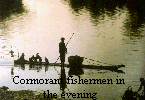
A boat trip on the peaceful Li River is the absolute high point of any visit to Guilin. A cruise from Guilin to Yangshuo, visitors will experience the winding and twisting Li River, goes past the many bizarre mountains whose shapes have inspired and fired the Chinese imagination, the Elephant Trunk Mountain, Old Man Mountain, Pagoda Mountain and Hole Mountain. Cormorant fishermen in narrow bamboo boats, bathing children, water buffaloes, small settlement and women doing their washing on the banks of the river can be seen along the way. Yangshuo, at the end of the boat journey is today a developed village that thrives mainly on tourism and seems to have nothing but tourist shops.

North-east of Guilin is Sanjiang, a settlement of the Song people. Changyong Bridge is an architecturally unique sight. South-west of Guilin, in the centre of the Autonomous region of Guangxi is Linzhou with 600,000 inhabitants, is an expanding industrial town, pricturesque and typically southern Chinese. The main attraction is the Dule Rock with its numerous karst caves. Another area with a beautiful landscape is the settlement of Guiping. The capital of the Autonomous Region of Guangxi is Nanning. It is located deep in the south and is only 160 km from the Vietnamese border. South-west of Nanning, near the Vietnamese border by the river Zuojiang, is a landscape as fantastic as that in Guilin. In Ningmeng county, visitors can see a 1,700 year old mysterious rock painting along a steep rock face by taking a boat on Zuojiang river.

Google Maps,Google Maps coordinate,Only show at Item-Page.


地理位置

1、地理位置:桂林是世界著名的风景旅游城市和历史文化名城,地处南岭山系西南部,广西壮族自治区东北部,109°45''-104°40'',北纬24°18''-25°41''。
  2、行政区划:辖秀峰,象山,七星,叠彩,雁山5城区和灵川,兴安,全州,临桂,阳朔,平乐,荔浦,龙胜,永福,恭城,资源,灌阳12个县,行政区域总面积27809平方公里。其中市区面积565平方公里。

  城市历史

  桂林历史悠久。根据市区宝积岩和甑皮岩洞穴发现的遗物,经考证,甑皮岩人已进入母系氏族社会阶段,距今约一万年。
  夏商周时期,这里是“百越”人的居住地。秦始皇置桂林,象,南海三郡,这是“桂林”名称的最早起源,但郡治不在今天的桂林市。汉元鼎六年(公元前111年),在这里设始安县,隶属荆州零陵郡。东汉时改属始安侯国。三国时先属蜀,后归吴。甘露元年(265年),置始安郡始安县,郡县治所都在今之桂林。隋唐时属岭南桂州总管府。唐武德四年(621年),李靖修城于独秀峰南。贞观八年(634年)改名临桂县,属桂州始安郡。光化三年(900年)始,属静江节度。五代十国时先后属楚和南汉的桂州。宋时,前属广南西路桂州,后属静江府。元时属广西行中书省静江路。明清时均属广西省桂林府。民国时属广西省。1914年改名桂林县,1940年始设桂林市。1944年11月至1945年7月28日,为日寇占领。光复后仍为广西省辖市。历史上长期为广西省会。   1949年11月22日桂林解放,为广西省辖市,1958年改称广西壮族自治区桂林市,辖桂林城区和郊区。
  1981年7月、1983年10月阳朔、临桂划归桂林市管辖。
  1996年12月26日桂林市委,市人民政府按国务院,自治区批复的方案,实行区划调整,将郊区更名为雁山区。
  1998年9月8日经国务院批准,桂林市和桂林地区合并,组建新的桂林市。More

Monday, October 09, 2006

The History of The Great Wall(长城)

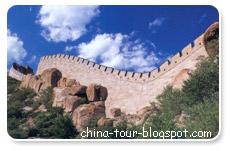
The Great Wall is well-known because of its magnificent majestic appearance.Now,in the call of "Loving our China, repairing our Great Wall", many places of The Great Wall have be repaired, which make it more boundless. The Great Wall has become the head key point of interest in China. more and more foreign people was attracted by it. The people who visited it are all acclaim as the peak of perfection.
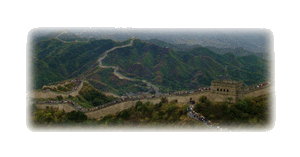
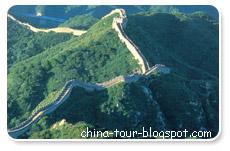
 The Great Wall convolves on the ridges of mountains and desert.It's maked up of city gates,circumvallations, enemy towers,signal beacon towers and so on, it was the martial recovery engineering system of the different place and nations in China Long time ago.It was built through several thousands years by Chinese people, it's the embodiment of the Great power and strong purpose of Chinese people. It has become the irradiant treasure of our Chinese archaic civilization. Many move one to praises and tears stories have taken place between the people bide inside and outside of The Great Wall in the long time traffics, it has been attracting many bookmen indited or paint for it, which added so many cantos and paints to our artistic thesaurus.
 B.c. Eleven Century, Xi-Zhou, Our country had the recordation that is "The city wall set down in the north". From B.c. Seven Century to B.c. Three Century that is called the Spring and Autumn Period and the Warring States Period, The princes of many little states began to fight and swallow up each other. They all built the long city wall for self-defence, for instance, Chu state built its wall in the Nanyang district firstly, Qi state built its wall in the Shandong province, Zhongshan state, Wei state, Han state, Yan state, Zhao state, Qin state and so on all began to build their city wall. The total of the city wall's length was more than five thousand kilometre, but they were distracted from each other.
 B.c. 221 Year, QinShiHuang consolidated all six states, He pulled down the wall between the states one side, the other side he built the new city wall in the north to defense the Hun. He command MengTian general and thousands upon thousands people to build the new city wall, it stretch more than five thousand kilometre in an unbroken chain, which is the oldest Great Wall.
 During the West Han state period, The Hun in the north bacame more and more stronger, So the Han state had to build new city wall, and strengthen the old Qin Great Wall. From the eastern parts of Liaoning province to the YuMen gate, The Great Wall is longer then ten thousand kilometre. Its scale had beyond the Qin Great Wall's by far. During the East Han state period, people built new wall inside of the West Han Great Wall to defense the Serbi and the Qiang nationality, The length of it is more then five kilomitres also. The Great Wall which was built in the two Han period, is the biggest project in our history.
 After this, the nations in the north began to come into the north of China, city gate and backland. They built the new North Dynasty kaiserdom, standed face to the North Dynasty kaiserdom. The West Wei state, East Wei state, West Qi state,West Zhou state in the North Dynasty kaiserdom, all built the mulriple Great Wall in the northern parts of Yellow River. The Shui Dynasty unified the whole nation, then built the new city wall from the middle-head reaches of the Yellow River to the western parts of Ganshu province, its length is three kilomitres, and it forms a new system with the eastern Great Wall.

 During the Tang Dynasty, the power of country is so strong that the all nantion in the north have to submit to the authority of Tang, So the archon haven't built any new Great Wall, only built three city to accept surrenders.Here, the eastern Gaoli built more the one thousand kilomitres Great wall from the northeast of China to the Datong River estuary to defense Tang.
 In the Zhu,Liao,Jin Dynasty Period, the north parts of Chian was occupied by the Khitan, the west parts of the Yellow River was occupied by West Xia, The North Song Dynasty only repaired the Yan Gate. Since this, Liao and Jin state became more and mire stronger, and occupied the whole parts in the north of the Yellow River, so the South Song has no ability to build any new Great Wall.But the Liao-Jin kaiserdom built the new Great Wall in the northeastern parts of Neimenggu province to fight against the other nantion in the northern parts. People often call it as "Genghis khan City Wall".
 After the Ming Dynasty was founded, the archons began to build new Great Wall in the northern parts of China to defense the Yuan state come back and Dadan, Waci, Nvzhen etc.And they also built many Great Wall in southeast of China near to the sea to oppugn the foreign enemy. The count of the Ming Great Wall is the best large in our history. The main part of it begins from the the Yalu River to the JiaYu Gate, its length is more than seven thousand kilomitres. Thereinto, The part which from ShanHai Gate to the JiaYu Gate is kept most well.
 At the beginning of Qing Dynasty, in the Liaoning,Jilin Province people built the ShengJing city wall, it extends 2600 kilomitres. And the people also repaired the ShanHai, JuYong, YanMen, JiaYu Gate etc. But from the metaphase of Qing Dynasty, the Great have not been repaired more.
 Now, Under the years run out and the man-made destroy, Many parts of The Great Wall have become very slipshod, even includes the Ming Great Wall. But The Great Wall whose length is more than a hundred thousand kilomitres is the huge Chinese dragon, is the best greatness and grandest work in the history of the whole human being. It also materializes the architectural skill. Now the people who bide inside and outside of The Great Wall, through the long time traffics, have unified one big family. The Great Wall is the symbolize of our China and is our pride. It will also contribute to promotion the friendship between people who come from the different countries.

Google Maps,Google Maps coordinate,Only show at Item-Page.

万里蜿蜒于中华大地的长城,以其无比宏伟的雄姿久闻于世。今天在“爱我中华、修我长城”的号召下,许多地方已修缮一新,更加气势磅礴,成为我国名胜之首。它吸引着国内外成千上万的游人,以一览长城为平生快事。凡到过长城的人,莫不叹为观止。

  像巨龙般腾越在崇山峻岭、沙漠戈壁的长城,是由城关、城墙、敌台、烽火台等构 成的,是我国古代各地和各民族统治集团间的军事防御工程体系。它是两三千年来,由各族人民反复多次修筑而成的,体现着中华民族的伟大力量和坚强意志,成为 我国古代文明中的一项光辉灿烂的瑰宝。长城内外各族人民在无数次斗争和长期交往中,发生过许多可歌可泣的动人故事,吸引着历代文人墨客为它们赋诗作画,在 我国文学艺术宝库中,增添了许多优美动人的篇章与画卷。

  远在公元前十一世纪,我国西周就有“城彼朔方”的记载。公元前七到三世纪的春秋战国时期,各诸侯国互相吞并,形成群雄并立不断混战的局面,他们在自己 的边境,先后筑起长城以自卫。如楚率先在南阳地区筑方城数百里;齐则在山东从平阴到东海边琅琊台筑长城,又沿黄河故道筑堤为城;中山、魏、韩、燕、赵、秦 等国,各修筑长城数百里至数千里。当时长城总长已上万里,不过是分散各自独立而已。

公元前221年,秦始皇统一六国后,一方面拆毁诸国间的长城,另一方面为防北边匈奴,又调动军民上百万人,命大将蒙恬督筑长城,西起洮河沿黄河向东,再按 原秦、赵、燕长城走向一直到辽东,绵亘万余里,成为我国最早的万里长城。

  西汉时,北部的匈奴族更强盛,屡向南犯,汉朝除采取通好、和亲及出击等手段外,并着手大规模兴筑长城以固边陲。除修缮秦长城外,西面更增筑河西、玉门 关、居延泽等长城。北出雁门,五原阴山,东循燕秦长城,从辽东到最西的玉门关,长达两万余里。并列亭西至楼兰,北至胪朐(乌兰巴托东北地区),规模远逾秦 代。东汉初北防鲜卑、西防羌戎,又在西汉长城以内,大兴障塞堠坞,总长也达万里以上。两汉时期一北一南所筑长城,是历代规模最大的。

  此后,北方各族逐渐进入华北、关中,直至中原,建立起北朝政权,形成南北朝对峙的局面。北朝的北魏、东魏、北齐、北周先后在黄河套以北东至辽西地区, 修筑了多重的长城,纵横交错,总长也上万里。隋统一全国后,在黄河中上游由云中经五原、榆林、宁夏至陇西,筑长城四五千里,与北朝在东部的长城正好构成又 一体系。

  唐代国势强盛,长城以北以西的各部族都归附通好,因此未筑长城,仅在阴山内建“受降城”三座,东西互距四百里,并连以城障;在甘肃西部复筑瓜州故城。 这时,东部的高丽为了防唐,在我国东北由扶余、开原、新宾至朝鲜大同江口筑长城二千余里。

  朱、辽、金时期,华北的燕云十六州尽归契丹、河西已属西夏、北宋只修治了雁门险阻。以后辽金相继强盛,深入淮汉、以至江北,造成南宋偏安局面,再无力去修筑长城。北方辽金政权却因与蒙古和其他各族间的斗争与矛盾,在今东北内蒙等地兴筑濠堑长城,总长也上万里,称明昌长城,俗称成吉思汗边墙。

  明朝建立后,为防范元朝复辟及达旦、瓦刺、女真、吐蕃等族骚扰,在北方不断修筑长城,并且为抗击外国入侵,在东南沿海要地也零星筑了一些长城。明长城 之多,是历代之最。主要长城从鸭绿江边的九连城到甘肃的嘉峪关,全长一万五千余里。在北京和山西偏关间,分成南北两道长城。在许多地段上长城除主城墙大边 外,还有二边、三边、外边、内边、护边等多道的城墙,如雁门关外有大石墙三道、小石墙二十三道。其中从山海关到嘉峪关间的一万二千七百里的主长城保存较完 善,特别是山海关到北京周围,经戚继光重新督筑过的长城最为壮观。

  清朝初,在辽宁、吉林间筑了有名的盛京边墙(柳条边),新旧边墙总长2600余里。对古长城也局部修缮了山海、居庸、雁门、嘉峪等关隘和长城的某些段落。中期以后就未再修缮了。

  经历了长久的岁月和人为的破坏之后,许多古长城已到了十分零落的程度。就是明长城也遭到许多损毁。但是,总长十几万里的中华巨龙,仍然是人类古代最巨 大壮观的工程。并且它在不同时代、不同地点、因险制塞、呈现着千姿百态、无一类同的奇丽景观,体现了建筑上的艺术才思。长城内外我国各族人民,经过长期交 往,终于突破人为的分割阻碍,已凝结成统一团结和睦友爱的中华民族大家庭。长城作为我们中华伟大文明古国的象征,既是我们民族感到自豪、也为世界各地人民 所向往,它将为增进各国人民的友谊作出重大的贡献

Saturday, October 07, 2006

Tian'anmen(天安门)-the Gate of China, Beijing

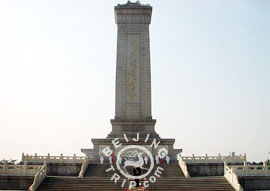
With a total area of 440,000 square meters, Tiananmen Square is the largest square in the center of Beijing. For over a hundred years, many ceremony and demonstrations have been held here. The grandeur of Tiananmen Gate (Heavenly Peace Gate) is a national symbol, with the Great Hall of the People on the western side and the Museum of the Chinese Revolution and the Museum of Chinese History to its east and west. The Monument to the People's Heroes - the 36 meters obelisk, made of Qingdao granite, dominates the center of the square. The Chairman Mao Memorial Hall and the Qianmen gate, sit in the south.

Tian'anmen Gate

A stone lion in front of the Tian'anmen TowerTian'anmen Gate (Gate of Heavenly Peace) was built in the 15th Century and restored in the 17th Century. From imperial days, the yellow glaze-tiled double-eaves tower functioned as a rostrum for proclamations to the assembled masses. October 1, 1949, Chairman Mao Zedong proclaimed the founding of the new China. The tower has five doors and in front of it are seven bridges spanning a stream. Only the emperor could use the central door and bridge. On the top of the central door is a gigantic portrait of Chairman Mao with slogans on each side stating 'Long Live the People's Republic of China' and 'Long Live the Unity of the Peoples of the World'. Walking through the gate, you can enter the imperial city - Forbidden City with free charge while a panoramic view from the tower costs 15RMB for Foreigners.

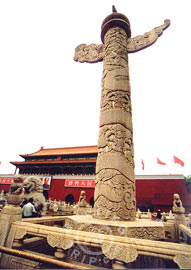
Obelisk marble columns engraved with entwisting dragons and clouds - an ornamental architecture called Huabiao in front of the Tian'anmen
Huabiao

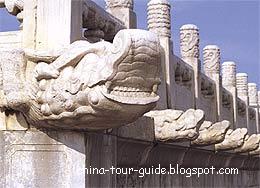
Right beside a pair of marble lions in front of the Tian'anmen Gate stand obelisk of marble engraved with entwisting dragons and clouds - an ornamental architecture called Huabiao. Its history can be traced back to the Yao and Shun, legendary kings in remote antiquity. To solicit public criticism, it is said that wooden crosses were erected at marketplaces for people to write down complaints. Later during the Han (206 B.C. -- 220 A.D.) wooden posts were replaced by stone pillars, which gradually became the sumptuous columns to palace gates. Huabiao can be usually found in imperial gardens and mausoleums.

On the top is a plate-shape flat called Chenglupan (dew-collecting) on which squats an animal called kong (a legendary animal for watch-keeping) facing to the south. They were called "Wangjungui" or "looking forward to the emperor's return," who watched over the emperor's excursions and called him back. The couple inside the gate facing north, called Wangjunchu or "looking forward to the emperor's progress," were considered to supervise the emperor's behavior in the court when he neglect court affairs.

Great Hall of the People

Great Hall of the People, in Tian'anmen SquareThis is the venue of the legislature, the National People's Congress. Summit meetings are often held in the 10,000-seat auditorium with the familiar red star embedded in a galaxy of lights in the ceiling. Also you can visit the 5000 seat banquet room where US president Richard Nixon dined in 1972. The admission costs £¤ 15.

Monument to the People's Heroes (Renmin Yingxiong Jinianbei)

Built in 1958 on the southern side of Tian'anmen Square, this 36-meter obelisk bears brass-relief carvings of key revolutionary events such as the Chinese destroying opium in the 19th century.

Mao Zedong Memorial Hall (Mao Zhuxi Jiniantang)

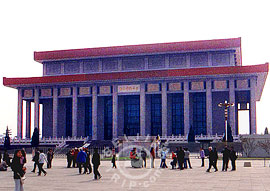
Behind the Monument to the People's Heroes is the hall where the embalmed body of Chairman Mao is kept and many Chinese show deep respect when confronted with the physical presence of Mao. more

Opening: 9:00 - 16:30


Google Maps,Google Maps coordinate,Only show at Item-Page.


位于北京城的中轴线上的天安门,始建于明永乐十五年(14l7年)。原名承天门,以示皇帝“承天启运,受命于天”。清顺治八年(1651年)重建后,改称天安门.既包含了皇帝是替天行使权力。理应万世至尊的意旨;又寓有“外安内和,长治久安”的含义。明、清时,天安门是皇城的正门,城门五阙,重楼九楹,高为33.87米;1970年翻建后高达34. 7米。它造型典雅,是我国传统建筑艺术的代表作。

天安门的主体建筑分为上下两层。上层是重檐歇山式,黄琉璃瓦顶的巍峨城楼,东西面阔九楹,南北进深五间,取“九五”之数,象征皇帝的尊严。正面有36扇菱花格式的门窗。城搂基座周围有汉白玉栏杆、栏板,雕刻着莲花宝瓶图案。城楼内所用木材大部分是楠木,60根红漆巨柱排列整齐,柱顶上有藻井与梁枋,绘着金龙吉祥彩画和团龙图案。地面铺的全是金砖,面积约2000平方米。屋顶的正脊与垂脊上装饰着螭吻、仙人、走兽。下层是高13米的朱红色城台,四周环绕琉璃瓦封顶的矮墙,下部是1.59米高的雕刻精美的汉白玉须弥座台基。城台的总面积达4800平方米,东西两侧各有一条长达百级供上下城楼用的梯道,俗称马道。还有5个拱形门洞,中间的门洞最大,高8.82米,宽5.25米,唯有皇帝可以进出。城楼前有外金水河,河上飞架7座汉白玉雕栏石桥,中间一座最宽阔的称“御路桥”。专为皇帝而设;御路桥两旁有宗室亲王过往的“王公桥”;王公桥左右的“品级桥”是供三品以上的官员行走的;四品以下的官员和兵弁、夫役只能走“公生桥”。公生桥架在太庙(劳动人民文化宫)和社稷坛(中山公园)门前。5座内金水桥除有类似严格的等级规定外,还表示“万方来朝”之意。金水河两岸有两对威风凛凛的石狮及两座连同须弥座高为9.57米的华表。石狮系明代永乐年间原物,距今已有500多年。石狮后面两边设有红色观礼台,台前东西各筑花坛,游人们常在这里驻足观景。华表上满刻着盘龙与云朵,巨柱顶端加上了云板、承露盘并蹲坐着石兽,此兽有注视皇帝出入之意,因而人们把前华表上两只背北面南的石兽叫“望君归”;把后华表上两只背南面北的石兽称“望君出”。

天安门在明、清两朝是皇帝颁发诏令之地。遇有新皇帝登基、大婚等重大庆典活动和皇帝父母进宫,都要启用天安门。皇帝平时一般不走天安门。只有每年去祭天、祭地、祭五谷时,才由此门出入。另外,皇帝御驾亲征或大将出征,都得在天安门前祭路、祭旗,以求马到成功,凯旋归来,同时显示威风。天安门还是“金殿传胪”的场所。每逢殿试后的两天,皇帝召见、传呼新中进士们的姓名,这叫“传胪”。考中前三名的状元、榜眼、探花插上金花,身披红绸,骑马游街,以谢皇恩。天安门唯独皇帝可以出入,而且只能出入喜事,绝对禁止出入丧事。

天安门是中华人民共和国举行开国大典的主会场,也是国徽图案的重要组成部分。它是我们伟大祖国的象征,已成为人们喜爱的观瞻胜地。more

The Forbidden City(故宫),Beijing

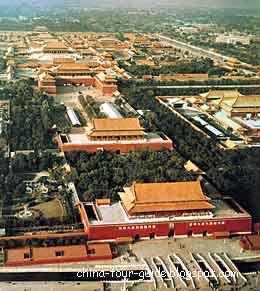
   The Forbidden City (Imperial Palace) in the heart of Beijing is the largest and most complete imperial palace and ancient building complex in China, and the world at large. Its construction began in 1406 and was completed 14 years later, having a history so far of some 580 years. Twenty-four emperors from the Ming and Qing (1644-1911) dynasties lived and ruled China from there. Most of the buildings in the Forbidden City were rebuilt many times, although they maintained the original architectural style.
  
   The Forbidden City, extending 753 meters from east to west, and 961 meters from north to south, makes a rectangular shape and covers a total area of 720,000 square meters. It consists of several dozen compounds of varying sizes and some 9,900 bays of rooms, with a total floor area of 150,000 square meters. Most of the buildings were built with wood, roofed with yellow glazed tiles and built on blue-and-white stone foundations, looking solemn and brilliant. City walls were 10 meters high, and a 52 meter-wide moat surround the Forbidden City. Three-storied towers are placed at each corner of the wall.
  
   The building arrangement within the Forbidden City is symmetrical. The Hall of Supreme Harmony, the Hall of Central Harmony and the Hall of Preserving Harmony, which comprise the outer palace, and the Hall of Heavenly Purity, the Hall of Union and the Hall of Earthly Tranquility, comprising the inner palace, stand in a line from south to north on the central axis. The 8 km central axis

runs through the
entire old Beijing
city to Yongdingmen in the south and
Zhonggulou in the north. The throne symbolizing imperial power is> positioned at the center of this
central axis.
  
   The buildings of the Forbidden City fully embody the artistic features and style of ancient Chinese palace architecture, and can be called a masterpiece in Chin
ese, even world, arch itectural history. Today, as the largest museum of cultural relics in China, the Forbidden City, also called the Palace Museum, collected and displayed some one million precious hist orical relics from the Shang Dynasty (16th century -771 BC) through to the Qing Dynasty. It was made part of the world cultural heritage list in 1987. more

Office of the Palace Museum Tel: 86-10-85117049
Google Maps,Google Maps coordinate,Only show at Item-Page.


故宫又称“紫禁城”,是明清两代的皇宫,也是世界上最大的宫殿,占地72万平方 米(长 960米,宽750米),建筑面积15万平方米,始建于公元1406,1420年建成,是明朝第皇帝朱棣始建,设计者蒯祥(1397—1481年,字廷瑞,苏州人),占地面积78万平方米,用30万民工,共建了14年,有房屋9999间半
,主要建筑是太和殿、中和殿和保和殿,保和殿也是科举考试举行殿试的地方,科举考试的一至三名分别称状元、榜眼、探花。

  故宫严格地按《周礼·考工记》中“前朝后市,左祖右社”的帝都营建原则建造,其前半部分为外廷,是皇帝朝政场所。建筑庄严、宏伟,特别是太和殿、中和殿和保和殿三大殿,建筑在8米高的三层汉白玉石阶上,以显示封建帝王至高无上的威严,太和殿座落在紫禁城对角线的中心,故宫的设计者认为,不这样不足以显示皇帝的威严,不足以震摄天下。

  现在我们参观时都为故宫的宏大而叹服,这一点在参观三大殿时感觉最明显,故宫是目前世界上最大的宫殿。

  午门是紫禁城的正门。东西北三面以12米高的城台相连,环抱一个方形广场。当中的正门平时只有皇帝才可以出入,皇帝大婚时皇后可以进一次,殿试考中状元、榜眼、探花的三人可以从此门走出一次。文武大臣按文东武西由两侧门出入。

  故宫参观的重点(必看):
  1、故宫中路外庭的三大殿(太和殿、中和殿、保和殿)、内庭三大殿(总长近一公里,走下来1个半小时);
  2、故宫西路(主要是养心殿,位于西路南端,从雍正开始清代8个皇帝在此居住,参观半小时);
  3、珍宝馆(在外东路,收藏有大量的故宫珍宝,票价10元,下午3点半停止售票,细看要3小时)more

Friday, October 06, 2006

HuangShan(黄山) Anhui

Huangshan Mountain in east China's Anhui province is one of Chinas ten best-known scenic spots, It is characterized by the four wonders, namely, odd-shaped pines, grotesque rock formation, seas of clouds and crystal-clear hot springs. Mount Huangshan is celebrated for having all the features of mountain scenery. Known as the No. 1 Mountain Under heaven, it features numerous imposing peaks(77 exceed an altitude of 1,000m), forests of stone pillars and evergreen sturdy pines; other features include grotesquely-shaped rocks (many of which are individually named, such as "pig-headed monk eating water melon"), waterfalls, pools and hot springs. Because of its mists and clouds, natural scenery in the area changes beyond prediction. Xu Xiake, a noted Chinese geologist and traveler in Ming Dynasty, praised Huangshan Mountain as the best of all mountains.

Mount Huangshan was listed as one of the World Natural and Cultural Heritages in 1990.

Mount Huangshan extends 40 kilometers from south to north and 30 kilometers from east to west, covering an area of 1200 square kilometers, the highlights of which occupy 154 square kilometers.
Huangshan Mountain is a marvel: within an area of 154 square kilometers there is a crowd of peaks, 72 of which have names indicating the shapes they resemble. Lotus, Brightness Top and Celestial Capital are the three major ones, all rising above 1,800 meters above sea level. The mountains are a body of granite, often with vertical joints. Erosion and fracture contributed to shape the rocks into huge columns, giving rise to lofty peaks and deep ravines. When it is cloudy the pinnacles loom in mists as if they were illusionary, while the sun is shining they unfold in all their majesty and splendor. Huangshan Mountain change its color and appearance with the alternation of seasons. In spring blooming flowers decorate the slopes in a riot of color and fill the valleys with fragrance; in summer you see verdure peaks rising one upon another and hear springs gurgling merrily. Autumn dresses the mountains in red and purple as maples and some other trees are blazing-red; winter turns them into a world of frost and ice with silver boughs and rocks everywhere. Here in Huangshan, pines and rocks are intimately involved with each other, almost every rock has a pine tree growing out of the crevice, and every tree has tortuous and gnarled roots and branches.The still sea of snow-white cloud can suddenly begin to roll and toss, rise or fall, gather or disperse while the peaks emerge and disappear in the clouds like isles in the ocean. So from ancient times it has been frequented by tourists seeking their mystery and admiring their frequented by tourists seeking their mystery and admiring their scenery. They come to the conclusion that the fantastic pines, the grotesque rocks, the sea of clouds and the hot springs are the four major attractions of the Yellow Mountains. As a matter of fact there are marvels almost everywhere, especially in the following scenic areas: Wenquan (Hot Spring), Yupinglou (Jade Screen Tower), Xihai ( West Sea), Beihai (North Sea), Yungusi (Cloud Valley Temple) and Songgu'an (Pine Valley Nunnery).

There is plentiful rainfall in Huangshan Mountain. Therefore there are thick forests.Owing to the peculiar terrain, the Huangshan Mountain's climate is marked by a vertical change, and the vertical distribution of vegetation is also distinctive: plants on the summit, on the middle levels and at the foot belong to the frigid, temperate and subtropical zones respectively. There are more than 1500 species of plants, of which trees comprise one third. So the Huangshan Mountain occupy an important place in China's botanical research. Here you will find century-old pines, firs, ginkgoes, actinidia, Chinese torreyas and camphor woods, remnants of the glacial era. A number of trees are celebrated on account of their age, grotesque shape, or precipitously perched position. Mount Huangshan abound in flowering plants; many of them are rare ones, such as Huangshan Rhododendron, magnolia as well as azalea, camellia, plum, lily, orchid, and so on. It has a rich store of medicinal herbs; more than 300 kinds are found here; the notable ones being glossy ganoderma ginseng, Chinese gold thread rhizome and Chinese cinnamon. Maofeng tea of Huangshan is well known at home and abroad.

Huangshan Mountains also provide the natural habitat for a wide variety of fauna. Among the animals there are monkeys, goats, deer, pangolin and squirrels. There are rare birds such as the red-billed leiothrix, the silver pheasant, the octave-tone bird and the oriole, all good singers. The red-billed leiothrix (called "love birds" in Chinese) are so lovely that they have become favorites of foreign tourists and are exported by pairs. Besides, chukkar(stone frog) from the streams is good to make delicious dishes with.

Mt. Huangshan's climate is mild and humid, neither too hot in summer nor too cold in winter, the temperature is agreeable all the year round .
It is cool in summer, averaging 70 °F at the North Sea Area ( 1 ,630 meters above sea) and 80 °F at Hot Spring Area (630 meters above sea) in July (the hottest month). As clouds often shut out the sun, hot weather never stays long, and this makes Yellow Mountains an ideal summer resort.
Mt.Huangshan lies in subtropical zones, so it's not quiet cold in winter, at least, not so cold as some people expected. The temperature ranges from 25 °F to 40 °F, but it's enough to result in a fantastic snow scenery and a silver world with pines and precipitous peaks covered with snow and decorated with icicles

Today Mt. Huangshan has become a world-famous tourist attraction. With its convenient facilities: three cable lines, four three-star hotels on the top, all the paths paved with flat stones, it lures millions of visitors both from home and abroad. Seeing is believing. Welcome to Mount Huangshan. More


add:Google Maps,Google Maps coordinate

黄山雄距于风景秀丽的皖南山区,它以“三奇四绝”的奇异风采名冠于世。1982年黄山被国务院列为首批国家级重点风景名胜区,1986年经评选列入中国十大风景名胜区,1990年被联合国教科文组织列入“世界遗产”名录。此后,黄山又相继被评选为国家级“卫生山”、“安全山”,1998年被建设部、国家旅游局等部门确定为全国首批十个文明景区之首。

  黄山,古称黟山,唐天宝六年(公元747年)依轩辕黄帝曾在黄山炼丹羽化升天的传说,唐明皇敕改黟山为黄山。它地跨市内歙县、休宁、黟县和黄山区、徽州区,面积1200平方公里,现划入黄山风景区的154平方公里,是号称“五百里黄山”的精华部分。

  黄山是以自然景观为特色的山岳旅游风景区,奇松、怪石、云海、温泉素称黄山“四绝”,令海内外游人叹为观止。黄山有名可数的72峰,或崔嵬雄浑,或峻峭秀丽,布局错落有致,天然巧成。天都峰、莲花峰、光明顶是黄山的三大主峰,海拔高度皆在一千八百米以上,并以三大主峰为中心向四周铺展,跌落为深壑幽谷,隆起成峰峦峭壁,呈现出典型的峰林地貌。

  登上一千八百多米的高处纵览,山中奇峰汇聚,峭壁千仞,拔地擎天,峥嵘崔嵬。青松在悬崖上争奇,怪石在奇峰上斗艳,烟云在峰壑中弥漫,霞彩在岩壁上流光,自然的美在这里汇聚,在这里升华,赋予它超凡脱俗的品质,塑造出它威武雄壮的气概。在黄山的面前,时空变得狭小,沧桑变得平淡,它是大自然的骄子,独领天下奇山的风骚。故而当之无愧地赢得“登黄山天下无山,观止矣”(徐霞客语)的崇高赞誉。More

Thursday, October 05, 2006

Jiuzhaigou(九寨沟)

Known as the "Fairyland on Earth" . Jiuzhaigou sits on 103° 46' –I04° 4 ' E and32° 15 ' -33° 19' N, within the boundary of Jiuzhuigou County , Aba Prefecture , Sichuan . It lies between the southwest margin of the Qinghai-Tibet Plateau and at the north foolt of Duo'ema Mountain Range, with an average , altitude between 2, 000 and 3,000 meters, and a distance of about 435 kilometers from Chengdu , the capital city of Sichuan Province .

To its east, Jiuzhaigou neighbors both the Baihe River Nature Reserve and the Wanglang Nature Reserve , and to its south is the Huanglong Place of Scenic Interest . Jiuzhaigou covers a total area of 720 square kilometers, with a periphery zone of 600 sq. m. and a buffer zone of 110sq. m.

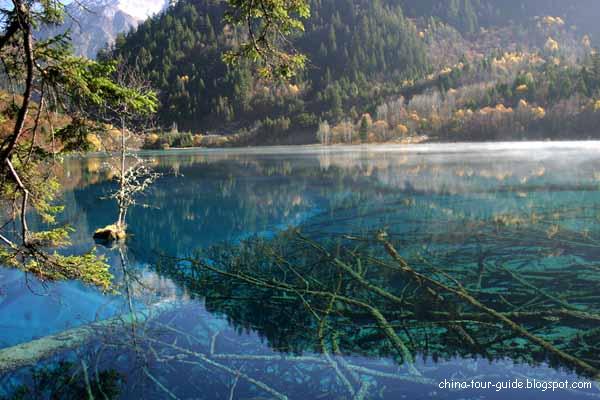
Jiuzhaigou, also called "Yangtong" in ancient times, cur- rently has other names like "Heyao Jiuzhai", and the " Jade Sea ". Jiuzhaigou, literally the Nine Village Valley , is hence known for the nine Tibetan villages within its boundary, that is, Panxin, Rize. Yacuo , Panya, Zechawa , Heijiao, Shuzheng, Heye and Zharu. The area of Jiuzhaigou as well as the upper reaches of the Jialing River and Minjiang River are called the land of Shiqiang (Qiang ethnic minority ) in aocient times, where human activities have been recorded dating back as early as to o the Yin-Shang Period (16th- 11th Century B. C.). Ac- cording lo The Records afSongpan (vol. I - Rivers and Mountains), the "Jade Sea is 50-odd kilometers to the northeast county, within the territory of Zhongyang Tongfan Tribe. Its valleys are as long as several kilometers with green water and jade-like ripples." This evidences that the Jade Sea beauty was well known as far back in ancient times.

Jiuzhaigou covers the Shuzheng Valley . Rize Valley and Zechawa Valley that take a "Y" shape, in the Minshan Mountain Range. Inhabited by Tibetans, the nine vil- lages and alpine lakes, affectionately called "Ham", are like reflecting mirrors or crystal jade blocks inlaid in snow mountains and forests. At the end of Zechawa Valley is the Chang (Long) Lake and the end of Rize Valley are virgin forests. From .south to north, both val- leys stretch and meet al Nuorilang. The drop between the two valleys and Shuzheng Valley is over 1,000 meters, with 1 14 lakes lying downward in an echelon manner, on which arc 17 waterfalls, 11 rip currents and 5 travertine beaches, formulating alpine lake clusters and travertine spots that are rarely seen in China and even in the world. A fairyland on earth. Jiuzhaigou col- lects the primitive, natural beauties best demonstrated in its lakes, waterfalls, beaches, water currents, snow peaks, virgin forests and Tibetan customs. more

Magic Mirror Cliff
It's a gigantic cliff rising 800 metres from the level ground. Its surface is as smooth and slippery as a mirror. Capped with pines and China firs, the cliff top resembles a human head with cropped short hair and curly beard, which in local mythology, was left over by Zhayiga, the Ancester of mountains to keep the evil spirit under control.

Penjinghai Lake (Miniature Landscape Lake)
On the Lake's shallows, a few dozens of miniature-potted-landscape-like bushes of azalea, poplar, metasequoia etc. scatter about. They assume various forms: some in the shape of a fierce spread eagle, and some, of a galloping steed.

Luweihai (Reed Marshes)
It is 1375 metre long and over-grown with reeds. A clear brook zigzags its way through the marshes, where waterfowls are seen hovering overhead. When the season turns, the green meandering brook presents a striking contrast with the yellow spread of reeds.

Huohahai (sparkling Lake)
The west hill commands a spectacular view of the sparkling reflections of bright sunlight upon the Lake's deep blue surface. Lying Dragon Lake: In the middle of the lake, submerges a dimly visible yellowish "Lying Dragon" in some 20 metre deep water. When a gentle wind from the mountain whips up ripples on the Lake's clear surface, it looks as if the "Dragon" were stretching herself, and once the wind increases intensity, the "Dragon" begins to shake her head and wag her tail, as if poising for a take off.

Shuzheng Group of Lakes
It consists of some 40 large and small inter-connected lakes stretching as long as ten Li. The waters overflow the inter-lake banks of calcic soil over-grown with willows, pines and cypresses and become a succession of waterfalls. The nearby Shuzheng stockaded village still preserves two primitive stone mills and one wooden bridge, They are simple and rough, but very charming.

Nuorilang waterfalls
A massive water current washing over a cliff top over-grown with willows, drops some 30 metre down and form spectacular waterfalls of various size and shape. Some waters fall straight down to the ground. Some dash against protruding rocks midway and explode into millions of colorful tiny beads.

Pearl Shoal
A stream rushes down a 20 degree slope into the Shoal splashing water about like millions of bouncing silver pearls and then goes on down to form fantastic waterfalls of various shape with thunderous roars echoed by the deep valley.

Wuhua Hai (Five Flower Lake)
Due to different water depths and silts on the bottom, the Lake's waters assume a variety of colors, such as light yellow, dark green, deep blue, jadeite, under the sun light, they are as colorful and beautiful as a peacock's feathers.

Panda Lake Waterfall
It consists of 3 waterfalls with sizes of 5x19m., 2x24 m., and 14x19 m., respectively. Three separate streams rush down a precipice and form waterfalls with multiple sections of 65 m, in total height.

Swan Lake
It's 2250 m. long and 125 m. wide (at maximum) encompassing an area of 142.8 mu . The surface is domed with weeds and wild flowers. It's a tranquil and secluded place frenquented by swans and wild ducks.

Hanging Dagger Spring
Overlooking the Swan Lake is a solitary Lofty peak, 500 metre high and resembling a dagger piercing through the sky. From the halfway down the peak, voluminous waters gash out and drop some thousand feet like a white chain hanging in the air.

Five Color Pool
Filled with crystal-clear waters the pool looks colorful, radiant and fascinating.

Long Lake
It's the largest lake in Jiuzhaigou Valley, covering an area of 7.5 km, long and 0.375 km. wide. It is 3103 metres above sea level, with a maximum depth of 103 metres. The melted snow from the South Peak and the waters of surrounding mountain streams and brooks all find their way into the Lade which has no exit. The excess water either vapours or seeps into the earth. The waters never spill over the banks in spite of downpours in summer and autumn. The Lake won't dry up either in spring and winter, even there's a long dry spell. In spring, Jiuzhaigou Valley is radiant and enchanting. The air is filled with fragrance of wild blossoms. In summer, the beautiful trees are luxuriantly green. In autumn, the breeze is intoxicating, while tree leaves turn crimson. In winter, the mountains and valleys are wrapped in snow and ice.


九寨沟风景名胜区位于四川省阿坝藏族羌族自治州南坪县境内,距离成都市400多公里,是一条纵深40余公里的山沟谷地,因周围有9 个藏族村寨而得名,总面积约620平方公里,大约有52%的面积被茂密的原始森林所覆盖。林中夹生的箭竹和各种奇花异草,使举世闻名的大熊猫、金丝猴、白唇鹿等珍稀动物乐于栖息在此。 自然景色兼有湖泊、瀑布、雪山、森林之美。沟中地僻人稀,景物特异,富于原始自然风貌,有“童话世界”之誉。有长海、剑岩、诺日朗、树正、扎如、黑海六大景区,以翠海、叠瀑、彩林、雪峰、藏情这五绝而驰名中外。

  九寨沟处于四川盆地向青藏高原过渡的边缘地带,属松潘、甘孜地槽区,恰好位于我国第二级地貌阶梯的坎前部分,在地貌形态变化最大的裂点线上,地势南高北低,有高山、峡谷、湖泊、瀑布、溪流、山间平原等多种形态。其地貌属高山狭谷类型。山岭的海拔高度大都为 3500-4500米,最高峰嘎尔纳峰海拔4764米,最低点羊峒海拔2000米。整个景区内沟壑纵横,山峦叠嶂,好似大自然撰写的一部壮丽史诗,记录着地壳的沧桑变迁和生命的进化历程。

  在传说中九寨沟是仙女的宝镜幻化而成,优美的故事带给人梦幻般的想象。但从科学的角度看,九寨沟翠海叠瀑的形成,则是由于地壳变化、冰川运动、岩溶地貌和钙华加积等多种因素造就的。

  九寨沟地处四川盆地向青藏高原延伸的过渡带,为多种自然要素交汇地区。山地切割较深,高差悬殊,植物垂直带谱明显,植被类型多样,植物区系成分十分丰富。区内有高等植物2576种,其中国家保护植物24种;低等植物400余种,其中藻类植物212种,且40余种属四川首次发现,为九寨沟独有。许多古老的孑遗植物保存良好,波士曼博士称“九寨沟是个丰富多彩的博物馆,是实力雄厚的基因库。”

  九寨沟海拔高差大,地形地貌复杂,植被类型丰富,保留有大面积的原始生态环境,为不同类型的动物提供了适宜的栖息环境。湖面,野鸭水鸟起落;林中飞禽走兽云集。据有关部门粗略统计,生活在这里的野生动物,已知的就有近300种。其中被列为国家重点保护的珍稀动物27种,如大熊猫、金丝猴、牛羚、白唇鹿、黑颈鹤、天鹅、鸳鸯、红腹角雉、雪豹、林麝、水獭等,九寨沟堪称动物王国。

Monday, October 02, 2006

Putuoshan(普陀山)


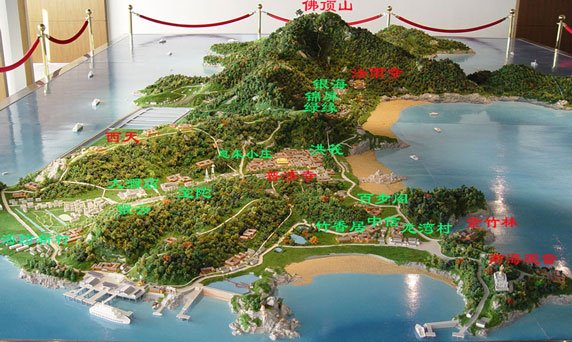
Located on the Lianhua Ocean of Zhoushan Archipelagoto the east of Hangzhou GuIf,Mount Putuo covers an area of only 12.5 square kilometers. There are many wonderful scenic sites on the island,including" Temples and Nunneries”,“Golden Sands"," Exotic Rocks","Tide Sounds and "Mirage" which are callad Five Putuo Beautie,and" Lotus Pool's Night","Pantuo Evening GIow"," Duanyin Sacred Site" etc.which are caIled Ten Famous' Sites. So it is known as " the Buddahist Kingdom amidst the Sea and Sky" Mount Putuo.It is one of China's four Buddhist Sacred Mountains has a long history in 916 A.D. it began toenshrine Guanyin ,and in1214,it was designated to perfom Buddhist rites especially enshrining Guanyin.The main scenic spots are three large temples named PujiFayu and HuijiPurple Bamboo Forost Da Cheng Monastry Guanyins Footstep and mount Luojia. There are Over 50O monks and nuns In the mountain.and pilgrims over one million evey year. On Guanyins Three Festivals(19th of Februarv, June and September In Chinese lunar calendar),pilgrims gather here like tide
more @ putuoshan.gov.cn & putuoshan.net

Sunday, October 01, 2006

Lijiang Yunan(丽江-云南-中国)

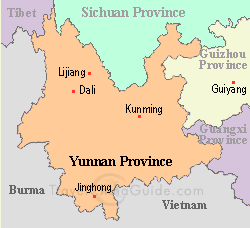
Location: located between 9923' - 10131' east longitude and 2559' - 2756' north latitude, and northwest of Yunnan province, middle reaches of Jinsha River
位置:位于西经9923' - 10131'北纬2559' - 2756',云南省西北方。

Neighboring Areas: Sichuan province and Guizhou province; Tibet Autonomous Region and Guangxi Zhuang Autonomous Region

Physical Features: lies in the joint area of Qingzang Altiplano and Yungui Altiplano

Nationalities: Han, Lisu, Pumi, Nuosu, Tibetan and Naxi

Geographic Feature: an intimate mountain town of stone and tile, laced with swift canals; a gathering place of rugged mountain people from various ethnic groups of Naxi Lisu, Pumi, Nuosu Yi, Tibetan

Climatic Features: distinctly vertical temperature difference, sufficient rainfall and clear division between dry seasons and humid seasons

Average Temperature: 12.6C -19.8C
Rainfall: annual average rainfall adds up to 1000mm

Mountains: Mt. Laojun, Jade Dragon Snow Mountain
Rivers: Jinsha River, Lancang River

Local Highlights: The Life of Naxi Women, Naxi Ancient Music, Old Town
丽江古城形成于宋末元初,明清以来一直是滇西北商贸中心和连接滇、川、藏的茶马古道重镇,已有800多年历史,面积3.8平方千米。古城北靠金虹山,西倚 狮子山,东南向着千顷沃野,气候舒适宜人。玉河水在玉龙桥下一分为三,入城后分成更多的支流走街过巷、穿墙进院流遍全城,富有小桥流水人家的审美情趣。街 道和房屋布局以水为脉随势自然,与内地城市方正严整的布局迥然不同,五花石路面色彩斑斓,融汉、白、藏等民族建筑文化的纳西民居古朴厚重保存完好,天井铺 地、门窗隔扇等古风犹存,具有较高的欣赏和研究价值。overview

west lake of Hangzhou


Misty Trees by Nine Streams

Guozhuang Park

Autumn Moon on the Calm Lake

Bai Dyke
I visited it at 2001 for the first time.
the West Lake has all along been extolled as a sparkling pearl. Legend has it that the lake used to be an auspicious pearl hewn into its sparkling shape by the Jade Dragon and the Golden Phoenix but it was later stolen by the Mother Queen of the West. When Jade Dragon and Golden Phoenix scrambled with the Mother Queen, this pearl accidentally fell onto a land that was known as Hangzhou.

overview

The ABC's of Tourism in China

Sightseeing

China has many tourist attractions thanks to its vast territory, beautiful landscapes, long history, and splendid culture. There are 99 state-class historical and cultural cities, 750 national-class cultural relics and places of historical interest under key government protection, and 119 major scenic spots, 19 of which are listed as world Natural and Cultural Heritages.

The long history and brilliant culture of China can be retraced in the ancient ruins and relics. Beijing, Xi’an, Nanjing, Luoyang, Kaifeng, Hangzhou, and Anyang are the seven ancient capitals, and people can follow the traces of Confucius, Qin Shihuang, and Genghis Khan to admire the extensive and profound Chinese culture.

China has long been known for its beautiful landscapes. Some of the most famous are the Lijiang River in Guilin, the Five Mountains, the Three Gorges along the Changjiang River, and the water scenes in southern China. There noted tourist attractions include Mount Huangshan in Anhui Province, Mount Emei in Sichuan Province, the Huanggoushu Waterfall and Limestone Caves in Guizhou Province, the Stone Forest in Yunnan Province, the Grasslands in the Inner Mongolia Autonomous Region, and the frost-covered trees in Jilin Province in winter.

China’s folklore is especially attractive. There are more than 40 yearly festivals. And every ethnic minority group have its own festivals. China is also famous for its special arts such as Beijing Opera, acrobatics, songs and dances, and calligraphy and painting.

With a long coastline, China’s many fine ports and coastal areas are choice destinations for vacationers. China has established a number of national holiday resorts, thus offering more choices for vacationers.

China has seen a rapid development in tourism and a great improvement in tourist facilities such as accommodations, food, shopping, and recreation. You will enjoy the best service during your stay in China.

Transportation

The Civil Aviation Administration of China (CAAC) is an organization for civil air transport in China. Today, the Chinese aviation has opened 750 domestic airlines, 100 international airlines, and 21 regional airlines, linking 58 cities in 39 countries. The domestic airlines serve 136 municipalities in China. Chinese airlines have reached world standards. Constant improvements are being made to the main airports and their facilities. Air China has become one of the safest airlines in the world.

1.Railway
Railways in China have developed rapidly, and many new domestic and international lines have been opened. The domestic lines include quasi-express trains, express trains, tourist trains, special expresses, and through expresses.

2. Highways
The highways in China have a total mileage of 1.18 million kilometers. These include 70 national highways and1,600 provincial highways. Great efforts are being made to construct more expressways and class I and Class II highways for motor traffic. The following expressways and Class |and Class || motor highways are convenient for tourists: Shenyang-Dalian, Beijing-Tanggu, Nanjing-Shanghai, Shanghai-Hangzhou, Hangzhou-Ningbo, Xi’an-Lintong, Xi’an-Baoji, Guiyang-Huangshi, Jinan-Qingdao, Guangzhou Shenzhen, Guangzhou-Foshan, Chengdu-Chongqing, Fuzhou-Xiamen,Hainan Island Ring Road, Guilin-Liuzhou, Guangzhou-Shantou, and Luoyang-Kaifeng.

Water Transportation

China has a vast sea area with the Bohai Sea, the Yellow Sea, and the South China Sea in the south. China's long coastline has ports in Shanghai, Tianjin, Guangzhou, Yantai, Qing dao, Qinhuangdao, Dalian, Beihai, and Hong Kong. These ports are vast and deep with beautiful surroundings, making them
another choice for sightseeing in China.

International Lines on the Sea
A regular weekly line of the Sino-Japanese International ferry company runs between Shanghai and the Japanese cities of Kobe, Osaka, and Yokohama, A one-way trip takes 45 hours.

Domestic Sea Lines
Domestic sea lines link all Chinese port cities. The main lines include Shanghai-Dalian, Dalian-Tianjin,Dalian-Yantai, Shanghai-Qingdao, Shanghai-Guangzhou, Beihai-Guangzhou, Shenzhen-Zhuhai,and Zhuhai-Hong Kong.

Routes on inland Rivers
China’s mainland is crisscrossed by 226,800 kilometers of rivers, of which 136,000 kilometers are navigated.

Hotels

Hotels have proliferated in China to accommodate a growing number of visitors from every nook and corner of the world. China has 3,700 hotels for foreign guests, half of which are star-star, 600 three-star, 930 two- star, and 300 one-star. All star-rated hotels are equipped with the best facilities and offer world-class service.


Major Travel Services

Travel agencies in china are divided into two groups: international and domestic. The international travel agencies specialize in the inbound and outbound international travel and can also arrange domestic travel.

There are 1.000 travel agencies operating in various provinces, autonomous regions, and municipalities of China. All of China’s leading travel services-such as China international Travel Service (CITS), China Travel Service (CTS), China Youth Travel Service (CYTS), and china comfort Travel (CCT)-have branches in various localities and at major scenic spots.

The business scope of the international travel agencies includes the following:
1. Organizing and arranging tourist activities for inbound and outbound individual travelers and tourist groups;
2. Providing a complete guide service in foreign languages and local Chinese dialects;
3. Reserving airplane, ship, and train tickets, and handling passports, visas, and various notarizations.


Entertainment

The splendid Chinese culture and the hospitable Chinese people offer foreign tourists rich cultural and recreational activities including operas such as Beijing Opera, Shanghai Opera, and Henan Opera; acrobatic performances; and folk singing and dancing. Foreign Guests can know China better by joining in
the celebrations of traditional festivals of China’s 56 ethnic groups.


Chinese Cuisine

Chinese cuisine has a long history, and is one of the Chinese cultural treasures . It is as famous all over the world as French cuisine. Chinese cookery has developed and matured over the centuries, forming a rich cultural content It is characterized by fine selection of ingredients, precise processing, particular care to the amount of fire, and substantial nourishment. Local flavors and snacks, and special dishes have formed
according to regions, local products, climate, historical factors, and eating habits.

1.Local Cuisine
Each local cuisine has its own characteristics, but Chinese cuisine as a whole is divided into four major schools--Shading, Sichuan, Huaiyang, and Guangdong (Cantonese). To these can be added four more: Hunan, Fujian, Anhui, and Zheijiang. Sometimes Beijing and Shanghai cuisine are also counted.

2.Special Cuisine:
Palace, vegetarian, and medicinal dishes are categorized as special cuisine. Palace cuisine originated from the imperial kitchens, where dishes for emperors and empresses were cooked. Palace dishes are made from carefully selected ingredients and cooked with great care. Different dishes are made for different seasons. Cutting methods are exquisite, Diners eat according to traditional procedures.

3.Local Flavors and Snacks
China has many local flavors and snacks. The southerners prefer rice, while the northerners refer noodles. Beijing flavor is famous for sweetness, Guangdong snacks are more Western, and Suzhou snacks have pleasant colors and beautiful shapes. The most famous Chinese local flavors and snacks include bean curd jelly in Beijing;Goubuli steamed dumplings in Tianjin, small steamed soup dumplings with the ovaries and digestive organs of crabs in Zhenjiang, small steamed pork dumplings served in the steamer tray in
Shanghai, dumplings stuffed with crab meat in Guangzhou, and noodles with sesame paste and pea sprouts.


Shopping in China

China has a wonderful variety of raw materials due to its vast territory and various climates. The tumultuous history of Chinese civilization has left behind a rich cultural heritage, which can be found in traditional arts and crafts. Shopping is a major activity for tourists who come to China. High up on their shopping lists are silk products, embroidery, Chinese calligraphy and paintings, Chinese medicine, cloisonne enamel, ceramics, carvings, woven arts and crafts, lacquer ware, Chinese fans, the four treasures of the study, tea, liquor, folk arts and crafts, and local products.

1.Silk. China is known as the home of Silk. Silkworms are raised in many places, such as Jiangsu, Guangdong, Hunan, and Sichuan. Hangzhou is the most famous city in China for silk products in great variety, including silk, satin, damask, and brocades.

2.Embroidery. The four most famous types of embroidery in China are embroideries from Jiangsu, Hunan, Guangdong, and Sichuan provinces. The most famous styles of brocade are yunjin from Nanjing, songjin from Suzhou, and shujin from Sichuan. There are other well known styles of brocade made by minority peoples, such as Zhuang, Dai Li, Dong, and Tujia.

3.Chinese calligraphy and paintings. Chinese calligraphy and paintings form a cross-section of the traditional Chinese culture. High-grade calligraphy and paintings are the best souvenirs for foreign travelers. Most works are done on a kind of paper known as xuan. There are also other forms of art, such as shell paintings from Dalian, Qingdao, Beihai, Guangdong, and Fujian; bark paste-ups from Jilin; soft-wood paintings from Fuzhou; paintings on bamboo curtains from Sichuan; straw patchwork from Guangdong and Heilongjiang and feather paste-ups from Shenyang and Shandong.

4.Ceramics. Ceramics is one of the many traditional Chinese handicrafts. The best pottery-making sites in China are Yixing in Jiangsu Province, Shiwan in Guangdong Province, and Luoyang in Henan Province. Luoyang's tri-colored glazed pottery is world famous. It uses red, green and white colors to imitate the tri-colored glazed pottery popular in the Tang Dynasty. Yixing mainly produces pottery for daily use. Pottery from Shiwan is simple and unsophisticated, often used to make containers in the shape of human figures.

Other choices for souvenirs areTraditional Chinese medicine, Cloisonne enamel,Four treasures of the study,Lacquer ware,Chinese fans,Tea,Liquor,Carvings, rugs silk umbrellas, New Year's paintings papercuts, kites, traditional and ethnic clothes, and traditional toys. Famous local products include candied fruits from Beijing, raisins from Xinjiang, cashmere and camel hair products from inner Mongolia, caracul from Qinghai, sheepskin from Ningxia, and fur from Jilin.

To help tourists buy what they want, many local travel agencies have accredited high-quality shopping centers or department stores as "fixed" or "reliable." All shopping centers or department stores recommended in this brochure have been approved by the appropriate government agencies. The tourist can also change money in medium and large-sized stores, which also offer other services such as mail-order, consignment, and customs applications for customers. These centers will offer the best services and goods at fair prices.

Do's and Don'ts When Traveling in China

Foreigners wanting to travel in China can register in travel agencies in their countries or in China, which will arrange the trip. Travelers can also make arrangement by themselves. They should apply with a local Chinese organization of foreign affairs, consulates, or other organizations authorized by theMinistry of Foreign Affairs for tourist Visas. In the event of more than five persons, the organizer has to apply for group tourist visas, which will be issued by the organizer. For foreigners whose government has signed visa agreement with the Chinese government, they could follow the agreement. Foreign travelers who want to travel in Tibet could apply for visa with the permission of the Tibetan Tourist Administration or its overseas offices. Foreigners requesting to visit Shenzhen, Zhuhai, and Xiamen special economic zones (SEZ) may apply directly with visa authorities, approved by the Ministry of Public Security, in these zones for "tourist visas to SEZs". Foreigners who will stay in Hainan Province for less than 15 days for business talks, traveling, of visiting relatives can apply with entry visas in Haikou or Sanya. Foreign tourist groups from the Hong Kong Special Administrative Region (HKSAR) on a 72-hour visit to the shenzhen SEZ are exempt from entry visas.

Foreigners with tourist visas must enter of exit through passes opened to foreigners of designated passes especially for foreigners, and follow all entry-exit procedures. Foreigners are not allowed to enter areas not opened to foreigners. Foreigners who want to visit, on official business, an area not opened to them should apply with the local public security organ for a Foreigner's Travel Permit. The foreigner's Travel permit should be used along with the passport.

A foreigner staying in China with tourist visa is not allowed to engaged in activities unfitted to his position, such as employment, study, and illegal journalist interviewing. Foreigners staying in China must abide by Chinese law and respect Chinese habits and customs.

Foreigners traveling with their own transport vehicles should apply for approval before they enter china. These include bicycles, motorcycles, cars, boats, and aircraft.

A foreign tourist may travel in China during the approval period of his stay. If he wants to continue traveling after the approved term of his stay expires, he should apply with the local public security organ for the elongation of his stay.

Customs

Inbound and outbound passengers should follow:

1. Customs Clearance
According to related laws and regulations, the luggage of inbound and outbound passengers must be under customs supervision and control. Passengers should make factually declaration to the customs on the actual information on the luggage they carry into of the territory.

2. Restricted Inbound and Outbound items Cigarettes, liquor
PassengersSet Bounds to Duty-free Tobacco ProductsSet Bounds to Duty-free>12? Liquors Inbound and Outbound Hong Kong and Macao (including passengers from and to Hong Kong and Macao200 cigarettes, or 50 cigars, or 250 grams of cut tobaccoOne bottle (less than 0.75 litres) Forth and back within 24 hours, or shuttle between china and Hong Kong and Macao many times within a short period of time40 cigarettes, or 5 cigars, or 40 grams of cut tobaccoNot allowed for duty free Others400 cigarettes, or 100 cigars, or 500 grams of cut tobaccoTwo bottles (less than 1.5 litres)

Note: The limits on importation of non-duty-free cigarettes and liquor are the same as those of duty free; Passengers under 16 years old are not allowed to carry any cigarettes nor liquor.

Passenger's Personal Articles :Each passenger is allowed to carry a camera, a portable tape recorder, a small movie camera, a portable video-camera, and a portable word processor. If exceeding the scope, he or she should make declaration to the customs. Passengers should bring what they have brought with them back on their departure with the permission of the customs.

Gold, Silver, and Articles Made of These Metals Passengers with gold, silver, and articles made of these metals, each exceeding 50 grams, should make declaration to the customs, and should carry out. Gold,
silver, and their products (including new arts and crafts articles, such as inlays and containers) bought from fixed shops shall be released by the customs after examination of the Special Receipts issued by the People's Bank of China.

Foreign Currencies :There is no limitation for the amount of foreign currencies, traveler's check, and credit card. Inbound passengers who are residents of China carrying more than US$2,000 or non-resident passengers with more than US$5,000 or an equivalent amount in other foreign currencies should make a declaration to the customs. When the passenger leaves China, outbound customs will release remaining foreign currency after examination against the declaration form issued by the customs upon entry. For outbound passengers with foreign currencies exceeding the above-mentioned, the customs shall release the foreign currency after examination against the foreign Currency Carriage Permit issued by the State Administration of Exchange Control.

Renminbi (RMB):The limit of Renminbi for inbound and outbound passengers is 6,000 yuan. Inbound and outbound passengers with more than 6,000 yuan will not allowed to enter or leave the territory.

Cultural Relics (including works of died famous contemporary calligraphers and painters) If inbound passengers with cultural relics want to carry the relics out of the territory, they should make a clear declaration to the customs. Passengers could carry out the relics bought in China with the appraisal by the Chinese
administrative departments for cultural relics. When cultural relics leave the territory, the customs shall release them after examination against the export permit from these departments and the appraisal marks stamped on the relics.

If passengers carry cultural relics out of the territory but fail to declare them to the customs, the customs shall deal with them in line with law. Raw and prepared Traditional Chinese Medicines.

The limit for tourists bound for foreign countries on raw and prepared traditional Chinese medicines is 300 yuan; for tourists to Hong Kong and Macao, 150 yuan. To mail to foreign countries, the limit is 200 yuan; to Hong Kong and Macao, 100 yuan, Outbound tourists carrying a reasonable amount of raw and prepared traditional Chinese medicines for personal purpose bought with foreign currency will go through the customs with related receipts and foreign currency exchange certificate.

Tourist Commodities:There is no restriction as to amount, value and variety for overseas tourists carrying tourist souvenirs and handicraft articles purchased with foreign currency in china except the variety of duty or with export permit in line with national regulations. The customs will release against related receipts and foreign currency exchange certificate.

3.Rules for Duty of Luggage and Mail Articles

To simplify customs procedure, Chinese Customs has instituted special tariff rules and rates for inbound passengers' luggage and inbound mail. The tariff rate includes 10%, 30%, 80%, and 100%.The tariff of articles will be charged ad valorem import rate. The CIF prices are approved, published and carried out
according to the retail prices on international market.

4.Articles Prohibited from Entry and Exit:

Articles Not Allowed into China

Various weapons, imitation weapons, ammunition, and explosives; Counterfeit money and forged securities;
Printed matter, negatives, records, films, audio and video recordings, laser optical video-discs, computer storage media and other articles containing materials deemed harmful to China politically, economically, culturally, or ethically; Deadly poisons; Opium, morphine, heroin, marijuana, and other narcotics; Dangerous bacteria, harmful insects, and other harmful animals, plants, and their products; food, drugs, and other articles from epidemic-stricken areas if such articles may be harmful to human beings and animals.

Articles that may not be taken out of china

Manuscripts, printed matter, negatives, photos, records, films, audio and video recordings, laser optical video disc, computer storage medium and similar articles if they contain state secrets; Cultural relics and relics not permitted to exit; Endangered and protected animals and plants (including specimens), their seeds and breeding materials.

Quarantine Service

Inbound and outbound passengers must accept health quarantine inspections by frontier quarantine services if so requested.

Persons carrying such objects as microorganisms, tissues from the human body, biological products, blood, or blood products cannot enter or exit unless they apply with a health quarantine service and accept requited quarantine inspections.

Persons who enter or leave China carrying, or consigning for shipment luggage or objects which may cause the spread of contagious disease must submit to health quarantine inspections. The quarantine inspection service is obliged to treat or destroy such articles as foodstuffs, drinks, and aquatic products if they are contaminated by contagious diseases.

Persons arriving from areas infested with yellow fever must present certificates of inoculation against yellow fever to the quarantine department when entering China. Any such person not having the above mentioned certificate will be detained for observation until the sixth day after leaving the infested area, or such person may be inoculated and detained until the time when the inoculation is deemed effective.

Animal & Plant Quarantine

The following objects may not be brought into China: 1) Animal and plant pathogens (including bacterial and venomous vaccines), pests and other injurious organisms; 2) animals and plants, their products, and other quarantinable objects from countries and regions infested by infectious diseases; 3) animal carcasses; and 4) soil.

Persons intending to bring animals, plants, and related products or other quarantinable objects into China must submit application forms to the customs, and they should be examined by the frontier quarantine department. Those whobring animals into China must present quarantine and other certificates issued
by the country or region of origin.

Each passenger is allowed to bring one pet into China. Such pets should be accompanied by quarantine and rabies-immunization certificates.

Main Ports of Entry

Air:
Beijing, Chengdu, Dalian, Guangzhou, Hangzhou, Harbin, Hohhot, Hong Kong, Kunming, Qingdao, Shanghai, Shenyang, Tianjin, Urumqi, Xiamen, and Xi'an

Land:
Erenhot, Manzhouli, Ji'an, Hunchun, Tumen, Xunke, Mohe, Suifenhe, Friendship pass, Pingxiang, Wanding, Ruili, Nyalam (Zhangmu),Yadong,Baketu, Alataw, and kunjirap

Water:Tianjin, Qinhuangdao, Dalian, Dandong, Shanghai, Lianyungang, Zhenjiang, Nanjing, Yangzhou, Ningbo, Jiujiang, Weihai, Qingdao, Yantai, Hankou, Guangzhou, Huangpu, Shantou, Shenzhen, Zhanjiang, Beihai, Haikou, and Sanya Practical Information

Chinese Currency:Chinese currency is issued by the the People's Bank of China

The standard unit of Chinese currency is the Renminbi (RMB), also known as the yuan, The subsidiary units are the jiao and the fen. One yuan equals ten jiao and one jiao equals ten fen. Yuan, jiao and fen are issued both in bills and in coins. Chinese currency is issued in the following denominations:one, two, five, ten, fifty and a hundred yuan; one, two and five jiao; and one, two and fivefen.

Currency Conversion

The circulation of foreign currencies and the setting of accounts with foreign currencies is forbidden in the people's Republic of china. All expenditures in China must be settled with RMB. The Bank of China and other designated Chinese banks can convert foreign traveler's checks and cash in 22 foreign currencies and the New Taiwan Dollar into RMB. These banks can also issue RMB against foreign credit cards. The following currencies can be converted into RMB: US dollar, British pound, German mark, Japanese yen, Australian dollar, Austrian schilling, Belgian franc, Canadian dollar, Hong Kong dollar, Swiss franc, Danish krone, Dutch guilder (florin), Norwegian krone, Swedish krona, Singapore dollar, Malaysian ringgit, Italian lira, Macao pataca, and Finnish markka. Some hotels, restaurants and stores in China also provide foreign exchange service. The daily exchange service. the daily exchange rate is issued by the State Administration Exchange control. A foreign traveler may have the remaining amount of RMB converted back into foreign cash and brought out of China within six months prior to departure from china, upon presentation of a foreign currency
conversion receipt
.
Credit Cards:The following foreign credit cards are accepted in China: Master; Visa; American Express; JCB; and Diners.These card holders can draw cash at the Bank of China or use the cards for payment in stores, restaurants, and hotels designated by the Bank of China.

Traveler's Checks:The Bank of China can cash traveler's checks sold by international commercial banks and traveler's-check companies in the United States, Canada, Australia, Hong Kong, Japan, Britain, France, Switzerland, and Germany.

The Bank of China also serves as agent for traveler's checks of the American Express Company, the First National City Bank, Thomas Cook Traveler's Check Co., Sumitomo Bank, and the Swiss Bank Corp.

Postal service

Postal service is available at the service desks of hotels and post offices. Note: to use standard envelopes, write the postal code, and be sure to use enough stamps. EMS is also available in most post offices and express mail agencies. Many stores can send items anywhere in the world.

Special Telephone Numbers

0086-IDD code of China
110-Police
119-Fire
120-Emergency
112-Telephone repair desk
113-Long distance operator
114-Directory inquiries and information
115-International operator
116-Long distance directory inquiries
117-Time
121-Weather

Electricity

The electricity in China is 220 volts, but the bathrooms of many luxury and medium-grade hotels also have 110-volt sockets.

Drinking Water:Only a few luxury hotels provide drinkable tap water, so don's forget to ask the hotel whether the tap water is drinkable or not. Boiled water is available in all guestrooms, and bottled mineral water is on sale everywhere.

Newspapers, Books, and Periodicals:Newspapers and magazines in English, such as China Daily and Beijing Review, are free in many hotels. Foreigners can also buy books and maps in foreign-language book stores or Xinhua Book Stores.

Television

English and Japanese television programs are available in many hotels via satellite relay. The China Central Television Station (CCTV) and some local TV stations also provide news and other programs in English.

Shopping

1.Business hours for most stores in China are 8:00 or 8:30 a.m. to 20:00 or 20:30 pm. In winter, the business hours for most stores are 9:00 a.m. to 19:00 p.m. Many shop assistants can speak English. Foreign currency exchange is available in most shopping centers and tourist stores.

2.The designated tourist stores are the most reliable place for shopping in China.

Medical Service

Hotels that receive foreigners have clinics that provide medical, health, and massage services. You can telephone the emergency centers in nearby hospitals or ask your tourist guide to make arrangements for medical service.

Work and rest

The working week in China is from Monday through Friday. Most people do not work on Saturdays and Sundays. Office hours are from 8:00 a.m. to 17:00 p.m. with one hour for lunch.

Public Holidays

1,New Year's day:
January 1, one day off;
2,Spring festival (Chinese New Year):
The first day of the first month on the Chinese lunar calendar, three days off;
3,International Labor Day:
May 1, three days off;
4,National Day:
October 1, three days off.

Air Travel

Airfare

Flying to China doesn't have to cost a bundle! Regent Travel is an airfare consolidator for major U.S.-China airlines and works with all major airlines flying from North America to China and other Asian destinations. You can obtain the latest group-based individual China-bound airfares in our ChinaPlanner (http://www.regenttour.com/planner), and you can also obtain current Asia-bound individual airfares at wholesale pricing at our Wholesale Airfare section of the site. Compare our airfares against those offered by others, including the airlines themselves, and you will see the advantage of traveling with Regent--in cost savings as well as other Regent perks.

Seat Assignment

All group-based seat assignments are done at the airline check-in counter at the international departure airport. If you have an individual air ticket, your seat can be confirmed prior to arriving at the airport. Note that airlines often save bulkhead seats for travelers with infants and those who are physically disabled. If you wish to request bulkhead seating, obtain a letter from your physician and present a copy of the letter at airport check-in. Be aware that the airline cannot guarantee a seat assignment prior to check-in.

Luggage Check-in

When you arrive at your departure airport, make sure that your luggage is checked through to your first city in China. For example, if you live in Cleveland, are flying to China via Chicago, and your first stop in China is Beijing, double-check that your luggage is marked for arrival in Beijing.

On-board Comfort

It is a long flight from North America to China. After all, you are traveling halfway around the world. During the flight, try to move around as much as possible. Walk the aisles frequently in order to minimize swollen feet and ankles. When seated, put your feet up on the edge of your carry-on case in order to keep the seat edge from limiting the circulation in your legs. Place the airline's pillow or your own roll-shaped cushion behind the small of your back. Neck pillows or inflatable pillows also help to make long flights more comfortable.

There are exercises you can do while seated that will help you relax. Move your head back and forth and from side to side in order to relieve neck tension. Loosen your shoulder muscles by shrugging. Relieve facial tension by opening your mouth as wide as you can, letting your tongue hang out, and opening your eyes as wide as possible. Stimulate your abdominal and gluteal muscles by contracting and releasing several times. Point your feet and wiggle your toes. Flex your hands, spread your fingers wide, and then make a fist.

Pack a sweater and a pair of slipper-socks in your carry-on. Be prepared in case it gets too cold for your comfort on the plane. Ask the flight attendant for a blanket if necessary.

Set your watch to China time as soon as you board the plane. This will help you start thinking in terms of your destination time and diminish some of the psychological effects of jet lag. In order to prevent dehydration, try to drink at least four ounces of water per hour of flight time. Flight attendants will serve water and fruit juice frequently. Avoid alcohol as it accelerates dehydration. Also, to counter the effects of the dry air in the cabin, use a moisturizer on your face and hands or spray your face with water from an atomizer bottle. Some people develop earaches during flight. In order to relieve ear pressure, "pop" your ears by holding your nose shut, closing your mouth, and attempting to blow air through your nostrils before take-off. During the flight, swallow frequently, chew gum or candy, and "pop" your ears as pressure builds. Do this especially if you feel you are coming down with a cold.

Lost Luggage

Luggage loss is rare--at an average of one piece out of every 1,000 items. If an airline does lose your luggage, complete the lost baggage report with the appropriate airline. Leave your itinerary with the airline so that when your luggage is found it can be delivered to you wherever you are. Keep receipts for any items you may have to purchase while your bags are missing in order to make it easier to obtain compensation from the airline for those items. Also, check your bags carefully for damaged or missing items before leaving the airport; the airline may not honor your claim once you have left the baggage claim facility.

Airport Taxes

U.S. and Chinese airports charge various airport taxes and fees. U.S. side of the airport taxes are reflected on your invoice. China side airport taxes are due at each local airport. You should prepare to pay approximately US$6 for each airport departure in China. For example, if you are flying from Beijing to Hangzhou, you should prepare to pay about 50 yuan (about US$6.25 at the January 2000 exchange rate) in airport tax at the Beijing airport. Your local guide will assist in this matter at the airport.

When you leave China, there is a departure tax. Currently, this tax is 90 yuan (about US$11).

Tags