


FUDAN University
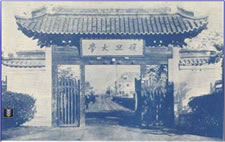 As one of the national topmost institutions of advanced learning and higher education, Fudan has achieved worldwide fame throughout its venerable past. The University was established by Ma Xiang-bo in 1905. "Fudan" found its lexical origin in the quotation "Heavenly light shines day after day" taken from "Annotations of Yu and Xia" (Yu Xia Zhuan) of Scholia of The Collection of Archaic Texts (Shang Shu Da Zhuan).
In 1917, Fudan Public School began to offer undergraduate programs and officially renamed itself "Fudan University". Li Deng-hui was the president from then on to 1937. After being expanded to a full-fledged university, the University had an increasing enrollment. It had three schools: Arts, Sciences and Business, a prep school, and a section of secondary education.
In 1929, Fudan University altered its educational system and opened four new departments: journalism, civil administration, law, and education. It consisted of seventeen departments, which comprised the four schools: Arts, Sciences, Law, and Business.
By 1937 Fudan had established four schools (Arts, Sciences, Law, and Business), which were made up of sixteen departments, a secondary school, an experimental secondary school, and two elementary schools for compulsory education. It became one of the most important institutions of academic research and higher education in southeast China.
The First Session of the 5th Congress of the Executive Yuan (Coucil) of the Repulic of China voted on 25th, November, 1941 to nationalize the Chongqiong Community of Private Fudan University. Wu Nan-xuan was appointed president of the University.
Fudan became one of the national elite universities after the founding of the People's Republic of China in 1949. At the request of Chen Wang-dao, the first post-liberation president of Fudan, Chairman Mao Tse-tung of the CPC handwrote the name of the University. Since the beginning of New China, Fudan has seized three golden opportunities for further development, thanks to the CPC and the People's Government.
The first one came in 1952 when colleges and universities all over the country underwent a thorough readjustment and reshuffling. Fudan lost its departments of applied disciplines for those of arts and sciences from other ten-plus universities in East China. This year saw the University's core disciplines greatly enhanced and its faculty re-energized with new arrivals: it was in this period that eminent professors like Su Bu-qing, Chen Jian-gong, Tan Jia-zhen and Lu He-fu came to join Fudan.
The first twenty years of the Reform and Opening-up Policy brought the second grand opportunity to Fudan, whose development received the Central Government's serious attention during the 7th, 8th and 9th National Construction Plans for the Next Five Years. The University became more intellectually comprehensive by covering a wider range of academic disciplines: the humanities, social sciences, natural sciences, technology, and management. It was to exert a more positive and profound influence on the world.
The latest is the official merger with Shanghai Medical University on 27th, April, 2000, from which a brave new Fudan was born. For the first time has the University had its own college for medical sciences. Better equipped and more robust, Fudan is one step further today toward its ambitious aim of becoming a leading university in the world. more

 Situated on several former royal gardens of the Qing Dynasty, surrounded by a few historical sites in northwest Beijing, is the campus of Tsinghua University. The garden-like landscape, with the Wanquan River meandering through, has inspired and motivated generations of students.
 Although Western culture was pervasive in the early history of the university, Chinese culture were also cherished and widely studied. The faculty greatly valued the interaction between the Chinese and Western cultures, the sciences and humanities, the ancient and modern. Tsinghua scholars Wang Guowei, Liang Qichao, Chen Yinque and Zhao Yuanren, renowned as the "Four Tutors" in the Institute of Chinese Classics, advocated this belief and had a profound impact on Tsinghua's later development.
 Tsinghua has flourished since 1978, with the re-establishment of the departments in sciences, economics and management, and the humanities. The Tsinghua graduate school has been recognized nationally, ranking first in the National Evaluation of Graduate Schools. The School of Continuing Education makes the best use of modern information technologies, as well as the advanced educational resources at Tsinghua. Currently, the university consists of 44 departments distributed in 11 schools, including the schools of sciences, architecture, civil engineering, mechanical engineering, information science and technology, humanities and social sciences, economics and management, law, arts and design, public policy and management, and applied technology. A medical school is currently being established. Tsinghua is developing into a comprehensive university at a breathtaking pace.
 The educational philosophy of Tsinghua is to "train students with integrity." Among the over 100,000 students who have graduated from Tsinghua since its founding are many outstanding scholars, eminent entrepreneurs and great statesmen remembered and respected by their fellow Chinese citizens. Hence, to study at Tsinghua is the dream of many Chinese youth. Presently, Tsinghua has over 20,000 students, including 12,000 undergraduates, 6,200 master's degrees candidates and 2,800 doctoral candidates.